Thursday, 30 May 2013

DOGS ARE FUNNY


Our dog Rufous can be very funny - they say animals don't have a sense of humour but I'm sure I've seen dog humour. I don't mean that his cute antics make me laugh, no, I mean the dog understands fun.

Chewing sticks
When we first moved into our house, it was not much more than a big shed filled with furniture and boxes, and plenty of places to hide. Rufous and I did play hide and seek.  I'd hide somewhere and give a tapping signal and he'd search for me.  There was great excitement when he found me, lots of jumping up and down, squealing etc and Rufous was excited too. The games usually ended with a treat for him.

This is the treat cupboard
As we worked on the house, dividing off rooms and moving things around the game went on and one day I realised that Rufous was also hiding. I'd hide, he'd find me and then run off and hide himself. Sometimes he will start the game - I miss him and go looking and when I find him behind a box or a curtain he'll give me a huge Staffie grin and rush for the treat cupboard to be rewarded.  At other times he'll pop out from a hiding place, waggling all over as if to say 'boo'.  Just a coincidence, of course and an excuse for the treat cupboard.


Rolling a log


Another favourite game he plays with a log.  Aussie trees are always dropping branches or just falling over so we have a good supply of dead wood for the winter fire.  The logs are left dry out, in the paddock or until Ruffie get them. He likes logs about half his body size in diameter. He straddles them, bites and rips off the bark, and rolls the log around the paddock, even flipping it over at times and always making an aarrrrh aarrrh sound - not growling, more like a cartoon pirate. The sound is so loud I can hear it up the hill in the house and I know he is rolling a log. When visitors are around the log rolling is more vigorous and the  aaaarrrhh  even louder - what a little show off he is.  It is exhausting work but he keeps at it until we insist the log game is over, then he staggers home to collapse on the floor. Over the years the tips of his big teeth have been left, embedded in dense logs and he lost one tooth when it was split in two after chewing wood.  But log rolling is not a game for older dogs and the Ruf is beginning to realise this.

My ball
Rufous has never chased a ball AND returned it.  He's never seen the sense in that. Once he has what he's been chasing he keeps it, in fact he claims anything lying on the ground or on the floor as his property including lizards, tissues, cardboard boxes and food.  It's not that he won't give them up, he just doesn't volunteer it.  Any ball he gets is bitten in half within seconds.  He had a basketball for a few months, but only because Big R kept it on the move and Rufous did not had possession for more than a nanosecond.  It finally died when he was quick enough to grab it and run, and his big teeth punctured right through both sides - one dead ball.


I've read about those lovely gentle dogs who own baskets of fluffy toys and balls and Frisbees that they play with, and share with others.  The Staffie jaw would demolish all of these - even the extra hard rubber toys, in minutes.  The famous Kong is an amazing toy, indestructible - almost.  Other people see them and say, my dog has one of those, he's had it for years!  What!  When the Ruf was younger he destroyed an indestructible Kong in a few weeks.  I was buying a new Kong every three months. I don't want to count how many that is over the years.  But dogs need to chew and as he can't eat bones - his delicate tummy vomits up the chewed bits of bone - the next best thing is a Kong for games - and a raw carrot everyday.  

I've watched him with a Kong held tightly in his paws as he nibbles at bits of red rubber with his front teeth and .... do other dogs do this? ... spits it out!  Little bits of red Kong cover the floor around him and fly into all corners of the room.  I didn't know dogs could spit.  Then he'll get the Kong right into his mouth and work those back teeth on it until it splits.  And that is the end of Kong. 

Where I keep my Kongs

Now that Rufous is over 12 he's losing interest in playing Kong.  The two he owns have actually survived a couple of years They live jammed into the wire of his crate, and, on the odd occasion, when exciting visitors have just left or if he's in a very good mood, he'll rush over to the crate and pull out a Kong. He throws it into the air so it bounces and he can chase it.  He does this with raw chicken wings too and little frankies (frankfurters).  I've seen him put a frankie on the floor mat and giggle the mat with his feet so the frankie hops around.  Funny dog.


Chasing something that moves is Ruffie's greatest joy.  Somehow the kookaburras know this and they tease him by flying very low over the paddock. They fly low anyway to catch their dinner of beetles, lizards, snakes etc, but they do it more when Rufous is around.  Swoop goes the kookaburra and Rufous takes off after it.  And they'll do it two or three times in a row, often to an audience of other kookaburras sitting in a tree.  He has no hope of catching one but he loves the game and comes running back, tongue lolling, big grin on his face with an expression that says, 'Did you see that?'

The Staffie grin

Wallabies (like kangaroos) are also good to chase and probably the reason that last year Rufous had to have surgery on both his knees.  He is not allowed to chase them anymore because of his knees, and I've noticed that with this restriction the number of wallabies in our little forest has increased and they are getting much bolder.  I counted 11 wallabies in the paddock recently.

But, the sense of humour.

There are other dogs living along our road.  It's a short road of acreage blocks and each house sits on 4 - 6 acres of land, so not many houses.  Several people have 2 dogs, many have other animals too. At times cows push down the fence to graze on the road side. Several times lost horses have appeared in our paddock, they follow the wallaby tracks through the bush. A gaggle of geese wanders back and forth from one house to another, wild ducks also cross the road changing dams (ponds) and one neighbour has a dozen chooks (chickens) that live out the front on the nature strip. At different times wildlife such as bush turkeys, carpet snakes and large lizards are seen in the bush by the road - you have to drive carefully.

Our track

We have always kept Rufous away from the road unless he is on the lead.  I'd hate him to be the one to upset the chooks or freak out a goose. If they ran he'd chase. When he first came to live with us we walked him up and down the road and introduced him to the neighbours, but over the years the neighbours have changed and other dogs have arrived.
Every day Rufous walks back and forth across the hills with Big R or down the paddock helping with farm work and in between walks he sits guard, which is apparently tiring as it makes him very sleepy.  I don't like walking in the paddock in wet weather as it gets boggy and slippery so Rufous and I walk up to the letter box every afternoon, and along the road as far as the bend and back and down the neighbours track, where we often see wallabies.  We only walk to the bend in the road because around that bend the road is owned by other dogs - mainly Muttley, a big lanky loveable fella, with a very loud bark, who lives in a car port of the first house, and next door to him is another Staffie.  There are also German Shepherds at the top of the hill and they bark a lot, a Neo Mastiff and a black bittza live somewhere in the bush and a Jack Russell/Fox Terrier couple live half way along. Not all of these dogs are in a yard, they just hang out in front of their houses, waiting to bark at passers by.  Muttley likes to lie in the centre of the road, in the sun.

All of these dogs would be wonderful to chase and run in circles with and slobber over while going aarrrhh and grrrrrr, but ... the expensive knees - the fact that Rufous will always overdo that sort of socialising - the habit he has of running into the bush when off-lead or the problem of handling one dog on a lead while the others are off, forces us into a u-turn at the bend and the walk back to our own bush track.  I would love to be able to jog ... well walk briskly ... with Rufous on the flat surface rather than up and down the hilly paddocks, but it's out of the question.

So, we avoid Muttley. He barks at anything passing his house, alerting all the other dogs and then there is barking and yelping all the way up the hill and all the four legged residents rush out to see who is using their road.  At times Rufous and I have hidden in the bush to avoid being spotted. Of course the more we stay at our end of the road the more convinced the other dogs are that they own the rest. So, no socialising with the neighbour dogs but Rufous seems happy enough to enjoy their scents and leave his own because every day he rounds me up for our walk to the letter box and beyond.

Rufous wears a raincoat on winter mornings
One day it was drizzling enough for me to take an umbrella.  After a wet weather day inside Rufous really needed a walk. It was also drizzling enough for Muttley, and the other dogs, to be inside their own houses.  We got to the bend in the road. Rufous looked at me and his eyes went to Muttley's house.  I looked at him and knew what he was thinking.  Let's see how far we can go before Muttley hears us. Up the road we went, Rufous sniffing every blade of grass and every stone by the road, covering every other dog scent with his own, and me keeping watch. No sign of any other dogs. Feeling brave we got as far as the bushes by Muttley's driveway, crossed over the road and began walking back towards home. 

There is a deep storm water ditch on that side, mostly filled with long grass. Rufous stopped and looked back - it looked like he was forming an idea.  Tugging on the lead he dragged me back. As we drew level with Muttley's house Rufous went down into the grassy ditch where the other dogs like to play, squatted down and left a huge sample of his new diet - brown rice, sweet potato, carrots and chicken.  It was huge.  (No I didn't pick it up, the rain would take care if it eventually).

Finally he did the little hop, skip and jump he usually does to avoid stepping in his business, leapt out of the ditch grinning at me and together we both scuttled along the road towards home.  I am sure he was laughing.


Run Rufous, run


Friday, 24 May 2013

understanding COUSINS

- it can be confusing and over the years the exact description may have changed a little, but a simple explanation is this ...

Brothers and sisters have the same parents. 
The brothers and sisters of your parents are your aunts and uncles. 
The children of your aunts and uncles, and your cousins, are your cousins.

FIRST cousins are the people who have two of the same grandparents as you.

SECOND cousins are the people who have the same great-grandparents as you, but not the same grandparents.

THIRD cousins are the people who have the same great-great-grandparents...

FOURTH cousins are the people who have the same great-great-great- grandparents ...

FIFTH cousins are the people who have the same great-great-great-great-grandparents ...

A cousin REMOVED is only slightly different.  Removed indicates that the two people (you and the cousin) are from different generations. 
You and your first cousin are in the same generation which is one generation younger than your parents and two generations younger than your grandparents.

A cousin ONCE REMOVED has a difference of one generation so your mother's first cousin is your first cousin once removed, because you are one generation younger.

A cousin TWICE REMOVED has a difference of two generations so your grand-mother's first cousin is your first cousin twice removed, because you are two generations younger.

Working in the other direction if you have a son, and your first cousin has a son, they are SECOND cousins. The relationship of your son to your first cousin is cousin ONCE REMOVED.
Your grandchildren and your first cousin's grandchildren will be THIRD cousins.

Going up or down, the generations remain the same - counting first, second, third etc cousin for the relationship and then removing by one for each separating generation.


1925 - cousins with an Aunt

It can be good to make a graph, finding the common ancestor and working out from there. Working with half brothers and sisters might be a little difficult and while in real life it makes no difference to your feelings for them it can complicate a family tree with lots of extra entries. As long as you are not in a hurry it's a lot of fun, and very satisfying when you work it out.


1986 - first cousins on holiday


---------------------------------
NOTE: The children in the photos above are related -
Top photo: the little girl front left with the tongue poking out, is Margaret, 
Bottom photo: these children are Margaret's grandchildren - though she only knew the oldest 3.

Thursday, 16 May 2013

looking at THE FAMILY TREE ...

I hate housework, but if you can do it on automatic you can use the time to meditate on other areas of life. While vacuuming the bedroom I went over the interesting discoveries I'd made on an ancestry site the night before.  Taking my Dyson out to empty I passed the TV  - showing a Star Trek episode.  Seeing the 'SS Enterprise' uniforms, reminded me of the old sci fi movies that predicted we'd all be wearing skin tight metallic onesies by now when I realised the characters were talking about family history and almost the exact thoughts I'd had a few moments before - family stories can be passed down incorrectly, names mispelled or confused, secrets hidden ... etc.

In the days before the wikis and sites like Trove  and all those ancestor-dot-coms, learning family history relied on the family memory. Researching details involved finding birth, death and marriage certificates which often had to be viewed in the archives of the church where they were registered, head stones, newspaper archives and military records, also requiring you to be there in person or finding old letters and diaries. Now we save all that time and travelling because libraries, history buffs and anyone who has worked out a way to make money from this interest, have put so much on line you can almost do it all from your desk.  

Ancestry is usually the activity of the over 50's, possibly because that is when people are adjusting to changes in their life and many find they have the time and also because you need to live quite a few years before looking back is interesting .

Once you begin you can become addicted, a bit like a metal detector on the beach, you don't know what you'll find but there is no end to the finds. My family tree now has over 300 'characters', many of them people I'd never heard of until this year and twenty of them new this week.   Only the closest branch of my tree resembles the family group I knew of - amazing how people will gloss over some things, leave someone out, just never pass on information and every generation has those who are not interested.  I relied on conversations with my mother and her mother ...  and they had reasons for not sharing the whole truth or for getting it wrong.

One problem is finding family.  For those of us who are of British descent the easiest way is to follow the surname - fine if it's something fairly simple like Stone or Frost - easy and common enough to work with. Then you get some difficult ones like some European family names, changes in spelling or language as people move around. In Denmark the number of surnames is limited and it's not easy to trace an Anderson or Jensen. My grandfather's family changed their name to Weston at the start of WWl.  Before that the name had been Swertman, or Schwertmann or even Schwertdmann - the further back you go the more letters in the name.  I'm not sure how other cultures would do it.

So, it occurs to me that we limit ourselves.  What about the women? - and what is this 'family name' thing we have invented, for boys only.  I can see that following the surname is the easy way - the Family Name or Blood line - except that it isn't. Every man who marries and has children has mixed that precious blood line with another - it's watered down by the blood line of another family, over and over, with each generation.

When I look at my mother's family I started with two surnames but by following the women as well as the men I now have more names from each generation ... more than several, those families had 8 - 10 children and if half of them were women who married that is 4 or 5 new surnames in the family and their children are related to me as blood cousins.  This is why it's fun... but also dangerous ... can you imagine how much time it all takes?

I planned to limit my search to those who were born overseas and died in Australia. This shortens the paternal branches of both my grandfathers as their fathers immigrated but both mothers are from old Aussie families and there seem to be some very feisty ladies on the list. I'm interested in finding out more about the one wife from Tasmania, maybe they were convicts (shhhh, don't tell Ma-ma). The new surnames I've found through the woman in my family include Wilmington, Weeks, McHugh and Earlam on my mother's side and on my father's, King, Noble, Styles, Hammond, Kirk, Webster, Wood and Green.  Not too difficult and makes me feel very rich in relatives.

My big find this week was one Russell Henry Morehead, or Henry Russell Morehead, depending on which document you read. He was born in 1897 at Greendale, near Wallacia NSW, one of seven children. At the age of 21 his occupation was Dairyman when he enlisted in the AIF and went off to fight in the Great War. His sister, Ivy Elizabeth Morehead, of "Wanatta" Ewart St, Dulwich Hill, was listed as his next of kin, possibly because their father, Thomas Morehead was deceased. 

My grandmother was Eva Morehead. Her grandparents arrived in Australia on a ship named Wanatta.  She grew up on a dairy farm at Wallacia, NSW and had relatives living at Dulwich Hill, so this is definitely my family.  Russell would have been my grandmother's cousin. He was 9 years younger than Eva, and his father, Thomas, would have been her uncle or great uncle, a branch of the family I have not yet pursued - and this is exciting.

On 17th July 1918 Russell's ship left Sydney, but on the 31st July he was taken to the ships hospital and diagnosed with pulmonary tuberculosis. A week later he was admitted to hospital in Durban, then sent to Cape Town and returned to Sydney in September - discharged as medically unfit in October 1918, one month before the war ended. 

He later married Dorothy Emily Weeks, who was 13 years his junior, bought property at Wiseman's Ferry and they both lived happily and prosperously until 1999, always including his sister Ivy in their lives. If only I'd known, I was not far from them through the 1970's and 80's. I had lost touch with all my mother's family because some relatives suffered embarrassment over situations during the depression - but that's another long story.


Russell Henry Morehead - photo 1918


-----------------------------------------------------------

---------------------------------------------------


Sunday, 12 May 2013

about PATCHWORK ...


I love patchwork, I love looking at patchwork and pictures of patchwork. I have stacks of magazines and books and I watch youtube clips on making patchwork. I have made patchwork from fabric and wool and paper. You can stitch, knit, crochet, glue, carve, plant, cement or nail a patchwork.  You can buy fake patchwork with the patches printed onto fabric but real patchwork is made of small pieces or patches, joined together following a set design, or strips of fabric joined and re-cut and joined again. New designs and patterns are constantly being made and with endless variations it would be most unusual for a quilt to be repeated exactly.

This is a small section of a Bargallo quilt, made for me by my friend Alison.
It's an example of how beautiful patchwork can be.


Decorating with mosaic tiles is a bit like patchwork, as is laying a patterned pathway or planting a flower garden in a particular design but we usually associate the word patchwork with sewing fabric. And that brings up the image of quilts - as many quilts are made of patchwork, which is why they are called patchwork quilts. There are other quilts,  'whole cloth' quilts that are not patchwork at all.

Crochet squares.
Back in the days when my fingers and wrists were nimble, and I could successfully multi-task, I crocheted many small squares and circles from different coloured wool or cotton, and joined these pieces to make patchwork shawls and baby blankets and waistcoats. Thousands of women of all ages around the world do the same, some of them creating amazing works of art in wool, just with their fingers and one little hook or with two knitting needles.

I made my first patchwork on a hand operated Singer sewing machine in the corner of the kitchen.  It was a blanket for the very large rag doll I had also stitched on that machine. The sewing machine had been owned by a great aunt and passed on to my grandmother who gave it to me. Two years later, when she saw I was into sewing, she gave me her more modern machine which was operated by pressing a bar with the knee.  It was another Singer, one of the first electric machines and it only went forward, no back stick and certainly no zigzag.

I used that machine to make dolls and doll clothes, then all my clothes for 20 years. I've also carried it with me around Australia and it was only recently I discovered the wooden outer had disintegrated. It didn't like being left under the house for the last eight years.  In 1972 I made a full layette, including the bassinet liner and blankets for my first child. My first patchwork bed cover, not quilted, for my baby daughter was made of flannelette squares in pastel lemon, pink and mauve.  Each lemon square was decorated with an embroidered cuddly animal and the backing was white spotted mauve flannelette. Very pretty, and as it turned out, not very practical. The washing machine wore out the flannelette in a few years. 

My 38 year old UFO
Around that time I started looking for books about patchwork - not too many around in those days, but I did find some illustrated history books. So, by the time my daughter was three I had finished a bedspread for her, also not quilted, of hand stitched hexagons - my own design of a tree surrounded by flowers. It had taken me a long time to make even though the hexagons were huge - I did have a young child to look after and a part time job and I'll repeat... hand stitched. Each piece was cut out with scissors and stitched over a cardboard shape before being hand stitched together and the cardboard removed.  We used it but it's never been finished. When I found it recently it looked like the work of a child, possibly because the fabrics were off cuts of other things, not pretty new fashion fabrics specially chosen.  It could be worth fixing, but I'd be tempted to change so much it might not be a good idea.  Quilters and patchworkers call these unfinished projects UFOs.

This blog post is about my mistakes and, as usual, my search for understanding. The quilts I have kept are the those with memories or the experiments, so this is certainly not a display of amazing craft work.  I have a passion for understanding how things came to be the way they are - origins, history, stories all fit into that. But, with my investigation into patchwork and quliting, I didn't look for the source at first, but worked backwards from my own fumbling attempts to translate ideas into fabric.

When I did look at patchwork patterns, I was delighted to discover it could all be done on the sewing machine.  About this time my stepmother bought a new sewing machine and in a moment of unusual generosity for her, she gave me her old machine - rather than trade it in.

Patchwork begins with small pieces, squares, strips or triangles. These are sewn together in a certain pattern to create a block. The blocks are stitched together in rows to make the 'top'. This can be surrounded by one or more borders and finally bound to the backing fabric by a folded strip called the binding. In between the top and the backing a layer of wadding is usually added for bulk and warmth.  I didn't know all this. 

Even though sewing machines were passed around in the family I don't remember anyone, other than me, ever sewing.  Mum and my grandmother taught us to knit and I taught myself to crochet. No one knew about patchwork. There were no classes that I knew of, and I'd never seen a patchwork/quilting magazine. All I had were library books. Being unfamiliar with terms like piecing and blocks and sashing and with a dislike for following patterns I learnt by looking at the pictures and working out for myself how the blocks went together. I made some silly mistakes and did everything the hard way. Now I know there are short cuts and tips to make it much easier, but back then I actually cut a tiny triangle and stitched it to another tiny triangle to make a square.

When my little girl went to preschool I made a sampler bedspread. The idea is to work on different patterns as a 'sample' piece.  Samplers are also used to show off stitching skills. The blocks are separated by strips of fabric, called sashing, so the patterns can be seen better. Most sampler quilts are very simple, like mine, which had 6 designs on 12 large blocks, but some can be real show off pieces for piecing and quilt stitches.

I sold my sampler at a school fete and was given orders for more.  At this stage I'd still not done any quilting, my pieces were just bedspreads with no filling - though everyone called them quilts.  A friends husband worked for a textile wholesaler and he organised for me to get some fabric samples - most 2 or 3 yard lengths.  I soon found that the fabric 'made' the finished product. It's a huge investment though, so I bought a roll of plain calico and a roll of light weight denim (not stretch in those days) and designed my quilts around those fabrics.

The 35 year old checkerboard calico quilt
I continued making and selling my counterpanes (old fashioned word for bedspread).  I was amazed because I didn't think they were very good but people liked them and were happy to pay me. Before long I had 'quilts' on consignment in two shops and was selling and taking orders through a market stall. At the same time I was involved in making leather handbags and belts at home - hand made leather items were all the rage and we could hardly keep up with the demand at times.

One of my early quilts, made around 1978, was just a checker board of squares backed with calico. I had clued up on the wadding by that time so it was properly filled, but instead of binding I put a calico frill around the edge. There was no quilting but I 'tied' it by stitching through the three layers in the corners of the patches and tying that off in a knot. I still have that quilt. It's wearing thin and one day I plan to add new filling and quilt it properly.

Finally I made a red quilt, for my daughter. It was properly pieced, filled and bound but the quilting wasn't the best and some seams have pulled open. This quilt was passed down to my granddaughter, but I have if back now for repairs, which I hope to get to soon, and maybe a great granddaughter will use it one day. 

The red quilt - well used, torn and stained and in need of repair


This was followed by countless patchwork cushions, shopping bags, dressing gowns, rag dolls and other toys as well as the odd quilt. Living in the cold climate of the Blue Mountains, NSW, I had plenty of inside time to fill and this was in the days before computers, internet and facebook. 

When my first son arrived I made boy clothes, especially overalls, which I could draw on, paint or decorate with braid. My little boy came with me to markets and people began asking about his overalls.  I was a bit bored with the patchwork by then so began to make children's clothes instead. I'm a terrible craft worker, always distracted by something new and not very interested in repeating what I've done before.  It's really the design process that interests me.

Years later, still looking at pictures and reading about patchwork I fell in love with the plain fabric Amish quilts and Seminole patchwork patterns. By then I had two growing boys. I made them Seminole style quilt covers, rather than quilts, and this worked well for us. I bought the fabrics from a Sheridan sheet outlet, so it was very good quality cotton. When I pulled them out from the cedar chest this week to take these photos I found them in perfect condition despite ten years of heavy use and longer than that in storage.


The boys quilts with details of the Seminole style patterns.


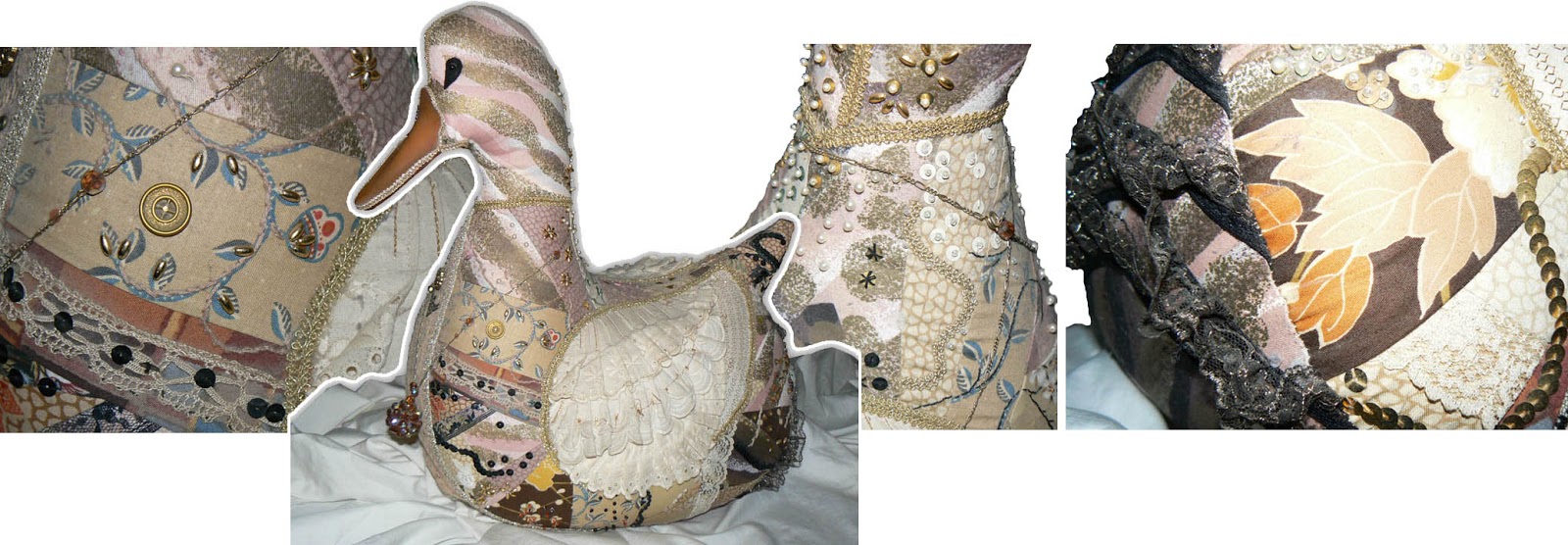
I also love crazy or scrap patchwork, which includes as many fabrics as possible in more random arrangements, along with embroidery and embellishments. I am very proud of my prize winning crazy patchwork duck. It was my first crazy project and, just for fun, I entered it into the patchwork section of the local Show .... and it won!  It won the overall prize and I was stunned - usually my work is experimental and more naive than professional so this was amazing. The fabrics were mostly curtain samples, I used different types of lace, some of it very old and I used a piece of leather for the beak and it was the beak that got attention and made the whole piece.  


The crazy patchwork duck with details.

Eventually I learnt to quilt, by hand and by machine. Stitching together three layers, a top, a layer of batting and the backing,  is called quilting and the quilting stitches often follow very involved and lovely patterns - one area I've never gone into.  These days most quilts are made of patchwork but before patchwork was developed they were whole cloth quilts. 

Egyptian sailing boat
During those years of my experiments in patchwork I was also reading about the history of patchwork and quilting, the culture that has grown around it and the language within the craft.  Way back in ancient Egypt patchwork was used to make sails for fishing boats on the River Nile - I find that very interesting. As I've also done a little (and I mean tiny little) bit of weaving I understand that the size of the loom limits the size of the cloth. If you want a big piece of cloth you take the lengths from the loom and sew them together to make a wider piece - and that would be patchwork, of a sort.

Remnants of patchwork have been found in ancient China and illustrations show that it was probably practiced in other cultures as well, but as fabric doesn't survive like pottery, we can't know for sure. Some people might think that patchwork was invented in America, but the craft was taken to America by early settlers from Europe. Who knows when or where it began, the birth of patchwork was a matter of women saving precious scraps of fabric from worn out clothing. Old skirts and shirts were cut down to fit children and any leftover patches were stitched together for head coverings, blankets, draft stopping curtains or small decorative items. Fabrics made by working people may have been rough and hand dyed but when anything is hard to get, or expensive, it becomes precious.  I love that it came from need, became a handcraft and is now preserved as art.

Those who could afford softer fabrics often had clothing decorated with embroidery, lace and beading.  From about the 12th century traders brought painted and printed fabrics from India, but the dye wasn't always reliable and it was expensive so was mainly used as decorative wall hangings. By the end of the 17th century printed linen and calico was produced in France and Germany, but working people didn't have access to cheap printed cloth until after the industrial revolution, early in the 19th century, and this was in the form of printed calico flour sacks. Bread was baked at home and the sacks washed, opened up and made into clothing. In America the flour producers deliberately used floral printed calico for their sacks, to attract the housewife. What did not go into petticoats and skirts became patchwork bed covers.

Here in Australia my great grandmother, Annie Morehead, made a new petticoat for each of her six daughters, every year. They were made from bleached flour sacks or sugar bags. No pretty flowers though, just the product name printed on the calico. Any leftover scraps were saved to use in quilts. pillows or as bandages.

Gradually patchwork designs developed to make use of different coloured and patterned  fabrics. Designs travelled the world, were copied and adapted, given names and meanings and we arrive at the patchwork phenomenon we know today.  It's a huge industry.  There are now millions of fabric designs and colours to make into millions of patterns.  The original idea of using salvaged fabrics is long gone and today's patchworkers buy new fabric to cut up.

Patchwork has a vocabulary, a history with special museums, local and international shows and competitions, university degrees, folk tales, an industry in publishing and fabric sales - even super star pattern and fabric designers.

A quilt made with pre-cut fabric squares,
which also means pre-chosen by the manufacturer.
And, Patchwork has risen from a craft to an art form. Works are embellished with beads, embroidery, other fabrics and feathers or hand dyed and hand painted. Patterns can be traditional, scrappy or even free form. Landscapes and portraits are made in patches and new processes of printing at home enables us to print our photos onto fabric, our favourite poetry or personal messages. Today you don't even have to cut your fabric as precuts are sold in rolls of strips or packs of squares, to enable a bulk buy that includes several different patterns, and with such unfabric-ey names as jelly rolls, charm packs or bundles of fat quarters.

Patchwork can also incorporate appliqué, which is stitching a fabric shape over the top of a base fabric, a little like sewing a patch over a worn area, but decoratively. Appliqué designs can be very elaborate and have been found as part of folk art across the world, from Africa to Egypt to South America.


This appliqué piece was made in Egypt - by a man, as this is an industry for tourists now and not suitable for women in that culture. Men run the stalls and stitch while waiting for customers. I recognised the story above as a fable often called, The man, the boy and the donkey.  Originally by Aesop there are different versions of the story from different places. The original version ended with the donkey falling off a bridge and drowning - not nice - so I prefer this version from Switzerland. It doesn't match exactly with the design but almost.


A man was riding home on his donkey, while his boy walked beside them. 

A traveller passing by said, "Father, it is not right for you to ride while you make your boy walk. You have stronger limbs."

So the father climbed off the donkey and let his son ride. 

Another traveller came along and said, "Boy, it is not right for you to ride while you make your old father go on foot. You have younger legs."

So they both mounted the donkey and road on a little way. 

A third passer by and said, "How stupid! Two fellows on one weak animal. Someone should take a stick and knock you off its back!"

So they both climbed off, and all three went along on foot, the father and son left and right, and the donkey in the middle. 

A fourth traveller came along and said, "You are three strange companions. Isn't it enough if two of you were to go on foot? Wouldn't it be easier if one of you would ride?"

So the father tied the donkey's front legs together, and the son tied its back legs together. Then they put a strong pole that was lying beside the road through its legs and carried the donkey home on their shoulders.

That's how far it can go if one tries to please everyone.


                                                       ---------------- FIN ----------------


Working with hexagons
                                                            

A watercolour patchwork landscape


Patchwork waistcoat

Patchwork garden