Showing posts with label sewing. Show all posts

Saturday, 14 December 2013

How did you MAKE that?

So many blogs I read are on arts and crafts and I enjoy looking at all the lovely things being made - so I thought it's probably time to show my work. It will have to be something a little bit novel as my crafting skills are just average. This latest project surprised me when it came out as well as it did.

I make laundry bags for Aussie Hero Quilts and Laundry Bags, to send to Aussie personnel deployed overseas.  I enjoy it because I know the bags will help people keep track of their laundry and that saves time often spent trying to find a clean uniform.  Also I can also be as creative as I like.  More information is available on the AHQ blog - http://aussieheroquilts.blogspot.com.au/

Laundry bags - cotton drill, and printed duck with kangaroos

Probably most of the AHQers make quilts - I've not done a large project like that for years, and quilts are mostly repetitive - that's not a put down, I love quilts, I love traditional patterns and modern styles. I love the fact that so much work goes into them. I especially love scrap quilts and crazy quilting, but - for me, once the design is decided the most interesting part is over.  Until it's completed, that is - holding up a quilt you have made yourself, or that has been made for you, is a very special feeling.
We had a dinner in Brisbane for the Qld AHQers and along with speeches, door prizes and a pretty good raffle, there was a laundry bag competition.  The theme was open, but the Aussie flavour seemed to be the most popular. I wanted to enter just to be in it and thought maybe I could have fun and be really creative.

I had a picture in my head of a photo bombing giraffe I'd seen on line and a painting by my little grandniece, Izzy. I thought of making a wall hanging or cushion from that image - but with an Aussie animal. Earlier in the year I'd used left over strips of fabric for the desert landscape above, with Ayres Rock and a kangaroo -  I could do that again.


Giraffe by Izzy
My plan was to draw onto calico with fabric pens, fuse that to the bag and see if I could draw more into it with the sewing machine - not embroidering, I'll leave that to the very clever ladies with wonderful computer embroidery machines -  just drawing with sewing thread using the common straight and zigzag stitches.

Now to the design.  Australia = big blue sky, bright sunshine, orange earth, lots of green, and blue ocean. Recently I'd made a block for a group quilt with these colours - it was included in the quilt they raffled at the dinner.

Aussie theme patchwork block
Choosing animals. I like kangaroos but they are not easy to draw - they can turn into huge mice or rabbits if you aren't careful. I wanted something orange to contrast with the blue I'd chosen as a background so I tried a kangaroo.

Years ago I made papier mache animals as stage props. They were the size of small children and were carried across the stage by the small children.  One was an emu. He'd be perfect.

Drawing animals is not easy for me and I always need to research. Once upon a time I'd be searching through books and magazines, then photocopying the pictures, but now we can google anything. I cfound animals in the positions I wanted, copied them. turned them black and white, erased the details and outlined the shape - just love PhotoShop.   I worked out the size I wanted then cut the pictures up in the program, as my printer only takes A4.  When printed I stuck the bits together, cut out the shape and used it as a guide to get the outline and proportions, drawing around it with a 3B pencil. The choice of picture is important because any foreshortening does not translate to a flat image.

Once the outline was on the fabric I filldc in the details with ink, looking back at the original photo on the computer screen. The pose or expression can be changed at this stage.  Colour and shading was done with fabric ink pens I bought on line.  When I felt it was ready I cut out the calico animal. The kangaroo looked uncomfortable - but they look that way in photos too. I had high hopes for the emu.


The background had to be sky blue but I didn't have the right colour. I like to use a medium weight cotton drill or printed duck for the laundry bags because it's sturdy and nice to sew and comes in lots of colours.  But my usual ebay sellers couldn't help me with sky blue drill or similar so I was forced to actually go to a shop. I'm not an expert on fabric but love to handle it and finally found some cotton chino in the right colour. I'd never seen Chino before.  It was a bit lighter in weight than the fabric I usually use, and felt a lot softer, but looked almost the same.... hmmm.

The blue alone lacked richness so adding a strip of bright yellow desert, in cotton drill, to the bottom made a big difference. Using a fabric fix I ironed/glued the animals to the chino.  Ugh. Chino is not the same as drill.  It stretched out of shape and twisted. Also it was very humid that day and the fixative came away from the backing and didn't iron on properly. That turned out to be a good thing as I was able to pull the calico off and stretch the chino in the other direction - almost flat.  But, it meant the glue didn't take hold at the edge ... so all the edges would have to be covered by stitching. These little accidents along the way have a part in defining the finished piece, and I love that. Art often wanders in a different direction to the pattern.

Heat fusing the sketches on calico to the backing and stitching on Kangaroo

Stitching, stitching, stitching. I changed top thread colours but kept a neutral in the bobbin. The back of the piece was almost as interesting as the front. Some areas were straight stitched first, outlining the eyes and some long feathers, but most were zig zagged in different widths, making sure feathers or fur stitches covered all the raw edges.  I worked on the stitching for 4 or 5 days - in spurts. I loved it.  Maybe it wasn't exactly like drawing with thread, a little more like painting at times, I was learning what my machine would do in the way of free stitching and it was exciting to see the animals develop under the sewing machine.  I love the eyes on both of them and Emu's little grin is his own. Kangaroo looked a bit nervous so I added a stalking emu and then Emu needed a kangaroo to chase him.

Ironing the back of the fabric to smooth out puckering  - stitching feathers onto Emu

There are no instructions to give because the stitching is like drawing, you go with what feels right at the time. I did spend time unpicking tiny stitches when the Chino stretched our of shape, several times. And no, I didn't win the competition - I didn't really expect to. I find the sort of things I make never get the popularity vote, I think my designs have to grow on people - and, the judges were male soldiers. They are not into fabric art, they want something to give them a laugh, to tell jokes about and that's what they chose.  Congratulations to the winners, who understood the nature of their recipients.

At this stage the bag was one flat piece. I decided on where to fold it, ironed, stitched the side seam (three rows of stitching), ironed, added the channel for a drawstring, lined the bag with flannel shirt type checks and ironed again. While sewing the bottom seam I realised the bottom of the Emu and Kangaroo would meet in an ugly, thick lump. All I could do was sew in another folded strip of fabric to at least make colour break. The final job was to thread the drawstring through. I use cotton sash cord because it feels so nice.

OOppppsssss I had cut out a yellow sun which was to be over-stitched in white, but I  forgot to attach it before sewing on the drawstring channel. By that time I'd done so much sewing and unpicking ... I just couldn't do anymore. The sun was left off.

One flat piece - side seam stitched and ooopps, the sun wasn't included - bottom seam done with inset strip
- Kangaroo on a full laundry bag.

I posted the bag away and found I missed Emu's face for days, almost like losing a pet. When I saw it in the display a week later he seemed to have settled down and was sitting fairly flat.  I wonder who will open a parcel one day, pleased to get a new laundry bag, and find my Emu looking back at them. I'd love to see that.


The finished bag - Kangaroo's side with the lining hanging out, Emu in all his glory
and demonstrating how he'll look on a full laundry bag. He might be a little bit scary.

Monday, 12 August 2013

serving real HEROES

I am very proud to be working with a group known as Aussie Hero Quilts and Laundry bags, supporting our men and women deployed overseas. Between January 2012 and August 2013 AHQ  sent 1868 quilts and 3005 laundry bags to Aussies serving overseas.

It began in October 2011 as an activity for one Sydney quilting group who made and posted 15 laundry bags and 24 quilts to a group of soldiers deployed in Afghanistan. The response was so heart warming that the group were inspired to sew for deployed relatives and friends of friends and by the 1st of January 2012 the blog was launched and the group was becoming an Australia wide organisation with ALL our Aussie men and women serving overseas on their list.   
It is not possible to count the people involved because it's purely voluntary and people contribute when and how they are able. Even the core group has changed over time, except for the original co-ordinator and founder Jan-Maree, former RAAF herself, who receives requests, assigns missions and keeps track of the projects.  And, she also sews.  We all sew in one way or another, many sew laundry bags, some make patchwork blocks, some sew the blocks together to make quilts, some appliqué, some just quilt and many are able to combine all those talents and turn out full quilts.

The age of AHQers ranges from 7 years up to 101 and we include several men in the ranks. There are people sewing for Aussie Heroes in every state and territory of Australia and even a few from overseas. Those who sew are married, single, mothers, grandmas, wives or children of service men and women, ex-serving members, wives of veterans, and people who just care a lot.

Applique blocks and laundry bags
Laundry bags and quilts are sent in response to requests received from serving members - for themselves, the men serving under them or their mates. Other requests come from wives, girlfriends or mothers. Sometimes a box of laundry bags will be sent to a chaplain to be handed out to men and women, who do not receive other mail. Our parcels go to Army, Air Force and Navy personnel, in several different countries and at sea. To keep track of so many items and so many recipients, all orders go through Jan-Maree.

So the next question is why? 
Don't our armed services supply the needs of serving members?
The answer is yes, they do - but in bulk, and everything looks alike. Laundry bags for example are issued in plain white or green or sometimes pale blue. You write your initials on the outside with a marker pen and take the bag, filled with your dirty uniform, to the laundry. Some laundries are huge and are run by local people. You drop off your bag and come back a few days later to find hundreds of laundry bags waiting, all look exactly the same. It is common for soldiers to lose their laundry in this situation and much time is wasted looking for belongings that have been taken by mistake. 


Colourful laundry bags
Other posts have a small DIY laundry. You put your dirty uniform into a washing machine and leave your laundry bag on top. There is no time to stand around waiting, you might only be on base for two days and have other things to catch up with like eating and sleeping, so the machine is left to do the job. When the load is finished the next person pulls out the wet contents and loads them into a dryer with the laundry bag hanging on the door. When that dryer is needed by someone else your clothes are removed and stuffed into your laundry bag. You return to find your laundry, hopefully washed, dried and bagged, waiting. BUT some of these bags are mesh and hard to name, some are plastic shopping bags or clones of standard issue and easily mixed up so, once again, you have the frustrating task of searching for a clean uniform or going without.

AHQ laundry bags are made of bright fabrics with patches for initials or even the actual initials stitched on the outside. The most important thing is THEY ARE ALL DIFFERENT.  Just imagine how red and orange stripes or big pictures of daffy duck would stand out in a pile of lookalike bags.

Laundry bag (hanging) and quilt made for a RAAF fireman


And quilts. Aren't most of our deployed service men and women in hot deserts?  Well many of them are, but it can get pretty cold in the desert at night and did you know that it snows in Afghanistan in winter?  But our washable cotton quilts are not just for warmth, they are for colour and caring and to bring something from home into a harsh environment. They brighten up a dreary sleeping area or wrap around the shoulders of lonely men, like a big hug.  In fact the size we use, length and width is designed to do exactly that.

Quilts in the desert
We also make WWQs (wounded warrior quits) and some are kept on hand to be transported to hospital with the wounded. Sadly, there is the occasional need for a Fallen Warriors Quilt.  You can read more about this on the blog.

WWQ always have an Aussie theme

And the rewards? We get many rewards in the form of messages that are received every week and shared at - http://aussieheroquilts.blogspot.com.au 

Thank you so very much for my laundry bag! I absolutely love the colours and patterns. I really appreciate the effort and time you have taken to create this for me.  Receiving this gift has completely made my day and it will be something that will make me smile every time I look at it on our continuing patrols in the Middle East. It is easy to forget that other people apart from family appreciate what we are doing and it is very heart warming on these open lonely seas so far from home to be reminded of others back at home thinking of us.
---
I am currently serving in the Middle east on deployment and would be honoured to receive an Aussie quilt.   Thank you so much for your kind thoughts it means a lot to us over here as we miss home terribly and to know we are thought of by many back home keeps us going stronger every day.
---
Having a network like yours sending these gifts over here not only brings colour to our life, but reinforces the fact that we are not alone.  It is nice to have a constant visual reminder that the folks back home care enough to go to all this effort for us. These quilts and laundry bags are special to us not just for what they are, but also for what they represent.
---
Afghanistan is a very bleak place, so it's really nice to have something girlie in a place like that. I have to honestly say that although I have never met you, every time I do my laundry I think of your kindness. I do believe that what goes around comes around, and you have a lot of good coming your way! 

---
I am touched by your generosity, kindness and supportiveness to all the troops that are putting their life on the line for our country. It is people like you and your helpers in this project, that make us feel that what we are doing here, and being away from our family and friends for such a long period of time, is worth it.
---
Thank you very much for the Quilt and Laundry bag which arrived in country around on the 2nd of June. However, I didn't receive it until the 8th because I've been very busy over the last few weeks.
I would like you to know that I now have a laundry bag that is envied by all who see it.  It is very distinct and has bought many comments. It is also extremely easy to find amongst the piles of washing.
The quilt is awesome. I have it in my room and took it out with me one time, however, I don't think I will be doing that again as it got filthy.  I had to wash it twice.  I felt terrible as I was wondering when I washed it if Sue would be unhappy with me. She did say this is the only Quilt like it in the world. However, it kept me warm and I didn't need to carry around a giant sleeping bag. I hope you are well and all is well with Aussie Hero Quilts. Thank you once again. 
---
I am so pleased to hear about a quilt group sewing for such a worthy cause. I am a quilter who is deployed (separated from my machine - oh the injustice),  I started quilting many, many moons ago.  This email is because I would love a quilt.  I  have never had one made for me and it would give me great pleasure to receive one.  I have actually been going around camp admiring those who have chosen to put theirs on display and I try to view as many as possible.  I really am experiencing my own private quilt show - what fun.
---
Hi Ladies,  Just a quick note to say how awesome the quilt and laundry bags are that XXX received from you.  I had a look at your blog and I think it is a fantastic thing that you are doing. What a great bunch of ladies! I love the kangaroo on XXX's quilt. I think you ladies are the Aussie Hero's - it is always great when people appreciate us.
I have a bright doona cover over here, so do not need a quilt but would really love a bright, loud laundry bag if someone has the time.
---
The impact your group is having is just incredible.  I have made it my mission to ask everyone I meet if they have a quilt.  It is just amazing seeing grown men melt as they talk about "their" quilt.  The disbelief they have of a group of caring people actually taking the time and making the effort to put so much work into an item blows them away and they cannot believe that you ask for nothing for in return.  I met a guy only  a couple of days ago who said that he only had a laundry bag now, I asked him why?  He told me that he received a Star Wars quilt and it was just brilliant.  He was showing it off, when his mate begged to have it as he was such a big star wars fan.  He did not have the heart to say no and passed it over.  He found great pleasure in giving too.  The impact on morale is just beautiful. The laundry bags are all being used and it seems to be a fashion statement for some.  It's nice to see them sitting on top of the washing machines to mark which tub has their items. 

Laundry in Kandahar


You can find AHQ on facebook
or see the blog here 
http://aussieheroquilts.blogspot.com.au  


A group quilt, blocks made by different people and others putting it together


                "We care about the people, not the politics or the mission."


Saturday, 29 June 2013

knowing a little bit about COPYRIGHT

I was looking into this for someone else, and as it's quite interesting I'm also posting it here. Most of the information comes from the Australian Copyright Council website. I didn't go into music or digital copyright because the original task related to using text on quilts, embroideries and in art work, but music would be similar. It's important to understand what we can use legally but in the end it is a moral issue and we must monitor ourselves.


In Australia, copyright protection is free and automatic; there is no registration system but this does not mean it doesn't exist.  The Australian Copyright Council website has all the information available if you need more detail - http://www.copyright.org.au/    

Copyright is a legal protection for material including writing/poetry, visual images/logos, music/lyrics and more. Copyright protection gives the copyright owner the right to control the use of their material including reproduction and electronic communication - anyone who uses their material without permission will infringe copyright.  An infringement means the copyright owner could bring an action against the person who infringes their copyright to recover damages.

In most cases, copyright lasts from the time the material is created until 70 years after the end of the year the creator dies. During that time the copyright can be inherited by the creator's family or friends, or included in the assets of a business.  

You need permission to quote from a work if the quote forms a "substantial" part of the source work. A part will generally be "substantial" if it is an important, distinctive or recognisable part. The quality of the part is more important than the quantity or proportion. The purpose of the use may be relevant; if you are using it for a commercial purpose you will need permission and possibly will have to pay for the right.  There is no provision in the Copyright Act that allows you to use copyright material after you have tried, but failed, to find the copyright owner if it is still under copyright protection.

There is no special exception which allows you to use copyright material without permission for educational purposes or for a non-profit purpose - you still need to get the permission. And, just because certain information, poetry, lyrics etc is available on the internet does not necessarily mean it is free to use.

A work is in the "public domain" if its copyright protection has expired. There is no list of works that are in the public domain so you'll have to find out who the author was, when the author died and whether the work was first published during the author’s lifetime.  Once copyright on a work has expired, it cannot be revived by subsequent publication ... an  example is the works of William Shakespeare - anyone can reproduce all or parts of his work.  A publisher who produces Shakespeare's work will only own copyright to the typographical arrangement and can prevent another publisher making an exact copy of that publication, but not of Shakespeare's work.  

"Moral rights" are rights relating to a creator’s reputation in connection with their work - in addition to the "economic rights" - like the right to reproduce the work. Creators are entitled to take legal action if they are not credited for their work; if their work is falsely attributed to someone else; or if their work is treated in a derogatory way – for example, by distorting it or modifying it.

If you are requesting permission to use copyright material you should provide the copyright holder with as much detail as possible, such as: title and author (ISBN if possible) of the publication from which you want to take the material; a description of the material you want to use, number of words or line count; the format of publication as well as your details.


Most sport teams would not allow people to use their logo for commercial purposes. In charity situations, they may still control the use very closely so you'll need to inquire about the legal use.  
But if you are buying fabric that has a logo printed on it then the legal use has been sorted out.  This also applies to licensed cartoon characters, other commercial images and creative writing on fabric. Someone else has obtained the permission.

It is risky to use creative work without permission unless you are absolutely certain that the work is in the public domain.  There was a case in the US of a lady who had written a short poem in 1989 titled 'Families are like quilts'. She developed this and sold as a stitchery/embroidery pattern, copyrighted in 2005.   Later she found her poem was being sold on decorative wall hangings and embroidered pillows.  She claimed these were unauthorised copies and filed a lawsuit against 6 companies. I think it's still with the courts.
So, it seems that if it is already printed on fabric bought by the metre, that's alright, but if you appliqué, embroider, knit or paint it on you need permission.

Please keep in mind that creative material has been written, designed or put together by someone and they deserve recognition for their work and control over how it is used. 


Friday, 14 June 2013

about QUILTING

Quilting can be defined as the process of stitching three layers of cloth together - modern day quilters call it a quilt sandwich consisting of a top layer of cloth, usually cotton, a layer of wadding or batting, usually wool or cotton and a bottom layer of cloth.  All three layers are stitched through, so they are held together firmly with the rows of stitching close enough to stop the filling moving inside. The three layers are stronger and warmer than single layers of clothing.

The skill of weaving is older even than spinning, as weaving began with grasses and leaves. When people began to produce cloth they opened the way for all the other textile related skills.  Samples of quilting have been found in ruins of ancient Egypt and in ancient China.  Quilted fabrics of cotton, flax, wool and silk, were used to make tents and floor covers as well as clothing like jackets, pants, headwear, undergarments and padding to wear underneath armour.
There were no factories to produce fabric before the 19th century so fabrics woven on looms in homes. This made fabric valuable and scraps from sewing, as well as usable sections of worn out clothing, were kept to be recycled as other clothing and bed covers. This patch work was combined with quilting to make warmer coverings.


Quilted jacket

During the middle ages in Britain heavy cloth, quilted with strong thread stitched in straight lines was worn as body armour by the army of William the Conqueror and the Crusaders. Through the 11th, 12th and 13th centuries, quilted bed covers were mentioned in household inventories and accounts.


Whole cloth quilt

In the 14th century the climate of Western Europe changed and they experienced bitter winters.  People used whatever they could find to fill their quilts from lamb's wool to grass, moss or feathers.  In Britain and Holland making bed covers, or 'bed furniture' became a business for many people. The quilted bed covers became prized possessions that were handed down through generations and other traditions developed around the craft. Before a girl married she was expected to have a number of quilts completed and the last one was often quilted by her relatives and friends. This quilt would become a part of her dowry. It was popular to hold quilting bees, where friends gathered to share the work, sitting around homemade quilting frames and enjoying the social occasion while sharing patterns and skills


Quilting bee

In Europe quilted bed covers and wall hangings were in use before the 16th century.  These quilts were whole cloth quilts, just one colour fabric all over with a design created by quilting. Patterns for the quilting stitches to follow ranged from very simple to very complicated and women with fine quilting skills were sought out to work for wealthy people. The sewing machine was invented around 1790 and this made piecing a quilt top easier and faster but the quilting was still done by hand.

Today quilting is used in a wide range of items such as ski jackets and other cold weather clothing, dressing gowns, slippers, seat covers, tote bags, baby cot liners and change mats, bedding such as pillow covers and mattresses as well as decorative bed quilts.  Commercial quilting is done on huge machines in factories and is not what ladies who love handcrafts mean when they refer to quilting.


Section of a winning quilt from the Australian National Quilt Show


If you asked women in America about quilts they would say that quilting was an American invention.  Possibly they don't realise that quilting was a skill used by the Pilgrims, who were told to take at least one piece of bed furniture with them. IN the early 19th century patchwork and quilting came to Australia with the convicts, who practiced their stitching skills aboard ship.
  
A great example of quilting skills moving from Europe to America is the Amish.  Their quilts are known around the world and Amish quilting patterns and quilts are even sold on the internet.  As part of their life style, being 'plain' people, the Amish wear homemade clothing of plain colours. Their quilts are made from clothing scraps, and while their geometric patchwork designs are greatly admired, it's in the quilting that they become art works.


Amish Quilt

Across the world the skills of patchwork and quilting were in use up until World War l broke out in 1914.  With the men away women found they didn't have the time for sewing and after the war improvements in shipping meant that readymade items were available at reasonable cost. As people became more prosperous they gave their time to other things. The handcraft skills began to fade until the 1960's when the 'back to the basics lifestyle' became popular.

By the early 20th century quilters all around the world were able to use their sewing machines for simple quilting. Today sewing machines are computerised and some are capable of producing very fancy quilting patterns.  Special quilting machines are also available for home use and installed in garages, sheds and spare rooms all over the world.

What began as an activity to protect and warm the family is now a hobby and big business for millions of women and men around the world involved in specialist shops, books, websites and clubs. Conventions, competitions, classes and exhibitions are held. We still stitch for our families and for charity, and patched, embroidered and quilted works are exhibited in art galleries. 


---------------- QUILTERS will understand this ----------------

I've been put on this earth to sew
and finish a certain number of 
projects.
I am so far behind now…
I will never die! 
--------------------------------

Sunday, 12 May 2013

about PATCHWORK ...


I love patchwork, I love looking at patchwork and pictures of patchwork. I have stacks of magazines and books and I watch youtube clips on making patchwork. I have made patchwork from fabric and wool and paper. You can stitch, knit, crochet, glue, carve, plant, cement or nail a patchwork.  You can buy fake patchwork with the patches printed onto fabric but real patchwork is made of small pieces or patches, joined together following a set design, or strips of fabric joined and re-cut and joined again. New designs and patterns are constantly being made and with endless variations it would be most unusual for a quilt to be repeated exactly.

This is a small section of a Bargallo quilt, made for me by my friend Alison.
It's an example of how beautiful patchwork can be.


Decorating with mosaic tiles is a bit like patchwork, as is laying a patterned pathway or planting a flower garden in a particular design but we usually associate the word patchwork with sewing fabric. And that brings up the image of quilts - as many quilts are made of patchwork, which is why they are called patchwork quilts. There are other quilts,  'whole cloth' quilts that are not patchwork at all.

Crochet squares.
Back in the days when my fingers and wrists were nimble, and I could successfully multi-task, I crocheted many small squares and circles from different coloured wool or cotton, and joined these pieces to make patchwork shawls and baby blankets and waistcoats. Thousands of women of all ages around the world do the same, some of them creating amazing works of art in wool, just with their fingers and one little hook or with two knitting needles.

I made my first patchwork on a hand operated Singer sewing machine in the corner of the kitchen.  It was a blanket for the very large rag doll I had also stitched on that machine. The sewing machine had been owned by a great aunt and passed on to my grandmother who gave it to me. Two years later, when she saw I was into sewing, she gave me her more modern machine which was operated by pressing a bar with the knee.  It was another Singer, one of the first electric machines and it only went forward, no back stick and certainly no zigzag.

I used that machine to make dolls and doll clothes, then all my clothes for 20 years. I've also carried it with me around Australia and it was only recently I discovered the wooden outer had disintegrated. It didn't like being left under the house for the last eight years.  In 1972 I made a full layette, including the bassinet liner and blankets for my first child. My first patchwork bed cover, not quilted, for my baby daughter was made of flannelette squares in pastel lemon, pink and mauve.  Each lemon square was decorated with an embroidered cuddly animal and the backing was white spotted mauve flannelette. Very pretty, and as it turned out, not very practical. The washing machine wore out the flannelette in a few years. 

My 38 year old UFO
Around that time I started looking for books about patchwork - not too many around in those days, but I did find some illustrated history books. So, by the time my daughter was three I had finished a bedspread for her, also not quilted, of hand stitched hexagons - my own design of a tree surrounded by flowers. It had taken me a long time to make even though the hexagons were huge - I did have a young child to look after and a part time job and I'll repeat... hand stitched. Each piece was cut out with scissors and stitched over a cardboard shape before being hand stitched together and the cardboard removed.  We used it but it's never been finished. When I found it recently it looked like the work of a child, possibly because the fabrics were off cuts of other things, not pretty new fashion fabrics specially chosen.  It could be worth fixing, but I'd be tempted to change so much it might not be a good idea.  Quilters and patchworkers call these unfinished projects UFOs.

This blog post is about my mistakes and, as usual, my search for understanding. The quilts I have kept are the those with memories or the experiments, so this is certainly not a display of amazing craft work.  I have a passion for understanding how things came to be the way they are - origins, history, stories all fit into that. But, with my investigation into patchwork and quliting, I didn't look for the source at first, but worked backwards from my own fumbling attempts to translate ideas into fabric.

When I did look at patchwork patterns, I was delighted to discover it could all be done on the sewing machine.  About this time my stepmother bought a new sewing machine and in a moment of unusual generosity for her, she gave me her old machine - rather than trade it in.

Patchwork begins with small pieces, squares, strips or triangles. These are sewn together in a certain pattern to create a block. The blocks are stitched together in rows to make the 'top'. This can be surrounded by one or more borders and finally bound to the backing fabric by a folded strip called the binding. In between the top and the backing a layer of wadding is usually added for bulk and warmth.  I didn't know all this. 

Even though sewing machines were passed around in the family I don't remember anyone, other than me, ever sewing.  Mum and my grandmother taught us to knit and I taught myself to crochet. No one knew about patchwork. There were no classes that I knew of, and I'd never seen a patchwork/quilting magazine. All I had were library books. Being unfamiliar with terms like piecing and blocks and sashing and with a dislike for following patterns I learnt by looking at the pictures and working out for myself how the blocks went together. I made some silly mistakes and did everything the hard way. Now I know there are short cuts and tips to make it much easier, but back then I actually cut a tiny triangle and stitched it to another tiny triangle to make a square.

When my little girl went to preschool I made a sampler bedspread. The idea is to work on different patterns as a 'sample' piece.  Samplers are also used to show off stitching skills. The blocks are separated by strips of fabric, called sashing, so the patterns can be seen better. Most sampler quilts are very simple, like mine, which had 6 designs on 12 large blocks, but some can be real show off pieces for piecing and quilt stitches.

I sold my sampler at a school fete and was given orders for more.  At this stage I'd still not done any quilting, my pieces were just bedspreads with no filling - though everyone called them quilts.  A friends husband worked for a textile wholesaler and he organised for me to get some fabric samples - most 2 or 3 yard lengths.  I soon found that the fabric 'made' the finished product. It's a huge investment though, so I bought a roll of plain calico and a roll of light weight denim (not stretch in those days) and designed my quilts around those fabrics.

The 35 year old checkerboard calico quilt
I continued making and selling my counterpanes (old fashioned word for bedspread).  I was amazed because I didn't think they were very good but people liked them and were happy to pay me. Before long I had 'quilts' on consignment in two shops and was selling and taking orders through a market stall. At the same time I was involved in making leather handbags and belts at home - hand made leather items were all the rage and we could hardly keep up with the demand at times.

One of my early quilts, made around 1978, was just a checker board of squares backed with calico. I had clued up on the wadding by that time so it was properly filled, but instead of binding I put a calico frill around the edge. There was no quilting but I 'tied' it by stitching through the three layers in the corners of the patches and tying that off in a knot. I still have that quilt. It's wearing thin and one day I plan to add new filling and quilt it properly.

Finally I made a red quilt, for my daughter. It was properly pieced, filled and bound but the quilting wasn't the best and some seams have pulled open. This quilt was passed down to my granddaughter, but I have if back now for repairs, which I hope to get to soon, and maybe a great granddaughter will use it one day. 

The red quilt - well used, torn and stained and in need of repair


This was followed by countless patchwork cushions, shopping bags, dressing gowns, rag dolls and other toys as well as the odd quilt. Living in the cold climate of the Blue Mountains, NSW, I had plenty of inside time to fill and this was in the days before computers, internet and facebook. 

When my first son arrived I made boy clothes, especially overalls, which I could draw on, paint or decorate with braid. My little boy came with me to markets and people began asking about his overalls.  I was a bit bored with the patchwork by then so began to make children's clothes instead. I'm a terrible craft worker, always distracted by something new and not very interested in repeating what I've done before.  It's really the design process that interests me.

Years later, still looking at pictures and reading about patchwork I fell in love with the plain fabric Amish quilts and Seminole patchwork patterns. By then I had two growing boys. I made them Seminole style quilt covers, rather than quilts, and this worked well for us. I bought the fabrics from a Sheridan sheet outlet, so it was very good quality cotton. When I pulled them out from the cedar chest this week to take these photos I found them in perfect condition despite ten years of heavy use and longer than that in storage.


The boys quilts with details of the Seminole style patterns.


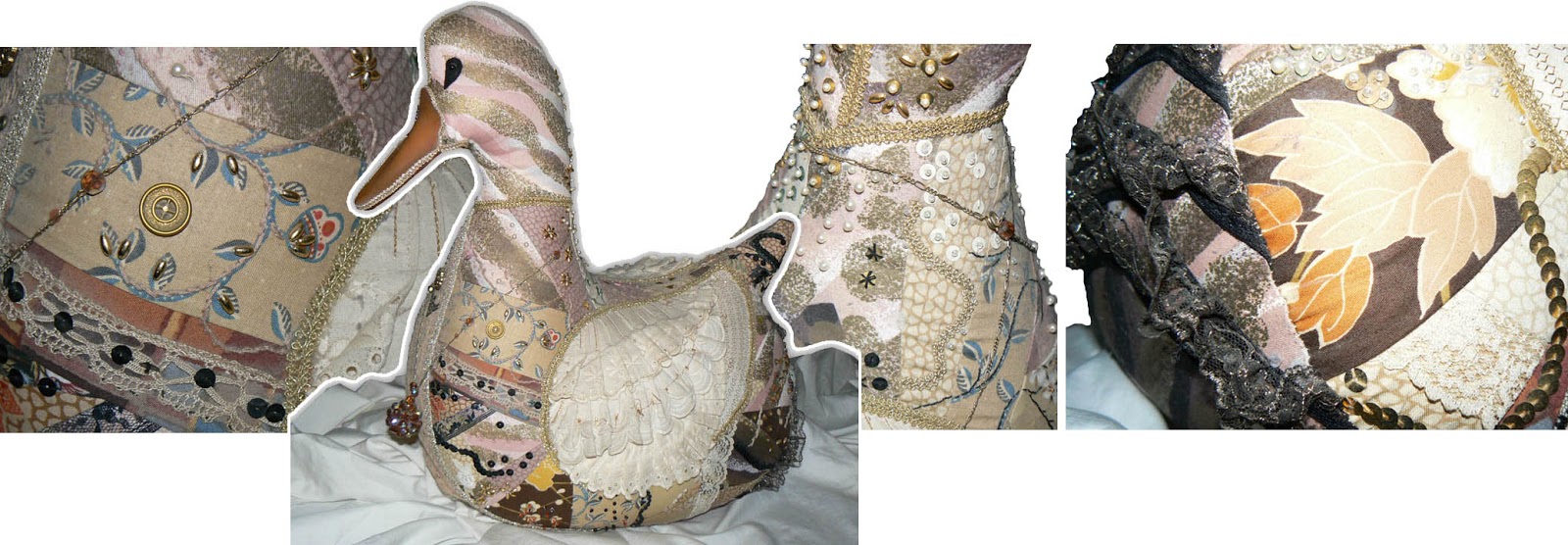
I also love crazy or scrap patchwork, which includes as many fabrics as possible in more random arrangements, along with embroidery and embellishments. I am very proud of my prize winning crazy patchwork duck. It was my first crazy project and, just for fun, I entered it into the patchwork section of the local Show .... and it won!  It won the overall prize and I was stunned - usually my work is experimental and more naive than professional so this was amazing. The fabrics were mostly curtain samples, I used different types of lace, some of it very old and I used a piece of leather for the beak and it was the beak that got attention and made the whole piece.  


The crazy patchwork duck with details.

Eventually I learnt to quilt, by hand and by machine. Stitching together three layers, a top, a layer of batting and the backing,  is called quilting and the quilting stitches often follow very involved and lovely patterns - one area I've never gone into.  These days most quilts are made of patchwork but before patchwork was developed they were whole cloth quilts. 

Egyptian sailing boat
During those years of my experiments in patchwork I was also reading about the history of patchwork and quilting, the culture that has grown around it and the language within the craft.  Way back in ancient Egypt patchwork was used to make sails for fishing boats on the River Nile - I find that very interesting. As I've also done a little (and I mean tiny little) bit of weaving I understand that the size of the loom limits the size of the cloth. If you want a big piece of cloth you take the lengths from the loom and sew them together to make a wider piece - and that would be patchwork, of a sort.

Remnants of patchwork have been found in ancient China and illustrations show that it was probably practiced in other cultures as well, but as fabric doesn't survive like pottery, we can't know for sure. Some people might think that patchwork was invented in America, but the craft was taken to America by early settlers from Europe. Who knows when or where it began, the birth of patchwork was a matter of women saving precious scraps of fabric from worn out clothing. Old skirts and shirts were cut down to fit children and any leftover patches were stitched together for head coverings, blankets, draft stopping curtains or small decorative items. Fabrics made by working people may have been rough and hand dyed but when anything is hard to get, or expensive, it becomes precious.  I love that it came from need, became a handcraft and is now preserved as art.

Those who could afford softer fabrics often had clothing decorated with embroidery, lace and beading.  From about the 12th century traders brought painted and printed fabrics from India, but the dye wasn't always reliable and it was expensive so was mainly used as decorative wall hangings. By the end of the 17th century printed linen and calico was produced in France and Germany, but working people didn't have access to cheap printed cloth until after the industrial revolution, early in the 19th century, and this was in the form of printed calico flour sacks. Bread was baked at home and the sacks washed, opened up and made into clothing. In America the flour producers deliberately used floral printed calico for their sacks, to attract the housewife. What did not go into petticoats and skirts became patchwork bed covers.

Here in Australia my great grandmother, Annie Morehead, made a new petticoat for each of her six daughters, every year. They were made from bleached flour sacks or sugar bags. No pretty flowers though, just the product name printed on the calico. Any leftover scraps were saved to use in quilts. pillows or as bandages.

Gradually patchwork designs developed to make use of different coloured and patterned  fabrics. Designs travelled the world, were copied and adapted, given names and meanings and we arrive at the patchwork phenomenon we know today.  It's a huge industry.  There are now millions of fabric designs and colours to make into millions of patterns.  The original idea of using salvaged fabrics is long gone and today's patchworkers buy new fabric to cut up.

Patchwork has a vocabulary, a history with special museums, local and international shows and competitions, university degrees, folk tales, an industry in publishing and fabric sales - even super star pattern and fabric designers.

A quilt made with pre-cut fabric squares,
which also means pre-chosen by the manufacturer.
And, Patchwork has risen from a craft to an art form. Works are embellished with beads, embroidery, other fabrics and feathers or hand dyed and hand painted. Patterns can be traditional, scrappy or even free form. Landscapes and portraits are made in patches and new processes of printing at home enables us to print our photos onto fabric, our favourite poetry or personal messages. Today you don't even have to cut your fabric as precuts are sold in rolls of strips or packs of squares, to enable a bulk buy that includes several different patterns, and with such unfabric-ey names as jelly rolls, charm packs or bundles of fat quarters.

Patchwork can also incorporate appliqué, which is stitching a fabric shape over the top of a base fabric, a little like sewing a patch over a worn area, but decoratively. Appliqué designs can be very elaborate and have been found as part of folk art across the world, from Africa to Egypt to South America.


This appliqué piece was made in Egypt - by a man, as this is an industry for tourists now and not suitable for women in that culture. Men run the stalls and stitch while waiting for customers. I recognised the story above as a fable often called, The man, the boy and the donkey.  Originally by Aesop there are different versions of the story from different places. The original version ended with the donkey falling off a bridge and drowning - not nice - so I prefer this version from Switzerland. It doesn't match exactly with the design but almost.


A man was riding home on his donkey, while his boy walked beside them. 

A traveller passing by said, "Father, it is not right for you to ride while you make your boy walk. You have stronger limbs."

So the father climbed off the donkey and let his son ride. 

Another traveller came along and said, "Boy, it is not right for you to ride while you make your old father go on foot. You have younger legs."

So they both mounted the donkey and road on a little way. 

A third passer by and said, "How stupid! Two fellows on one weak animal. Someone should take a stick and knock you off its back!"

So they both climbed off, and all three went along on foot, the father and son left and right, and the donkey in the middle. 

A fourth traveller came along and said, "You are three strange companions. Isn't it enough if two of you were to go on foot? Wouldn't it be easier if one of you would ride?"

So the father tied the donkey's front legs together, and the son tied its back legs together. Then they put a strong pole that was lying beside the road through its legs and carried the donkey home on their shoulders.

That's how far it can go if one tries to please everyone.


                                                       ---------------- FIN ----------------


Working with hexagons
                                                            

A watercolour patchwork landscape


Patchwork waistcoat

Patchwork garden