Showing posts with label stories. Show all posts

Sunday, 27 October 2013

ONCE UPON A TIME

 'Upon a day' or 'Once upon a time' has long been a traditional opening for myths, fables and folklore.  For most of us the phrase would belong to our earliest memories of listening to stories. I loved story time and looking at my books. I was delighted when my mother acted out parts of the story as she read and used squeaky voices.  But, those fairy tales they read to us when we were very young were often nicely revised versions of folk tales - originally almost horror stories designed to entertain with fright or teach lessons. 

Fairy Tales, originally called Little Tales, usually involved fantasy with magical creatures, curses, goblins, witches spells and the like. They often began with 'once upon a time', referring to a supposed age when magic was still in use. One old German opening was 'In the old times when wishing was still effective'.

Folk tales and legends included actual events and were often stories for adults while moral tales, including beast fables (animal characters) were told to adults and children.  Many stories appeared in a variety of languages, with changes to suit the local culture.

Jacob and Wilhelm Grimm travelled Germany writing down the folk tales told to them by a variety of people. They published a book titled 'Children's and Household Tales', volume one in 1812 and volume 2 in 1815 with a total of 83 stories.

The Brothers Grimm continued to add to the collection  and now we can read 200 stories under their name.  Stories without proven German origins were rejected and the brothers rewrote many tales to make them more acceptable to families. We now refer to their collection as Grimm's Fairy Tales.

Many of those tales have been made over again by the Walt Disney machine and what once were stories of horror, mutilation, curses and despair are now mostly plastic sugar and spice.

Hans Christian Anderson
The brothers Grimm inspired others to collect tales in their own language and writers such as Hans Christian Anderson continued writing tales that often drew on fables.  First published in 1822, his stories have been translated into over 125 languages, including The Emperor's New Clothes, The Princess and the Pea, Thumbelina and one I remember very well, The Tinderbox, live on today.

Whether they are fables or folk tales we all love the stories and new tales are being written for future generations. One of my favourites, by Oscar Wilde was published in 1888 - 'The Selfish Giant' - a moral tale of self sacrifice.

And from the Grimm collection;

The Pied Piper: (pied being a sort of patchwork of different colours) In the original story the piper rids the town of rats and when the town leaders refuse to pay him he leads the children to, not a wonderful paradise, but the river where they all drown.  That'll learn 'em.

Snow White: The evil queen wants Snow White killed because she is prettier than the queen. The hunter is told to take Snow into the forest and kill her,  cutting out not just her heart, but her liver and lungs too which were to be served for dinner in the palace.  Later when the Prince finds a dead Snow White in the forest, he hoists her body onto his horse and this jostling awakens her - not the Disney kiss.  When exposed in the end as an evil woman, the queen is welded into red hot iron shoes and forced to dance herself to death. ewwwwww

Cinderella: The Cinderella story dates back to 1st century BC in different forms, with different names.  In the version collected by the Grimm brothers the ugly sisters cut off parts of their feet to fit into the glass slipper. Does the Prince not notice the pools of blood? Eventually their eyes are plucked out by pigeons and they spend the rest of their lives as blind beggars, while Cinders enjoys a life of luxury in the castle.

Little Red Riding Hood or Little Red Cap:  This story was so horrible even the brothers Grimm had to nice'n it up.  In the original versions there was no woodsman to rescue Red and sometimes not even a grandmother. We tell this tale to babies when it's really about a young girl being seduced by a wolf and losing her virginity. An old saying from France, referring to a girl losing her virginity, translates as 'she saw the wolf'. In some versions, to illustrate that her life is over, the wolf eats her up.

Sleeping Beauty: A young woman falls into a deep sleep as the result of a prophecy. While unconscious she is raped by the King, gets pregnant, delivers twins and it is her children who finally wake her, not the modern day kiss of a handsome prince.

Hansel and Gretel: This is a scary story even today but in an early French version, called The Lost Children, the wicked witch was actually the devil.  The devils wife attempts to help the children but they are forced to trick her and then they slit her throat to aid their escape.

The Frog Prince: In the Grimm collection there is no magical kiss. The frog makes a bargain with the Princess to take him home to the palace to live. He gets closer and closer to her until he is in her bed but she throws him against the wall. Somehow this turns him into a Prince ... and it's a little confusing.

Rapunzel: Letting down her hair too often gets Rapunzel in the family way so the witch cuts off her hair and sends her away.  When the Prince comes back the witch lets down the hair for him. He is afraid of the witch, rejects her advances and she pushes him out the window. He falls into thorn bushes and brambles, which blind him, so he wanders the forest forever.

The Little Mermaid: One of many by Hans Christian Anderson this story originally ended with the mermaid's suicide, after watching her Prince marry a human Princess. Walt Disney added the happy ending we have today.

The Story of the Three Bears:  First published in 1837, this story by English author and poet, Robert Southey, featured a malicious old woman who invades the home of three male bears. As early as 1813 Southey had been telling the story to friends in various versions including a fox or vixen as the female. It is possible that this version had been a traditional oral tale. By 1849 Southey had changed the old woman to an intrusive little girl, who was given various names referring to her hair colour until she became Goldilocks early in the 20th century, and the three male bears evolved into father, mother and baby bear. The oral tale ending with the intruder being torn to pieces by the bears became the soft cuddly family story that is the most popular tale in the English language today. It comes under the banner of fairy tales even though it is more of an animal fable. The underlying theme of harsh punishment for those who trespass in areas they should not has changed to one of accepting others who seem different and making life 'just right', with the bears being the good guys. Some cartoon versions today show Goldi remaining with the bears to live happily ever after.


Usually this happy ending refers to the main characters only and indicates a work of fiction. It also gives us the comfort so necessary today.  While we read 'they lived happily ever after', many years ago it was 'and they all lived happily in the ever after'. 


Thursday, 11 July 2013

Looking at the MOON

I struggle to understand the phases and orbits of our MOON - and conversations with my Science teacher husband and my Scientist brother, who both claim knowledge and understanding of moons, planets and space stuff as one of their high interest subjects, just lead to my brain shutting down and I'm soon humming the old nursery rhyme...

I see the moon,    
The moon sees me.  
God bless the moon, 
And God bless me.

I do know the moon is about a quarter the size of the earth, that it takes 27.3 days to orbit the earth and I've also read that it takes 29 days to go through it's 'phases', from full moon to no moon, new moon and full moon again.  Apparently that has something to do with the moons slightly sloppy orbit, so that each time it goes around it takes a little longer and that's as far as my understanding goes.

However, I do enjoy creative stories, origins and interesting history tit-bits and there are even some jokes about the moon.

Q. What was the name of the first satellite to orbit the Earth?
A. The moon.

Starting with a strange, but true story, one that comes along once in a BLUE MOON ...... we all see that the moon is bright white or silver or sometimes yellowish, but not blue. Way back in the 14th century they knew the moon (or moone with a silent e) was not blue. An expression of that time - 'he would argue that the moon was blue' meant the same as our expression - 'she'd say black was white'.  So reference to a blue moon meant it was not so, or could not be.

As very little on this earth stays the same for long, a time came when people did see a blue coloured moon. Viewing the moon, at a certain angle, through a haze of chemicals like sulphur, can make the moon look bluish.  In 1883 the Indonesian volcano Krakatau erupted and the dust in the atmosphere made the moon look blue in many parts of the world for almost two years.  In 1927 a very long dry season in India caused enough dust for a blue moon and in 1951 the northern USA saw a blue moon through the smoke from forest fires in Canada. This does not happen very often and so the meaning of the expression altered to refer to something that happened rarely, or from time to time. 

But even this adaption didn't stay in place forever. Centuries ago people around the world  used different calendars and had different names and dates for the months of the year and it was all a bit of a mess if you were travelling. Some calendars followed the phases of the moon, others were based on movements of the sun. Gradually, due to trade and business, these different calendars were adjusted until most of the world was on the same page calendar wise. 

So, we have the year divided into 12 months, each month roughly 30 - 31 days. But the lunar month of 29 days from full moon full moon, is shorter than our calendar month and so it happens occasionally that a month will have two full moons.  This rare event of the second moon in a calendar month has recently become known as a blue moon.  Apparently it happens about 7 times in every 19 years - my husband explained this is because every 19 years the starting point of the earth's orbit around the sun, and the starting point of the moons orbit around the earth line up and they both begin again.


Q: "Why does the Moon orbit the Earth?"
A: "To get to the other side?"


This step in the naming of this phenomenon only developed in the last 25 - 30 years,  cemented into place by the media (it's a cool story when it happens) and also it became an answer in the trivial pursuit game.  This is exciting as it illustrates so well that we live in living history.


And a modern use for the blue moon - poets, and song writers use it to symbolise sadness and loneliness -  see as the Rodgers and Hart Blue Moon duet below - lots of great versions on YouTube.

HE SINGS:
Blue Moon
You saw me standing alone
Without a dream in my heart
Without a love of my own


SHE SINGS:
Blue Moon
You knew just what I was there for
You heard me saying a prayer for
Someone I really could care for


In some areas the moon was such a part of daily life that it stood for the period of time we now call month. The modern honeymoon holiday for newly married couples originates with a custom that began in 4th century Northern Europe.  To start married life on a sweet note, newlyweds drank mead, a drink brewed with honey, every day for the first moon (or month) of their life together - and that was a honeymoon.

A SUPER MOON is another good media story when it appears, and a great opportunity for photographers to show off.  Because the path of the moon's orbit around the earth is an elipse, not a circle there are times when the moon is closer to the earth than it is at other times.  When this closer position happens during a full moon it is called a super moon. People are convinced the moon is huge - but to my eye it's just nearer. 

2013 Super moon over central Australia
We know the moon is made of rock. Astronauts have been to the moon, walked around in the moon dust and brought rocks back to earth so it's difficult for us to understand that at one time people believed the moon was made of something else. We can check back to the 16th century again because that was when the printing press was invented meaning that from then on more copies of printed  works existed and some were kept while before that time the one or two hand made copies were lost of destroyed. We find that from the 16th and 17th centuries there were references to the moon being made of cheese.   

An English poet, John Heywood (1497 - 1580) wrote,  "Ye set circumquaques to make me beleue/ Or thinke, that the moone is made of greene cheese."   (You set circumstances to make me believe or think, that the moon is made of green cheese).  This mocking of the idea that the moon was made of cheese was possibly because some people at the time actually believed it was.   

An ancient folk tale tells of a simple farm boy who sees the reflection of the moon in the water of a pond. Not sure what it is he relates it to something of the same shape that he understands - a wheel of cheese. New, or un-aged cheese was called green cheese.  The story was told over and over and and as so often happens the origin meaning changed to the opposite meaning and up to the 19th century many children actually believed the moon was made of cheese!


Q. What do you get when you take green cheese and divide its circumference by its diameter?
A. Moon pi.


So with everyone looking at the moon over thousands of years it's no surprise that minstrels sang about a MAN IN THE MOON....


The man in the moon 
came down too soon
and asked his way to Norwich;
He went by the south 
and burnt his mouth

while supping cold pease porridge.


Of course this is a bit of nonsense - you can't burn your mouth on cold porridge so it follows that the man in the moon is nonsense too. But, strange creatures that we are this rhyme only added to the belief, at least among children, that there was a man in the moon.

In 1638 an English bishop named Francis Godwin wrote a sci fi book called The Man in the Moone, about a voyage to the moon. The Man in the Moon appeared in ballads and folk stories in many different cultures. This came from shadows on the moon taking on facial features. 

From my own childhood I remember -  
'Hello Mr Moon face, high up in the sky.
I can see you smiling, while in bed I lie'.
But I never actually saw the face in the moon as I grew up in the Southern hemisphere and these old stories come from the old world in the north.  European tradition was to see the figure of an old man on the full moon. He often carried a burden and was accompanied by a dog.

The need to have a visible place of banishment to frighten law breakers could be the reason some Germanic and Roman traditions represent the man in the moon as a thief being punished.  In Chinese mythology the goddess Chang'e is stranded on the moon, with a group of moon rabbits, after drinking a double dose of immortality potion.


The moon has a gravitational pull on the earth and so it affects the wind and the ocean tide. Once again that's the limit of my scientific knowledge.  The moon has been there for a long time so we named it. Our word moon comes from an Old English word, mona.  It was mene in Old German, mano in Old Saxon and Danish. By the 15th century English people were spelling it as moone and then moon.

In Latin the word for moon is Luna and this is still used for things relating to the moon such as the luna calendar.  Luna was also the moon goddess and from her we get the words lunacy and lunatic.  It was believed that the moon affected people and animals, causing madness or illness during the full moon. Science cannot prove this is true but many policemen, nurses and doctors think otherwise. Myths about werewolves or lycanthropes, men who transformed from a man into a wolf under the influence of the full moon, are still part of popular entertainment. 

But whatever you believe the moon is a beautiful thing.


2013 Full moon from east coast Australia
FULL MOON By Walter de la Mare

One night as Dick lay fast asleep,
 Into his drowsy eyes
A great still light began to creep
From out the silent skies.
It was the lovely moon's, for when
He raised his dreamy head,
Her surge of silver filled the pane
And streamed across his bed.
So, for a while, each gazed at each-
Dick and the solemn moon-
Till, climbing slowly on her way,
She vanished, and was gone.


This is a Moon Pie


Sunday, 12 May 2013

about PATCHWORK ...


I love patchwork, I love looking at patchwork and pictures of patchwork. I have stacks of magazines and books and I watch youtube clips on making patchwork. I have made patchwork from fabric and wool and paper. You can stitch, knit, crochet, glue, carve, plant, cement or nail a patchwork.  You can buy fake patchwork with the patches printed onto fabric but real patchwork is made of small pieces or patches, joined together following a set design, or strips of fabric joined and re-cut and joined again. New designs and patterns are constantly being made and with endless variations it would be most unusual for a quilt to be repeated exactly.

This is a small section of a Bargallo quilt, made for me by my friend Alison.
It's an example of how beautiful patchwork can be.


Decorating with mosaic tiles is a bit like patchwork, as is laying a patterned pathway or planting a flower garden in a particular design but we usually associate the word patchwork with sewing fabric. And that brings up the image of quilts - as many quilts are made of patchwork, which is why they are called patchwork quilts. There are other quilts,  'whole cloth' quilts that are not patchwork at all.

Crochet squares.
Back in the days when my fingers and wrists were nimble, and I could successfully multi-task, I crocheted many small squares and circles from different coloured wool or cotton, and joined these pieces to make patchwork shawls and baby blankets and waistcoats. Thousands of women of all ages around the world do the same, some of them creating amazing works of art in wool, just with their fingers and one little hook or with two knitting needles.

I made my first patchwork on a hand operated Singer sewing machine in the corner of the kitchen.  It was a blanket for the very large rag doll I had also stitched on that machine. The sewing machine had been owned by a great aunt and passed on to my grandmother who gave it to me. Two years later, when she saw I was into sewing, she gave me her more modern machine which was operated by pressing a bar with the knee.  It was another Singer, one of the first electric machines and it only went forward, no back stick and certainly no zigzag.

I used that machine to make dolls and doll clothes, then all my clothes for 20 years. I've also carried it with me around Australia and it was only recently I discovered the wooden outer had disintegrated. It didn't like being left under the house for the last eight years.  In 1972 I made a full layette, including the bassinet liner and blankets for my first child. My first patchwork bed cover, not quilted, for my baby daughter was made of flannelette squares in pastel lemon, pink and mauve.  Each lemon square was decorated with an embroidered cuddly animal and the backing was white spotted mauve flannelette. Very pretty, and as it turned out, not very practical. The washing machine wore out the flannelette in a few years. 

My 38 year old UFO
Around that time I started looking for books about patchwork - not too many around in those days, but I did find some illustrated history books. So, by the time my daughter was three I had finished a bedspread for her, also not quilted, of hand stitched hexagons - my own design of a tree surrounded by flowers. It had taken me a long time to make even though the hexagons were huge - I did have a young child to look after and a part time job and I'll repeat... hand stitched. Each piece was cut out with scissors and stitched over a cardboard shape before being hand stitched together and the cardboard removed.  We used it but it's never been finished. When I found it recently it looked like the work of a child, possibly because the fabrics were off cuts of other things, not pretty new fashion fabrics specially chosen.  It could be worth fixing, but I'd be tempted to change so much it might not be a good idea.  Quilters and patchworkers call these unfinished projects UFOs.

This blog post is about my mistakes and, as usual, my search for understanding. The quilts I have kept are the those with memories or the experiments, so this is certainly not a display of amazing craft work.  I have a passion for understanding how things came to be the way they are - origins, history, stories all fit into that. But, with my investigation into patchwork and quliting, I didn't look for the source at first, but worked backwards from my own fumbling attempts to translate ideas into fabric.

When I did look at patchwork patterns, I was delighted to discover it could all be done on the sewing machine.  About this time my stepmother bought a new sewing machine and in a moment of unusual generosity for her, she gave me her old machine - rather than trade it in.

Patchwork begins with small pieces, squares, strips or triangles. These are sewn together in a certain pattern to create a block. The blocks are stitched together in rows to make the 'top'. This can be surrounded by one or more borders and finally bound to the backing fabric by a folded strip called the binding. In between the top and the backing a layer of wadding is usually added for bulk and warmth.  I didn't know all this. 

Even though sewing machines were passed around in the family I don't remember anyone, other than me, ever sewing.  Mum and my grandmother taught us to knit and I taught myself to crochet. No one knew about patchwork. There were no classes that I knew of, and I'd never seen a patchwork/quilting magazine. All I had were library books. Being unfamiliar with terms like piecing and blocks and sashing and with a dislike for following patterns I learnt by looking at the pictures and working out for myself how the blocks went together. I made some silly mistakes and did everything the hard way. Now I know there are short cuts and tips to make it much easier, but back then I actually cut a tiny triangle and stitched it to another tiny triangle to make a square.

When my little girl went to preschool I made a sampler bedspread. The idea is to work on different patterns as a 'sample' piece.  Samplers are also used to show off stitching skills. The blocks are separated by strips of fabric, called sashing, so the patterns can be seen better. Most sampler quilts are very simple, like mine, which had 6 designs on 12 large blocks, but some can be real show off pieces for piecing and quilt stitches.

I sold my sampler at a school fete and was given orders for more.  At this stage I'd still not done any quilting, my pieces were just bedspreads with no filling - though everyone called them quilts.  A friends husband worked for a textile wholesaler and he organised for me to get some fabric samples - most 2 or 3 yard lengths.  I soon found that the fabric 'made' the finished product. It's a huge investment though, so I bought a roll of plain calico and a roll of light weight denim (not stretch in those days) and designed my quilts around those fabrics.

The 35 year old checkerboard calico quilt
I continued making and selling my counterpanes (old fashioned word for bedspread).  I was amazed because I didn't think they were very good but people liked them and were happy to pay me. Before long I had 'quilts' on consignment in two shops and was selling and taking orders through a market stall. At the same time I was involved in making leather handbags and belts at home - hand made leather items were all the rage and we could hardly keep up with the demand at times.

One of my early quilts, made around 1978, was just a checker board of squares backed with calico. I had clued up on the wadding by that time so it was properly filled, but instead of binding I put a calico frill around the edge. There was no quilting but I 'tied' it by stitching through the three layers in the corners of the patches and tying that off in a knot. I still have that quilt. It's wearing thin and one day I plan to add new filling and quilt it properly.

Finally I made a red quilt, for my daughter. It was properly pieced, filled and bound but the quilting wasn't the best and some seams have pulled open. This quilt was passed down to my granddaughter, but I have if back now for repairs, which I hope to get to soon, and maybe a great granddaughter will use it one day. 

The red quilt - well used, torn and stained and in need of repair


This was followed by countless patchwork cushions, shopping bags, dressing gowns, rag dolls and other toys as well as the odd quilt. Living in the cold climate of the Blue Mountains, NSW, I had plenty of inside time to fill and this was in the days before computers, internet and facebook. 

When my first son arrived I made boy clothes, especially overalls, which I could draw on, paint or decorate with braid. My little boy came with me to markets and people began asking about his overalls.  I was a bit bored with the patchwork by then so began to make children's clothes instead. I'm a terrible craft worker, always distracted by something new and not very interested in repeating what I've done before.  It's really the design process that interests me.

Years later, still looking at pictures and reading about patchwork I fell in love with the plain fabric Amish quilts and Seminole patchwork patterns. By then I had two growing boys. I made them Seminole style quilt covers, rather than quilts, and this worked well for us. I bought the fabrics from a Sheridan sheet outlet, so it was very good quality cotton. When I pulled them out from the cedar chest this week to take these photos I found them in perfect condition despite ten years of heavy use and longer than that in storage.


The boys quilts with details of the Seminole style patterns.


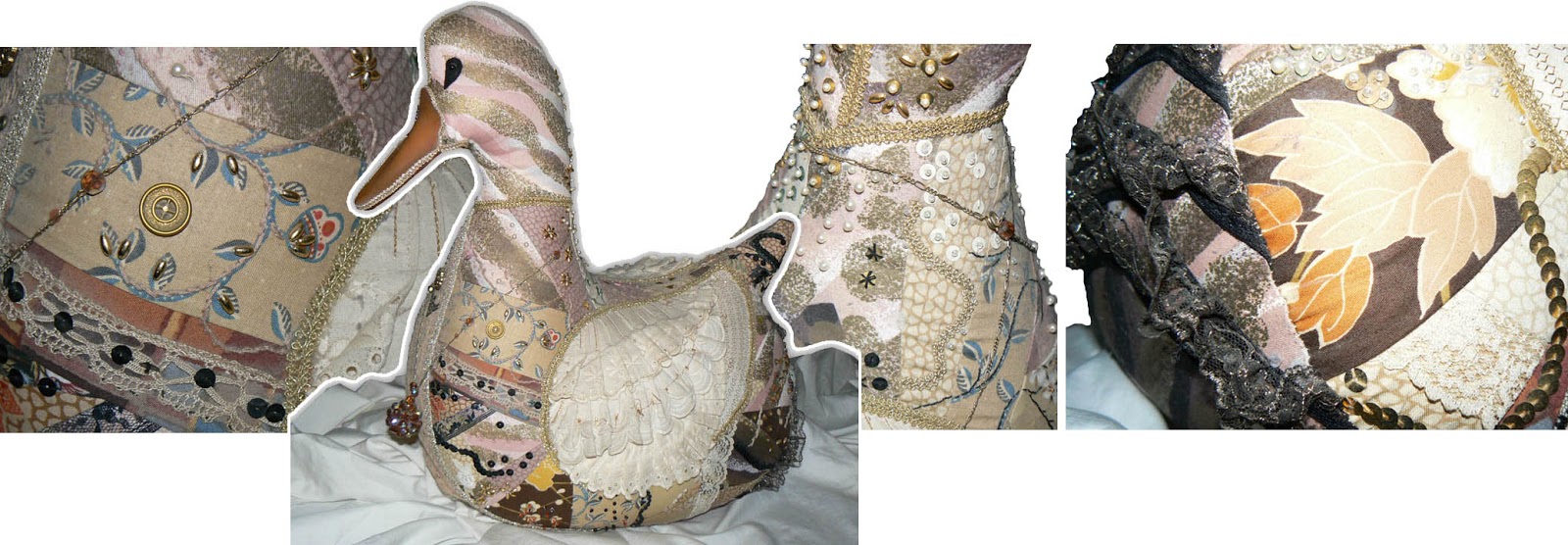
I also love crazy or scrap patchwork, which includes as many fabrics as possible in more random arrangements, along with embroidery and embellishments. I am very proud of my prize winning crazy patchwork duck. It was my first crazy project and, just for fun, I entered it into the patchwork section of the local Show .... and it won!  It won the overall prize and I was stunned - usually my work is experimental and more naive than professional so this was amazing. The fabrics were mostly curtain samples, I used different types of lace, some of it very old and I used a piece of leather for the beak and it was the beak that got attention and made the whole piece.  


The crazy patchwork duck with details.

Eventually I learnt to quilt, by hand and by machine. Stitching together three layers, a top, a layer of batting and the backing,  is called quilting and the quilting stitches often follow very involved and lovely patterns - one area I've never gone into.  These days most quilts are made of patchwork but before patchwork was developed they were whole cloth quilts. 

Egyptian sailing boat
During those years of my experiments in patchwork I was also reading about the history of patchwork and quilting, the culture that has grown around it and the language within the craft.  Way back in ancient Egypt patchwork was used to make sails for fishing boats on the River Nile - I find that very interesting. As I've also done a little (and I mean tiny little) bit of weaving I understand that the size of the loom limits the size of the cloth. If you want a big piece of cloth you take the lengths from the loom and sew them together to make a wider piece - and that would be patchwork, of a sort.

Remnants of patchwork have been found in ancient China and illustrations show that it was probably practiced in other cultures as well, but as fabric doesn't survive like pottery, we can't know for sure. Some people might think that patchwork was invented in America, but the craft was taken to America by early settlers from Europe. Who knows when or where it began, the birth of patchwork was a matter of women saving precious scraps of fabric from worn out clothing. Old skirts and shirts were cut down to fit children and any leftover patches were stitched together for head coverings, blankets, draft stopping curtains or small decorative items. Fabrics made by working people may have been rough and hand dyed but when anything is hard to get, or expensive, it becomes precious.  I love that it came from need, became a handcraft and is now preserved as art.

Those who could afford softer fabrics often had clothing decorated with embroidery, lace and beading.  From about the 12th century traders brought painted and printed fabrics from India, but the dye wasn't always reliable and it was expensive so was mainly used as decorative wall hangings. By the end of the 17th century printed linen and calico was produced in France and Germany, but working people didn't have access to cheap printed cloth until after the industrial revolution, early in the 19th century, and this was in the form of printed calico flour sacks. Bread was baked at home and the sacks washed, opened up and made into clothing. In America the flour producers deliberately used floral printed calico for their sacks, to attract the housewife. What did not go into petticoats and skirts became patchwork bed covers.

Here in Australia my great grandmother, Annie Morehead, made a new petticoat for each of her six daughters, every year. They were made from bleached flour sacks or sugar bags. No pretty flowers though, just the product name printed on the calico. Any leftover scraps were saved to use in quilts. pillows or as bandages.

Gradually patchwork designs developed to make use of different coloured and patterned  fabrics. Designs travelled the world, were copied and adapted, given names and meanings and we arrive at the patchwork phenomenon we know today.  It's a huge industry.  There are now millions of fabric designs and colours to make into millions of patterns.  The original idea of using salvaged fabrics is long gone and today's patchworkers buy new fabric to cut up.

Patchwork has a vocabulary, a history with special museums, local and international shows and competitions, university degrees, folk tales, an industry in publishing and fabric sales - even super star pattern and fabric designers.

A quilt made with pre-cut fabric squares,
which also means pre-chosen by the manufacturer.
And, Patchwork has risen from a craft to an art form. Works are embellished with beads, embroidery, other fabrics and feathers or hand dyed and hand painted. Patterns can be traditional, scrappy or even free form. Landscapes and portraits are made in patches and new processes of printing at home enables us to print our photos onto fabric, our favourite poetry or personal messages. Today you don't even have to cut your fabric as precuts are sold in rolls of strips or packs of squares, to enable a bulk buy that includes several different patterns, and with such unfabric-ey names as jelly rolls, charm packs or bundles of fat quarters.

Patchwork can also incorporate appliqué, which is stitching a fabric shape over the top of a base fabric, a little like sewing a patch over a worn area, but decoratively. Appliqué designs can be very elaborate and have been found as part of folk art across the world, from Africa to Egypt to South America.


This appliqué piece was made in Egypt - by a man, as this is an industry for tourists now and not suitable for women in that culture. Men run the stalls and stitch while waiting for customers. I recognised the story above as a fable often called, The man, the boy and the donkey.  Originally by Aesop there are different versions of the story from different places. The original version ended with the donkey falling off a bridge and drowning - not nice - so I prefer this version from Switzerland. It doesn't match exactly with the design but almost.


A man was riding home on his donkey, while his boy walked beside them. 

A traveller passing by said, "Father, it is not right for you to ride while you make your boy walk. You have stronger limbs."

So the father climbed off the donkey and let his son ride. 

Another traveller came along and said, "Boy, it is not right for you to ride while you make your old father go on foot. You have younger legs."

So they both mounted the donkey and road on a little way. 

A third passer by and said, "How stupid! Two fellows on one weak animal. Someone should take a stick and knock you off its back!"

So they both climbed off, and all three went along on foot, the father and son left and right, and the donkey in the middle. 

A fourth traveller came along and said, "You are three strange companions. Isn't it enough if two of you were to go on foot? Wouldn't it be easier if one of you would ride?"

So the father tied the donkey's front legs together, and the son tied its back legs together. Then they put a strong pole that was lying beside the road through its legs and carried the donkey home on their shoulders.

That's how far it can go if one tries to please everyone.


                                                       ---------------- FIN ----------------


Working with hexagons
                                                            

A watercolour patchwork landscape


Patchwork waistcoat

Patchwork garden