Showing posts with label memories. Show all posts

Monday, 23 March 2015

Surviving grief

  1. GRIEF:  a multifaceted response to loss, particularly to the loss of someone or something that has died, to which a bond or affection was formed. Although conventionally focused on the emotional response to loss, it also has physical, cognitive, behavioural, social, spiritual and philosophical dimensions.

I thought I knew about grief.  I felt it when my grandmother died and definitely when we lost our mother, though my reaction to my father's death left a numbness that has never gone away.  I've felt the pain of loss over the death of family pets and friends and acquaintances, over broken relationships and distance between loved ones, over a close call on my own life  - and I thought I knew all about it .... but I didn't and I don't.

Five months ago a family we have known for a very long time, and who have been both neighbours and work mates, lost a daughter. She was 25 years old and had lived those years with cystic fibrosis.  I witnessed their deep and painful grief through friends, face book messages and on their faces when I saw them.  Their battle with grief continues and like ripples on the pond, has affected everyone who knows them, causing many people to examine their own lives and fully appreciate their family.

We are told that grief is a natural, healthy process that aids healing from emotional wounds but the journey takes us through shock, denial, anger and deep sorrow, and it is not a comfortable ride.

When, less than three weeks ago, our beautiful, friendly, happiest-dog-in-the-world, Rufous, died on the living room floor at 4.30am, in the two minutes of that night we were not in the room with him - we were (and I do not often use this word as it is over used) devastated. We were shattered, shocked, stunned, dazed, traumatised, crushed, overwhelmed, distressed and overcome with the deep sorrow of loss.

We had seen the vet the afternoon before, knowing things were not right - and they had not been right for several months, but, being in a state of hope, we didn't fully realise that. Rufous died a week shy of his 14th birthday. That made him about 98 in people years.  He was more than five years past his use by date after a diagnosis of cancer, he had problems with his pancreas and digestive system, arthritis in the spine and he'd had both knees rebuilt after wearing them out. Regardless of what areas of his little body were shutting down, I feel he died of old age - it was his time, we knew it was coming but would never be ready. I still weep as I write this because I miss him so much.

For three days we hardly ate, we walked around in a daze, crying in anguish.  We thought we were prepared, we had chosen a burial site five years ago and that made the first task a little easier.  But we kept hearing him in every creak of the house and seeing him out of the corner of our eye.  He was in every room, every part of our day.  We suddenly had the first of many, many things - the first mail delivery without Rufous, the first shopping trip without Rufous, the first washing day - the first visitor to not be welcomed by Rufous - our days were full of missing him.

There is no way our loss could be compared to our neighbour's loss, after all they lost their daughter, we only lost a dog. But our pain was the same. Possibly we will adjust sooner .......... whatever sooner is.

But it set me wondering about what we grieve for and I came up with relationship. We have lost a relationship that we enjoyed, treasured and were blessed by.  I feel that relationship with family and friends is the core of emotional life for human beings, especially as relationship is a two way deal.  We have a relationship with God, with animals, with our garden, and the loss is like an amputation as it rips away a precious part of us.

Many people have written about grief with more knowledge and understanding than I have, but I needed to gather my thoughts into words, so I can look at them.


RIP little man Rufous.  
The 14 years we had with you will never end as you live in our hearts forever.  
You were an angel, sent to teach us about life, 
about strength and survival,
about not complaining,
about unconditional love and forgiveness, 
about joyfulness and the miracles that joy can bring,
and we embraced all those lessons.
Thank you.

Rufous B the Happiest Dog in the World,  10.03.2001 - 03.03.2015


Monday, 3 February 2014

will you still feed me?

My Aunty Joan is my living hero.  Now, almost 97 she has finally come to the place of knowing she can't live on her own anymore.  She is almost blind.  She's had a couple of falls, no serious damage, but enough to show it's not safe to be alone. The little timber cottage in Gatton has been closed up and Joan waited in the local hospital for the next step. That step was something she could not handle herself so her daughters, son and their spouses had to organise a residential home for her. It took a while, but finally she is installed in a lovely unit of a large bedroom/sitting room and a large bathroom, all kitted out with movement sensors and emergency buttons.  There is a dining room and a TV room, and a swimming pool.

"Will you swim?"  I asked.

Joan was never a highly sociable person. As a child she disliked helping with her mother's fund raising bridge parties when she wanted to crawl into a corner to read a book.  Through her teens she studied nursing and as a young woman she faced hard work in several areas.  Later she nursed her husband through heart disease and during his last days Joan slept on the floor by his hospital bed, just to be there for him.  She was 85 when he died.  So then she lived alone for almost 12 years, eventually adjusting to the busy social whirl of meals on wheels deliveries, a fortnightly home help cleaner, visits from a nurse/social worker and an occasional shopping trip on the bus for the elderly. She told me she loved the mango tree that filled the backyard. It was her retreat. When life got too much she'd go out there to feed her face and calm down.

I was interested to hear about social life in the new 'home'.  She is pleased to be one of only three at her table in the dining room. One of the other ladies is very  quiet, and that suits Joan. The other one chatters non-stop and Joan says she just has to accept she will be asked if she takes sugar in her tea over and over again throughout each meal.

95th Birthday cake
She said, "I thought I'd be nice to this poor woman so when she said there was a good film on the television I went with her to watch it. Of course I couldn't see anything as we sat at the back of the room, and I couldn't hear it but she seemed to be enjoying herself and I just tried to stay awake and think about other things. Then the next day I said to her, 'That was an interesting film we saw yesterday'.  And do you know, she didn't have a clue to what I was talking about.  She said, 'What film, I didn't see a film, I went to bed early'.  So that was a waste of time." This was presented in the tone of dry humour that is my Aunty Joan. The humour that wraps around ordinary things and makes them amusing from her point of view. 


I choose to phone her rather than visit because visits are physically exhausting for her.  Joan has children who visit her regularly and I have phone calls - and she phones me as often as I phone her.  That is very special.  She told me once that she has the names of her children and grand-children written in a notebook by the phone so she can remember who everyone is and who to ask about.  And one day I realised my end of the family is on the list too as she asks after my sister and brother and then our children in order, during conversations.  I'm delighted to be 'on the list'.  My daughter she calls 'your girl' and my granddaughter is 'the little one', as she knows them the best from the family gatherings for her 90th and 95th birthday celebrations.  "And I'm not having another one for 5 years", she said each time.  

It was wonderful that for the 90th birthday her cousin Ian came up to Brisbane, from Sydney, for the event. Their mothers were sisters and though Ian was a bit younger he spent a lot of time with Joan and my mother. Now he is no longer available for parties or anything else leaving Joan as the surviving member of that generation, in our family.


But, Joan was not born as an old lady.  She was a vibrant young woman who did well at school and wanted to continue studying. Her exotic looks were not appreciated by her blond haired, blue eyed mother so Joan grew up thinking she was not attractive and would have to fend for herself.  Careers for women were limited to nursing or teaching and Joan followed her mother and aunts into nursing.  The war came and she was patching up Aussies wounded in the mountain jungles of New Guinea. One wounded soldier staggered down the Kokoda track and into her life.

My uncle talked of their meeting at their 50th Wedding Anniversay celebration.  "Joan was an Army nurse. After being wounded on the Kokoda trail I was delivered to her at a Military hospital in Sydney in Dec 1942. Joan was an energetic business-like officer with two pips on her shoulders and me a lowly corporal with two stripes on my sleeve. I was a little the worse for wear but was slowly brought back to working order with her help. Then Joan was sent off to the war in New Guinea and I went to work in Sydney for a firm of wool brokers."

His elbow had been shot away so doctors gave him the choice of having the arm permanently set straight or bent.  He chose bent so he could ride a horse and shoot a rifle. As he had studied wool classing before he joined the army Don went back to that city job, but the 'bush' was always in his heart. When Joan returned from the war they were married and Don worked as a station manager, just west of Charleville and a year or so later moved to Murweh.

Joan told me, "Don finally won the soldiers ballot for free land. Mogera was 80,000 acres of rough country inhabited by dingoes.  We chose a paddock near a dry dam and pitched a big army tent for a bedroom. Don built an iron shed for a kitchen and a bough shed to 'live in'! Our fourth child was born at Mogera 1952."

The iron shed was too hot so cooking was on an open fire outside and the baby was hung in a sling from the tent post, to protect him from snakes. The children played in the dust under the gaze of wild dingoes - starving in the drought and on the lookout for easy prey.  They had no water, no fences and no grass. Don pushed down Mulga scrub for the sheep to eat and guarded them on horseback. Then the wool boom burst and the price went down overnight. Don had a fall from the horse and a long stay in hospital.

Eventually a house was built, the station sold and another bought closer to town. At least the children could attend school but the school burnt down and Joan had to teach them at home after all. And, as Don described it, this venture turned out to be a non-profit business. Life was a battle with heat, drought, snakes in the wood pile, distance from family, from friends, even from the post office. Visitors were few. Sheep had to be cared for, fed, sheared, drenched, sometimes killed and eaten. Dogs and horses had to be trained, fed and cared for. Shearers were accommodated and fed, cows herded and milked, fruit cakes baked, dingoes and wild pigs hunted, kangaroos discouraged, snakes killed, beggars and thieves chased from the door, children educated, clothes made, books read by lantern light, clothing washed by hand, wood chopped, fires put out, fire breaks burned, neighbours helped, illnesses treated, wounds bandaged, vehicles repaired and each day started it all over again.

Finally a generator added evenings to their day, better vehicles brought the town closer and telephones connected the family. The outback station was sold and a smaller produce farm, a few hours from Brisbane, became home. Four children turned into two nurses, an engineer and business woman, six grandchildren and two great grandchildren.   


The house near Charleville - Joan's sister Margaret (my mother) visiting.

Of course Aunty Joan is not the only person to live a life of struggle and difficulty and she told me that herself when she talked about the desperate situation of other families during the depression. She has memories of going in the car with her father to deliver food parcels, until the family business closed and they could no longer afford to help others as they were also eating wild caught rabbits and home grown potatoes. The family lost their home and when her parent's marriage broke up Joan was sent to live with her mother's sister - not a big disaster for Joan as her cousin Claire was her best friend. Little sister Peg stayed with Mother while Father moved in with his former secretary. The loss of her father that way hurt Joan deeply, a hurt that is still there today, though it lives in the shadow of losing her oldest daughter to cancer, the same year that Don died. 

Joan once said to me - "We each have our own life and how we live it depends on the bits we inherit from parents."

And so I asked about her new home.
"It's all very nice," she said. "In fact it's luxury but I suppose I'll get used to it."  lol  "I'm not sure about the pool though."
'What do you do during the day?
"I read, I've got a nice chair here and there is a library. In the afternoon someone brings me a cup of tea, it's all very nice. I have lots of little sleeps. I can go to the TV room if I want, but I'm not interested in television now."
"Do you need anything? A fruit cake or a packet of biscuits?"
"I have some biscuits in the room but I can't eat them because I'm always full."
"Maybe I'll bring you a little bottle of coke when I come."
"He he, yes, that would be nice. But I have to be careful because I only have rotten teeth left."
"How's the food?"
"Oh, it's ..... it's alright. There's plenty of it."
Hmmmm - change in tone. She won't explain unless I insist.
"What is wrong with the food?"
" Well... it's not what I'm used to."
"You were used to meals-on-wheels."
"Yes."
"And this is different?"
"It's .... the way they ... present it."
"How?"
"It's frozen."
"Oh!"
"Apparently, this is what all the big hospitals do."
"And the meals-on-wheels were cooked fresh each day."
"Yes......  it was like I used to cook myself."
"Some frozen food is okay."
"Some is."
"Even meals-on-wheels is going to frozen dinners in some places."
"That's a shame."
"So you're eating airplane food."
She laughed. "They do whatever they do to heat it and it tastes okay. Rice is a bit .......... well ... let's say I've had enough chicken and rice to last me."


I am so sorry. So sorry that we can't give our darling oldies fresh food, sorry that our infirm get microwave dinners served in cardboard trays, with instant mashed potato and dried out beef. So sorry that your reward for a life of caring for others is that we can't afford to feed you properly. Forget about the wounded soldiers, the dust and dingoes, the barefooted children and snakes in the woodpile - forget about the sacrifice, the pioneer spirit, the building of family, here - have a frozen dinner.  


Caring for our elders should be part of family life. Children who don't see their grandparents regularly, if not daily, are missing an important part of their development and they lose track of where they are in history.

In traditional societies people look forward to living out their last years surrounded by their children and aging friends. Ancient Chinese society was held together by the belief in family. The greatest virtue being devotion to one’s parents.  They still respect the declining abilities of the aged to tend gardens, care for babies, assist in the education of children - allowing the young adults to work. Value is given to craft work, sharing skills, knowledge and understanding of life and passing on the family stories.  In sedentary farming societies around the world, the elderly are fed and cared for and live in the same hut or one near their adult children.

With nomadic people the elderly can become a burden and occasionally tribes were forced to abandon their aged and infirm. There is even a word for it.  Senilicide. It loosely means doing away with the olds.  When there is enough food to go around, everyone gets a share, even those who are not productive. During times of famine not feeding the elderly often saved the young.  When desperate, the Inuit left their old folk outside to die of exposure or starve to death, considering it to be assisted suicide. It was often a mutual decision.

Today's elderly live away from their children. After they do the expected retirement road trip they're supposed to quietly disappear into assisted living villages or nursing homes - if they can afford it, or a council flat, out of sight, until required for weddings and funerals. They feed themselves, they feed cats and lap dogs and sometimes go without.

We are all part of the aging population. Grannies struggling to keep up with technology give the smart young things the impression that old people have no place in the modern world. These old people are eating food, breathing air, using up valuable natural resources and clogging the medical system - becoming a burden. Some hospitals have a policy of treating young people first, some doctors prescribe drugs with little attention given to good health for the elderly, it's easier and cheaper. A version of senilicide has been practiced in hospitals and nursing homes for centuries - withhold food and they fade away. 

Often they don't really mind - being very old is not fun. But what is old? It's getting younger every year. Applying for a job is difficult at 55 and TV ads tell us we should be buying funeral insurance in our 40s. The Protestant work ethic of measuring a person's value by their ability to work - has led to our youth centred culture in which we idolise individualism and independence. In 2004, France had to pass decree requiring citizens keep in touch with their geriatric parents after a heat wave killed 15,000 people - most of them elderly and many bodies were not found for weeks because of neglect by their families. Also, France had the highest number of pensioner suicides in Europe.

So what are we going to do? Maybe these huge modern houses with parent retreats, teenager's living area and home theatres should also include granny flats, for us - but that depends on our children becoming millionaires. The question of where we'll end up when we can no longer manage independently is a big one.

Will you still need me, will you still feed me, 
when I'm sixty/eighty four?

Sunday, 27 October 2013

ONCE UPON A TIME

 'Upon a day' or 'Once upon a time' has long been a traditional opening for myths, fables and folklore.  For most of us the phrase would belong to our earliest memories of listening to stories. I loved story time and looking at my books. I was delighted when my mother acted out parts of the story as she read and used squeaky voices.  But, those fairy tales they read to us when we were very young were often nicely revised versions of folk tales - originally almost horror stories designed to entertain with fright or teach lessons. 

Fairy Tales, originally called Little Tales, usually involved fantasy with magical creatures, curses, goblins, witches spells and the like. They often began with 'once upon a time', referring to a supposed age when magic was still in use. One old German opening was 'In the old times when wishing was still effective'.

Folk tales and legends included actual events and were often stories for adults while moral tales, including beast fables (animal characters) were told to adults and children.  Many stories appeared in a variety of languages, with changes to suit the local culture.

Jacob and Wilhelm Grimm travelled Germany writing down the folk tales told to them by a variety of people. They published a book titled 'Children's and Household Tales', volume one in 1812 and volume 2 in 1815 with a total of 83 stories.

The Brothers Grimm continued to add to the collection  and now we can read 200 stories under their name.  Stories without proven German origins were rejected and the brothers rewrote many tales to make them more acceptable to families. We now refer to their collection as Grimm's Fairy Tales.

Many of those tales have been made over again by the Walt Disney machine and what once were stories of horror, mutilation, curses and despair are now mostly plastic sugar and spice.

Hans Christian Anderson
The brothers Grimm inspired others to collect tales in their own language and writers such as Hans Christian Anderson continued writing tales that often drew on fables.  First published in 1822, his stories have been translated into over 125 languages, including The Emperor's New Clothes, The Princess and the Pea, Thumbelina and one I remember very well, The Tinderbox, live on today.

Whether they are fables or folk tales we all love the stories and new tales are being written for future generations. One of my favourites, by Oscar Wilde was published in 1888 - 'The Selfish Giant' - a moral tale of self sacrifice.

And from the Grimm collection;

The Pied Piper: (pied being a sort of patchwork of different colours) In the original story the piper rids the town of rats and when the town leaders refuse to pay him he leads the children to, not a wonderful paradise, but the river where they all drown.  That'll learn 'em.

Snow White: The evil queen wants Snow White killed because she is prettier than the queen. The hunter is told to take Snow into the forest and kill her,  cutting out not just her heart, but her liver and lungs too which were to be served for dinner in the palace.  Later when the Prince finds a dead Snow White in the forest, he hoists her body onto his horse and this jostling awakens her - not the Disney kiss.  When exposed in the end as an evil woman, the queen is welded into red hot iron shoes and forced to dance herself to death. ewwwwww

Cinderella: The Cinderella story dates back to 1st century BC in different forms, with different names.  In the version collected by the Grimm brothers the ugly sisters cut off parts of their feet to fit into the glass slipper. Does the Prince not notice the pools of blood? Eventually their eyes are plucked out by pigeons and they spend the rest of their lives as blind beggars, while Cinders enjoys a life of luxury in the castle.

Little Red Riding Hood or Little Red Cap:  This story was so horrible even the brothers Grimm had to nice'n it up.  In the original versions there was no woodsman to rescue Red and sometimes not even a grandmother. We tell this tale to babies when it's really about a young girl being seduced by a wolf and losing her virginity. An old saying from France, referring to a girl losing her virginity, translates as 'she saw the wolf'. In some versions, to illustrate that her life is over, the wolf eats her up.

Sleeping Beauty: A young woman falls into a deep sleep as the result of a prophecy. While unconscious she is raped by the King, gets pregnant, delivers twins and it is her children who finally wake her, not the modern day kiss of a handsome prince.

Hansel and Gretel: This is a scary story even today but in an early French version, called The Lost Children, the wicked witch was actually the devil.  The devils wife attempts to help the children but they are forced to trick her and then they slit her throat to aid their escape.

The Frog Prince: In the Grimm collection there is no magical kiss. The frog makes a bargain with the Princess to take him home to the palace to live. He gets closer and closer to her until he is in her bed but she throws him against the wall. Somehow this turns him into a Prince ... and it's a little confusing.

Rapunzel: Letting down her hair too often gets Rapunzel in the family way so the witch cuts off her hair and sends her away.  When the Prince comes back the witch lets down the hair for him. He is afraid of the witch, rejects her advances and she pushes him out the window. He falls into thorn bushes and brambles, which blind him, so he wanders the forest forever.

The Little Mermaid: One of many by Hans Christian Anderson this story originally ended with the mermaid's suicide, after watching her Prince marry a human Princess. Walt Disney added the happy ending we have today.

The Story of the Three Bears:  First published in 1837, this story by English author and poet, Robert Southey, featured a malicious old woman who invades the home of three male bears. As early as 1813 Southey had been telling the story to friends in various versions including a fox or vixen as the female. It is possible that this version had been a traditional oral tale. By 1849 Southey had changed the old woman to an intrusive little girl, who was given various names referring to her hair colour until she became Goldilocks early in the 20th century, and the three male bears evolved into father, mother and baby bear. The oral tale ending with the intruder being torn to pieces by the bears became the soft cuddly family story that is the most popular tale in the English language today. It comes under the banner of fairy tales even though it is more of an animal fable. The underlying theme of harsh punishment for those who trespass in areas they should not has changed to one of accepting others who seem different and making life 'just right', with the bears being the good guys. Some cartoon versions today show Goldi remaining with the bears to live happily ever after.


Usually this happy ending refers to the main characters only and indicates a work of fiction. It also gives us the comfort so necessary today.  While we read 'they lived happily ever after', many years ago it was 'and they all lived happily in the ever after'. 


Sunday, 12 May 2013

about PATCHWORK ...


I love patchwork, I love looking at patchwork and pictures of patchwork. I have stacks of magazines and books and I watch youtube clips on making patchwork. I have made patchwork from fabric and wool and paper. You can stitch, knit, crochet, glue, carve, plant, cement or nail a patchwork.  You can buy fake patchwork with the patches printed onto fabric but real patchwork is made of small pieces or patches, joined together following a set design, or strips of fabric joined and re-cut and joined again. New designs and patterns are constantly being made and with endless variations it would be most unusual for a quilt to be repeated exactly.

This is a small section of a Bargallo quilt, made for me by my friend Alison.
It's an example of how beautiful patchwork can be.


Decorating with mosaic tiles is a bit like patchwork, as is laying a patterned pathway or planting a flower garden in a particular design but we usually associate the word patchwork with sewing fabric. And that brings up the image of quilts - as many quilts are made of patchwork, which is why they are called patchwork quilts. There are other quilts,  'whole cloth' quilts that are not patchwork at all.

Crochet squares.
Back in the days when my fingers and wrists were nimble, and I could successfully multi-task, I crocheted many small squares and circles from different coloured wool or cotton, and joined these pieces to make patchwork shawls and baby blankets and waistcoats. Thousands of women of all ages around the world do the same, some of them creating amazing works of art in wool, just with their fingers and one little hook or with two knitting needles.

I made my first patchwork on a hand operated Singer sewing machine in the corner of the kitchen.  It was a blanket for the very large rag doll I had also stitched on that machine. The sewing machine had been owned by a great aunt and passed on to my grandmother who gave it to me. Two years later, when she saw I was into sewing, she gave me her more modern machine which was operated by pressing a bar with the knee.  It was another Singer, one of the first electric machines and it only went forward, no back stick and certainly no zigzag.

I used that machine to make dolls and doll clothes, then all my clothes for 20 years. I've also carried it with me around Australia and it was only recently I discovered the wooden outer had disintegrated. It didn't like being left under the house for the last eight years.  In 1972 I made a full layette, including the bassinet liner and blankets for my first child. My first patchwork bed cover, not quilted, for my baby daughter was made of flannelette squares in pastel lemon, pink and mauve.  Each lemon square was decorated with an embroidered cuddly animal and the backing was white spotted mauve flannelette. Very pretty, and as it turned out, not very practical. The washing machine wore out the flannelette in a few years. 

My 38 year old UFO
Around that time I started looking for books about patchwork - not too many around in those days, but I did find some illustrated history books. So, by the time my daughter was three I had finished a bedspread for her, also not quilted, of hand stitched hexagons - my own design of a tree surrounded by flowers. It had taken me a long time to make even though the hexagons were huge - I did have a young child to look after and a part time job and I'll repeat... hand stitched. Each piece was cut out with scissors and stitched over a cardboard shape before being hand stitched together and the cardboard removed.  We used it but it's never been finished. When I found it recently it looked like the work of a child, possibly because the fabrics were off cuts of other things, not pretty new fashion fabrics specially chosen.  It could be worth fixing, but I'd be tempted to change so much it might not be a good idea.  Quilters and patchworkers call these unfinished projects UFOs.

This blog post is about my mistakes and, as usual, my search for understanding. The quilts I have kept are the those with memories or the experiments, so this is certainly not a display of amazing craft work.  I have a passion for understanding how things came to be the way they are - origins, history, stories all fit into that. But, with my investigation into patchwork and quliting, I didn't look for the source at first, but worked backwards from my own fumbling attempts to translate ideas into fabric.

When I did look at patchwork patterns, I was delighted to discover it could all be done on the sewing machine.  About this time my stepmother bought a new sewing machine and in a moment of unusual generosity for her, she gave me her old machine - rather than trade it in.

Patchwork begins with small pieces, squares, strips or triangles. These are sewn together in a certain pattern to create a block. The blocks are stitched together in rows to make the 'top'. This can be surrounded by one or more borders and finally bound to the backing fabric by a folded strip called the binding. In between the top and the backing a layer of wadding is usually added for bulk and warmth.  I didn't know all this. 

Even though sewing machines were passed around in the family I don't remember anyone, other than me, ever sewing.  Mum and my grandmother taught us to knit and I taught myself to crochet. No one knew about patchwork. There were no classes that I knew of, and I'd never seen a patchwork/quilting magazine. All I had were library books. Being unfamiliar with terms like piecing and blocks and sashing and with a dislike for following patterns I learnt by looking at the pictures and working out for myself how the blocks went together. I made some silly mistakes and did everything the hard way. Now I know there are short cuts and tips to make it much easier, but back then I actually cut a tiny triangle and stitched it to another tiny triangle to make a square.

When my little girl went to preschool I made a sampler bedspread. The idea is to work on different patterns as a 'sample' piece.  Samplers are also used to show off stitching skills. The blocks are separated by strips of fabric, called sashing, so the patterns can be seen better. Most sampler quilts are very simple, like mine, which had 6 designs on 12 large blocks, but some can be real show off pieces for piecing and quilt stitches.

I sold my sampler at a school fete and was given orders for more.  At this stage I'd still not done any quilting, my pieces were just bedspreads with no filling - though everyone called them quilts.  A friends husband worked for a textile wholesaler and he organised for me to get some fabric samples - most 2 or 3 yard lengths.  I soon found that the fabric 'made' the finished product. It's a huge investment though, so I bought a roll of plain calico and a roll of light weight denim (not stretch in those days) and designed my quilts around those fabrics.

The 35 year old checkerboard calico quilt
I continued making and selling my counterpanes (old fashioned word for bedspread).  I was amazed because I didn't think they were very good but people liked them and were happy to pay me. Before long I had 'quilts' on consignment in two shops and was selling and taking orders through a market stall. At the same time I was involved in making leather handbags and belts at home - hand made leather items were all the rage and we could hardly keep up with the demand at times.

One of my early quilts, made around 1978, was just a checker board of squares backed with calico. I had clued up on the wadding by that time so it was properly filled, but instead of binding I put a calico frill around the edge. There was no quilting but I 'tied' it by stitching through the three layers in the corners of the patches and tying that off in a knot. I still have that quilt. It's wearing thin and one day I plan to add new filling and quilt it properly.

Finally I made a red quilt, for my daughter. It was properly pieced, filled and bound but the quilting wasn't the best and some seams have pulled open. This quilt was passed down to my granddaughter, but I have if back now for repairs, which I hope to get to soon, and maybe a great granddaughter will use it one day. 

The red quilt - well used, torn and stained and in need of repair


This was followed by countless patchwork cushions, shopping bags, dressing gowns, rag dolls and other toys as well as the odd quilt. Living in the cold climate of the Blue Mountains, NSW, I had plenty of inside time to fill and this was in the days before computers, internet and facebook. 

When my first son arrived I made boy clothes, especially overalls, which I could draw on, paint or decorate with braid. My little boy came with me to markets and people began asking about his overalls.  I was a bit bored with the patchwork by then so began to make children's clothes instead. I'm a terrible craft worker, always distracted by something new and not very interested in repeating what I've done before.  It's really the design process that interests me.

Years later, still looking at pictures and reading about patchwork I fell in love with the plain fabric Amish quilts and Seminole patchwork patterns. By then I had two growing boys. I made them Seminole style quilt covers, rather than quilts, and this worked well for us. I bought the fabrics from a Sheridan sheet outlet, so it was very good quality cotton. When I pulled them out from the cedar chest this week to take these photos I found them in perfect condition despite ten years of heavy use and longer than that in storage.


The boys quilts with details of the Seminole style patterns.


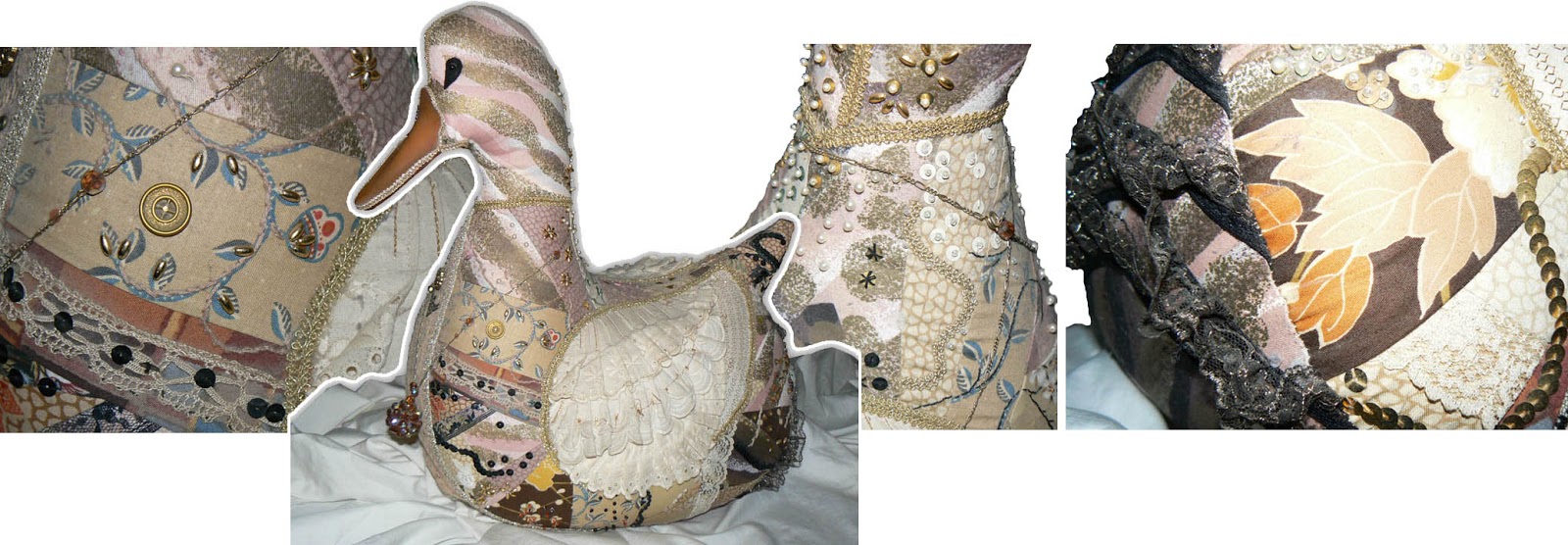
I also love crazy or scrap patchwork, which includes as many fabrics as possible in more random arrangements, along with embroidery and embellishments. I am very proud of my prize winning crazy patchwork duck. It was my first crazy project and, just for fun, I entered it into the patchwork section of the local Show .... and it won!  It won the overall prize and I was stunned - usually my work is experimental and more naive than professional so this was amazing. The fabrics were mostly curtain samples, I used different types of lace, some of it very old and I used a piece of leather for the beak and it was the beak that got attention and made the whole piece.  


The crazy patchwork duck with details.

Eventually I learnt to quilt, by hand and by machine. Stitching together three layers, a top, a layer of batting and the backing,  is called quilting and the quilting stitches often follow very involved and lovely patterns - one area I've never gone into.  These days most quilts are made of patchwork but before patchwork was developed they were whole cloth quilts. 

Egyptian sailing boat
During those years of my experiments in patchwork I was also reading about the history of patchwork and quilting, the culture that has grown around it and the language within the craft.  Way back in ancient Egypt patchwork was used to make sails for fishing boats on the River Nile - I find that very interesting. As I've also done a little (and I mean tiny little) bit of weaving I understand that the size of the loom limits the size of the cloth. If you want a big piece of cloth you take the lengths from the loom and sew them together to make a wider piece - and that would be patchwork, of a sort.

Remnants of patchwork have been found in ancient China and illustrations show that it was probably practiced in other cultures as well, but as fabric doesn't survive like pottery, we can't know for sure. Some people might think that patchwork was invented in America, but the craft was taken to America by early settlers from Europe. Who knows when or where it began, the birth of patchwork was a matter of women saving precious scraps of fabric from worn out clothing. Old skirts and shirts were cut down to fit children and any leftover patches were stitched together for head coverings, blankets, draft stopping curtains or small decorative items. Fabrics made by working people may have been rough and hand dyed but when anything is hard to get, or expensive, it becomes precious.  I love that it came from need, became a handcraft and is now preserved as art.

Those who could afford softer fabrics often had clothing decorated with embroidery, lace and beading.  From about the 12th century traders brought painted and printed fabrics from India, but the dye wasn't always reliable and it was expensive so was mainly used as decorative wall hangings. By the end of the 17th century printed linen and calico was produced in France and Germany, but working people didn't have access to cheap printed cloth until after the industrial revolution, early in the 19th century, and this was in the form of printed calico flour sacks. Bread was baked at home and the sacks washed, opened up and made into clothing. In America the flour producers deliberately used floral printed calico for their sacks, to attract the housewife. What did not go into petticoats and skirts became patchwork bed covers.

Here in Australia my great grandmother, Annie Morehead, made a new petticoat for each of her six daughters, every year. They were made from bleached flour sacks or sugar bags. No pretty flowers though, just the product name printed on the calico. Any leftover scraps were saved to use in quilts. pillows or as bandages.

Gradually patchwork designs developed to make use of different coloured and patterned  fabrics. Designs travelled the world, were copied and adapted, given names and meanings and we arrive at the patchwork phenomenon we know today.  It's a huge industry.  There are now millions of fabric designs and colours to make into millions of patterns.  The original idea of using salvaged fabrics is long gone and today's patchworkers buy new fabric to cut up.

Patchwork has a vocabulary, a history with special museums, local and international shows and competitions, university degrees, folk tales, an industry in publishing and fabric sales - even super star pattern and fabric designers.

A quilt made with pre-cut fabric squares,
which also means pre-chosen by the manufacturer.
And, Patchwork has risen from a craft to an art form. Works are embellished with beads, embroidery, other fabrics and feathers or hand dyed and hand painted. Patterns can be traditional, scrappy or even free form. Landscapes and portraits are made in patches and new processes of printing at home enables us to print our photos onto fabric, our favourite poetry or personal messages. Today you don't even have to cut your fabric as precuts are sold in rolls of strips or packs of squares, to enable a bulk buy that includes several different patterns, and with such unfabric-ey names as jelly rolls, charm packs or bundles of fat quarters.

Patchwork can also incorporate appliqué, which is stitching a fabric shape over the top of a base fabric, a little like sewing a patch over a worn area, but decoratively. Appliqué designs can be very elaborate and have been found as part of folk art across the world, from Africa to Egypt to South America.


This appliqué piece was made in Egypt - by a man, as this is an industry for tourists now and not suitable for women in that culture. Men run the stalls and stitch while waiting for customers. I recognised the story above as a fable often called, The man, the boy and the donkey.  Originally by Aesop there are different versions of the story from different places. The original version ended with the donkey falling off a bridge and drowning - not nice - so I prefer this version from Switzerland. It doesn't match exactly with the design but almost.


A man was riding home on his donkey, while his boy walked beside them. 

A traveller passing by said, "Father, it is not right for you to ride while you make your boy walk. You have stronger limbs."

So the father climbed off the donkey and let his son ride. 

Another traveller came along and said, "Boy, it is not right for you to ride while you make your old father go on foot. You have younger legs."

So they both mounted the donkey and road on a little way. 

A third passer by and said, "How stupid! Two fellows on one weak animal. Someone should take a stick and knock you off its back!"

So they both climbed off, and all three went along on foot, the father and son left and right, and the donkey in the middle. 

A fourth traveller came along and said, "You are three strange companions. Isn't it enough if two of you were to go on foot? Wouldn't it be easier if one of you would ride?"

So the father tied the donkey's front legs together, and the son tied its back legs together. Then they put a strong pole that was lying beside the road through its legs and carried the donkey home on their shoulders.

That's how far it can go if one tries to please everyone.


                                                       ---------------- FIN ----------------


Working with hexagons
                                                            

A watercolour patchwork landscape


Patchwork waistcoat

Patchwork garden