Showing posts with label books. Show all posts

Wednesday, 13 December 2017

A new Word

Revisiting a new word

At around age 15, sitting on a train, I understood that if I died at that moment the train would not stop. Busses would still run and airplanes would still fly and the people in this transport would go about their daily lives as if nothing had happened.  In fact, almost nothing in the world would change.  My leaving would be noticed only by the people who knew me.

This understanding was intriguing. I don’t remember feeling grief but at age 14 you think you will live forever.

Sometimes I wondered about other things like;
What if I was the only real person on earth and everyone else was a prop for my life?  They were all fake.
What if the entire world was here and everyone who travelled overseas and came back told invented stories, about the rest-of-the-world, which didn’t exist?
What if I was not real?  I was a fake person, a prop in the lives of other people.

At other times I felt panic at the thought of all the lives being lived and all the stories that could be told and wondering who had been given the task of knowing them all.

But, I’ve always been a people watcher – wondering what was behind the 2 minutes I saw of someone’s life, so when I stumbled over the word sonder - I liked it.


n. the realization that each random passer-by is living a life as vivid and complex as your own—populated with their own ambitions, friends, routines, worries and inherited craziness—an epic story that continues invisibly around you like an anthill sprawling deep underground, with elaborate passageways to thousands of other lives that you’ll never know existed, in which you might appear only once, as an extra sipping coffee in the background, as a blur of traffic passing on the highway, as a lighted window at dusk.


Definition shared from The Dictionary of Obscure Sorrows  - a website and YouTube channel, created by John Koenig, that defines neologisms for emotions that do not have a descriptive term. The dictionary includes verbal entries on the website with paragraph-length descriptions and videos on YouTube for individual entries). 

Definition Related: I heard about a book called 'Historia transversal de Floreal Menendez, which apparently means something life - Cross-sectional history of Floreal Menendez, by Leo Masliah - who is a musician.

I can only find the book in Spanish, but have been told it follows a chain of people who tough the lives of each other briefly.  I have a feeling that I've seen a short film on the same subject that was not in English but I can't find any reference to it ... seems like I'm the only person who's every seen it.
What I'm talking about is not like the movies 'Crash' (2003) or 'A Long Way Down' (2014), about several people who all meet up at the end.  No, this is a chain that follows the contact, not the person, and touches on the surface of several live - the camera follows me as I walk down the road and pass a boy, then the camera follows the boy, to his home, where he stops to talk to a neighbour and then the camera follows that man and what he is doing. He waves at a girl cycling by and the camera follows the girl.  That is a simplified person.

This animated movie called Sonder, is something different.


.


Sunday, 27 October 2013

ONCE UPON A TIME

 'Upon a day' or 'Once upon a time' has long been a traditional opening for myths, fables and folklore.  For most of us the phrase would belong to our earliest memories of listening to stories. I loved story time and looking at my books. I was delighted when my mother acted out parts of the story as she read and used squeaky voices.  But, those fairy tales they read to us when we were very young were often nicely revised versions of folk tales - originally almost horror stories designed to entertain with fright or teach lessons. 

Fairy Tales, originally called Little Tales, usually involved fantasy with magical creatures, curses, goblins, witches spells and the like. They often began with 'once upon a time', referring to a supposed age when magic was still in use. One old German opening was 'In the old times when wishing was still effective'.

Folk tales and legends included actual events and were often stories for adults while moral tales, including beast fables (animal characters) were told to adults and children.  Many stories appeared in a variety of languages, with changes to suit the local culture.

Jacob and Wilhelm Grimm travelled Germany writing down the folk tales told to them by a variety of people. They published a book titled 'Children's and Household Tales', volume one in 1812 and volume 2 in 1815 with a total of 83 stories.

The Brothers Grimm continued to add to the collection  and now we can read 200 stories under their name.  Stories without proven German origins were rejected and the brothers rewrote many tales to make them more acceptable to families. We now refer to their collection as Grimm's Fairy Tales.

Many of those tales have been made over again by the Walt Disney machine and what once were stories of horror, mutilation, curses and despair are now mostly plastic sugar and spice.

Hans Christian Anderson
The brothers Grimm inspired others to collect tales in their own language and writers such as Hans Christian Anderson continued writing tales that often drew on fables.  First published in 1822, his stories have been translated into over 125 languages, including The Emperor's New Clothes, The Princess and the Pea, Thumbelina and one I remember very well, The Tinderbox, live on today.

Whether they are fables or folk tales we all love the stories and new tales are being written for future generations. One of my favourites, by Oscar Wilde was published in 1888 - 'The Selfish Giant' - a moral tale of self sacrifice.

And from the Grimm collection;

The Pied Piper: (pied being a sort of patchwork of different colours) In the original story the piper rids the town of rats and when the town leaders refuse to pay him he leads the children to, not a wonderful paradise, but the river where they all drown.  That'll learn 'em.

Snow White: The evil queen wants Snow White killed because she is prettier than the queen. The hunter is told to take Snow into the forest and kill her,  cutting out not just her heart, but her liver and lungs too which were to be served for dinner in the palace.  Later when the Prince finds a dead Snow White in the forest, he hoists her body onto his horse and this jostling awakens her - not the Disney kiss.  When exposed in the end as an evil woman, the queen is welded into red hot iron shoes and forced to dance herself to death. ewwwwww

Cinderella: The Cinderella story dates back to 1st century BC in different forms, with different names.  In the version collected by the Grimm brothers the ugly sisters cut off parts of their feet to fit into the glass slipper. Does the Prince not notice the pools of blood? Eventually their eyes are plucked out by pigeons and they spend the rest of their lives as blind beggars, while Cinders enjoys a life of luxury in the castle.

Little Red Riding Hood or Little Red Cap:  This story was so horrible even the brothers Grimm had to nice'n it up.  In the original versions there was no woodsman to rescue Red and sometimes not even a grandmother. We tell this tale to babies when it's really about a young girl being seduced by a wolf and losing her virginity. An old saying from France, referring to a girl losing her virginity, translates as 'she saw the wolf'. In some versions, to illustrate that her life is over, the wolf eats her up.

Sleeping Beauty: A young woman falls into a deep sleep as the result of a prophecy. While unconscious she is raped by the King, gets pregnant, delivers twins and it is her children who finally wake her, not the modern day kiss of a handsome prince.

Hansel and Gretel: This is a scary story even today but in an early French version, called The Lost Children, the wicked witch was actually the devil.  The devils wife attempts to help the children but they are forced to trick her and then they slit her throat to aid their escape.

The Frog Prince: In the Grimm collection there is no magical kiss. The frog makes a bargain with the Princess to take him home to the palace to live. He gets closer and closer to her until he is in her bed but she throws him against the wall. Somehow this turns him into a Prince ... and it's a little confusing.

Rapunzel: Letting down her hair too often gets Rapunzel in the family way so the witch cuts off her hair and sends her away.  When the Prince comes back the witch lets down the hair for him. He is afraid of the witch, rejects her advances and she pushes him out the window. He falls into thorn bushes and brambles, which blind him, so he wanders the forest forever.

The Little Mermaid: One of many by Hans Christian Anderson this story originally ended with the mermaid's suicide, after watching her Prince marry a human Princess. Walt Disney added the happy ending we have today.

The Story of the Three Bears:  First published in 1837, this story by English author and poet, Robert Southey, featured a malicious old woman who invades the home of three male bears. As early as 1813 Southey had been telling the story to friends in various versions including a fox or vixen as the female. It is possible that this version had been a traditional oral tale. By 1849 Southey had changed the old woman to an intrusive little girl, who was given various names referring to her hair colour until she became Goldilocks early in the 20th century, and the three male bears evolved into father, mother and baby bear. The oral tale ending with the intruder being torn to pieces by the bears became the soft cuddly family story that is the most popular tale in the English language today. It comes under the banner of fairy tales even though it is more of an animal fable. The underlying theme of harsh punishment for those who trespass in areas they should not has changed to one of accepting others who seem different and making life 'just right', with the bears being the good guys. Some cartoon versions today show Goldi remaining with the bears to live happily ever after.


Usually this happy ending refers to the main characters only and indicates a work of fiction. It also gives us the comfort so necessary today.  While we read 'they lived happily ever after', many years ago it was 'and they all lived happily in the ever after'. 


Saturday, 29 June 2013

knowing a little bit about COPYRIGHT

I was looking into this for someone else, and as it's quite interesting I'm also posting it here. Most of the information comes from the Australian Copyright Council website. I didn't go into music or digital copyright because the original task related to using text on quilts, embroideries and in art work, but music would be similar. It's important to understand what we can use legally but in the end it is a moral issue and we must monitor ourselves.


In Australia, copyright protection is free and automatic; there is no registration system but this does not mean it doesn't exist.  The Australian Copyright Council website has all the information available if you need more detail - http://www.copyright.org.au/    

Copyright is a legal protection for material including writing/poetry, visual images/logos, music/lyrics and more. Copyright protection gives the copyright owner the right to control the use of their material including reproduction and electronic communication - anyone who uses their material without permission will infringe copyright.  An infringement means the copyright owner could bring an action against the person who infringes their copyright to recover damages.

In most cases, copyright lasts from the time the material is created until 70 years after the end of the year the creator dies. During that time the copyright can be inherited by the creator's family or friends, or included in the assets of a business.  

You need permission to quote from a work if the quote forms a "substantial" part of the source work. A part will generally be "substantial" if it is an important, distinctive or recognisable part. The quality of the part is more important than the quantity or proportion. The purpose of the use may be relevant; if you are using it for a commercial purpose you will need permission and possibly will have to pay for the right.  There is no provision in the Copyright Act that allows you to use copyright material after you have tried, but failed, to find the copyright owner if it is still under copyright protection.

There is no special exception which allows you to use copyright material without permission for educational purposes or for a non-profit purpose - you still need to get the permission. And, just because certain information, poetry, lyrics etc is available on the internet does not necessarily mean it is free to use.

A work is in the "public domain" if its copyright protection has expired. There is no list of works that are in the public domain so you'll have to find out who the author was, when the author died and whether the work was first published during the author’s lifetime.  Once copyright on a work has expired, it cannot be revived by subsequent publication ... an  example is the works of William Shakespeare - anyone can reproduce all or parts of his work.  A publisher who produces Shakespeare's work will only own copyright to the typographical arrangement and can prevent another publisher making an exact copy of that publication, but not of Shakespeare's work.  

"Moral rights" are rights relating to a creator’s reputation in connection with their work - in addition to the "economic rights" - like the right to reproduce the work. Creators are entitled to take legal action if they are not credited for their work; if their work is falsely attributed to someone else; or if their work is treated in a derogatory way – for example, by distorting it or modifying it.

If you are requesting permission to use copyright material you should provide the copyright holder with as much detail as possible, such as: title and author (ISBN if possible) of the publication from which you want to take the material; a description of the material you want to use, number of words or line count; the format of publication as well as your details.


Most sport teams would not allow people to use their logo for commercial purposes. In charity situations, they may still control the use very closely so you'll need to inquire about the legal use.  
But if you are buying fabric that has a logo printed on it then the legal use has been sorted out.  This also applies to licensed cartoon characters, other commercial images and creative writing on fabric. Someone else has obtained the permission.

It is risky to use creative work without permission unless you are absolutely certain that the work is in the public domain.  There was a case in the US of a lady who had written a short poem in 1989 titled 'Families are like quilts'. She developed this and sold as a stitchery/embroidery pattern, copyrighted in 2005.   Later she found her poem was being sold on decorative wall hangings and embroidered pillows.  She claimed these were unauthorised copies and filed a lawsuit against 6 companies. I think it's still with the courts.
So, it seems that if it is already printed on fabric bought by the metre, that's alright, but if you appliqué, embroider, knit or paint it on you need permission.

Please keep in mind that creative material has been written, designed or put together by someone and they deserve recognition for their work and control over how it is used. 


Wednesday, 5 June 2013

about PIRATES

I like to stay up late, sewing, drawing, reading, writing - in fact it's 2.30am as I write this. I always have the TV on, for company and I often see interesting programs that are not on at other times.  One documentary series was about people, mostly Americans I think, who had been imprisoned or taken hostage, while on holiday or travelling.  It was called 'Locked up Abroad'.

I've since discovered there were seven seasons but I only saw a few episodes earlier this year on free to air TV.  Apparently a similar Australian program was made in 2009, called 'Trouble in Paradise' and the British version was Banged up Abroad.

I managed to see several different stories over six weeks.  The program interviews the actual people involved and illustrates their story with re-enactments. Several episodes were about people who had been talked into smuggling drugs and were then caught in central American countries, or Asia, where the prisons are not nice at all.  There were also a couple of stories of people being taken and held for ransom.  One of these really stood out to me.

Martin and Gracia Burnham where an American couple, working in the Philippines as missionaries. Martin was a pilot who supplied missionary workers in the mountains with food, medicine and other supplies.  To celebrate their 18th Wedding Anniversary they had a weekend away at a tourist resort while friends cared for their three children.  It just happened that the night of May 26th 2001 was chosen by a bunch of Pilipino terrorist pirates to raid that resort and kidnap the guests in cabins near the water.  Gracia and Martin were in the group.

After a few days on a small boat the hostages were taken to an island while their captors tried to arrange for ransom to be paid.  The Islamic group, known as Abu Sayyaf, were constantly on the move to avoid the Philippine Army.  Some hostages were released quickly but the others were forced to walk around in the Philippine jungle with the terrorists for almost a year. Quite a story.

November 2001

I was really interested in how they coped and in the interview Gracia talked a lot about that.  She mentioned one thing I will never forget. After what seemed like endless walking the group camped in the mountains for a few weeks. They slept on the ground and Martin was usually chained to a tree overnight. One day Martin said that he had seen hatred, bitterness, greed, covetousness and wrong doing while they were in that camp. Gracia agreed, thinking of things she had observed as well.

But Martin explained he hadn't been thinking of the Abu Sayyaf and the way they withheld food from the hostages, their uncaring attitude or their cruelty .... he had seen these things in himself.  The acts of Abu Sayyaf had brought out hatred and covetousness and other negative feelings in him. They named the place Camp Contentment because they felt they were learning to be content with what they had.

This is a familiar teaching and one we never really believe we must to put into practice, but if you think about it we probably have opportunities to do so every day.

Three quarters of the way through the episode I suddenly wondered why they only interviewed Gracia, and then it dawned on me - Martin didn't make it.  He was killed during the rescue. Gracia made it out, wounded - shot in the leg by the Philippine soldiers who rescued her. She returned home in June 2002. What a story.  She wrote a book, called 'In the Presence of My Enemies' - and of course I had to get a copy and it was worth reading. The book answers many of the questions that came to my mind about these terrorists and their motivation and reveals a surprising lifestyle and attitude.

Arriving home

Hearing about these real life experiences leads me to wonder about the people involved on both sides, to wonder how I would cope in that situation and to look at my life and my attitudes - and that's what these stories are meant to do.  It's also a reminder that everything we have in life, family, material possessions, success and social standing can be taken away in a moment. Pirates are everywhere, in many different forms, waiting to pillage, plunder, sack and burn all that we hold dear. Often our only protection is our attitude.

Sharing personal struggles and how we overcome them is important for all of us, even more important than sharing our achievements.  From personal experience I know that sharing news of winning a prize or getting an expensive gift, gaining a promotion or some other honour can be met by varying degrees of resentment in others, while sharing about surviving cancer or disaster or overcoming poverty is greeted with joy and pride and happiness - other people are encouraged as proof of our survival helps to overcome their fears.  We humans are funny creatures. 


So, what do you think?


PS:  Piracy is the practice of attacking and robbing ships at sea, or similar crimes such as hijacking and holding hostages for ransom. Those who engage in acts of piracy are called pirates.  In the 21st century, the world is faced with a huge problem of dealing with pirates.

Tuesday, 26 March 2013

choosing a BOOK


I am always very tense to the point of being frightened at the dentist and usually there is nothing I can do to distract myself from that. But one day, trembling in the waiting room chair I forced myself to  look at a newspaper, left on the chair beside me and folded open to a page of book reviews.  The lead article was about the 'humble little book' that had taken New York book stores by surprise. 

And that's how I discovered the  No. 1 Ladies' Detective Agency series, by Alexander McCall Smith. I was able to get the first two books in the series then, and we are now up to No.13.  I buy them all and have a special book shelf for them.  I love the stories of Precious Ramotswe in Botswana,  and I love the story telling style that is sweet and simple, often seeming to state the obvious by our 'sophisticated' standards, but in the search for understanding why people do the things they do, it is just right. Alexander McCall Smith is a philosopher and that is the approach he takes to writing. And yes, there is a TV series now, and while it's a little different to the books, it follows the same stories and is lovely to watch.  These books show a simple world, like going back to the 1950's, and create a place to visit, escape to and hide. 

Alexander McCall Smith writes several series of episodic novels, though I've only ventured into two of them. The Isabel Dalhousie books, Sunday Philosophy Club, is one series, and 44 Scotland Street is the other. 
I like the Scotland Street stories which follow the lives of a group of people who all lived in the same building, at 44 Scotland Street, Edinburgh, in the first book, and though several have since moved out they still appear.  Bertie, the six year old saxophone player with an eccentric mother, and Cyril, the dog of an artist whose best friend lives at number 44, are my favourite characters but I won't spoil it further for those who would like to read the books.  My only complaint is that these books are too short, can be read in a weekend and then I have to wait a year or so for the next one.

Some book discoveries remain very clear in my mind. One winter morning back in 1967, I was on my way through Taylor Square in Darlinghurst, Sydney - to catch a bus to the city. On the corner, where the Bird Cage Nightclub used to be was a news stand. A man set it up in the very early hours of the morning, with folding tables and stands, and took it down before the night life began. On this particular morning he had new books on display and I reached for an interesting title and bought it.  He asked me to let him know if it was any good. I'd never heard of it before but it turned out I'd chosen a book that is often cited as one of the great literary works of the twentieth century.  It was Catch 22 by Joseph Heller.  Yes, it's been made into a movie, but I think it's easier to follow the movie if you've read the book first.

Two other favourite books came from reviews in the Women's Weekly. The Life of Pi was one. I had heard of it before, then after reading the review I bought it - I prefer to buy books rather than borrow them, probably so I can keep the ones that are really special.  I know it's unfair to the author, as they only earn from sales of new books, but many of mine are second hand. I kept Life of Pi.  

The other one was called Started Early, Took My Dog.  Again, I liked the title. The book cover says it's Kate Atkinson's best work to date!  Well, I'm sold.  It was hard going to start with but  once I was in tune with her writing style I found I really enjoyed the story, the characters, the little asides, the sudden switches from one scene/person to the next. I soon discovered this was the last book in a series of four, so I went online and ordered the first three, from different sellers and they didn't arrive in order so I had to wait until I had number one.  But, what a luxury!  I had four books in a series I really enjoyed and I got to read them like one very long novel. Though, the fourth title later became a disappointment because the dog who gets to start early with Jackson Brodie, described as an unlikely but utterly addictive detective and I agree,  is not actually his dog.  I soon went into Kate's other novels, also good, but the Jackson Brodie books are the best. 

Another source of recommendations is TV, in particular The First Tuesday Book Club, hosted by Jennifer Byrne - renamed 'Book Club' for 2013 - I suppose so it doesn't limit them to Tuesday.  As well as new books I've been encouraged to revisit ones I've read before and older books I might never have thought to read.  I have a list from the Book Club that I want to read one day.  The Light Between Oceans by M.L.Stedman is one of those, as is Gilgamesh by Joan London.  I'll wait until I find preloved copies at a good price. In the meantime I have revisited Catcher in the Rye and The Selfish Giant and have discovered new books, and some I've enjoyed a lot, like The Book Thief  by Markus Zusak, which I was put off reading until this cover came out - and just last month,  Daughters of Mars by Thomas Keneally. He writes about two sisters, from a dairy farm in NSW, who trained as nurses and went overseas during WWI, to nurse the wounded at Gallipoli and in France. Two of my grandmother's sisters, my Great Auntie Ada and Great Auntie Claire, from a dairy farm in NSW, went to France as nurses during WWI - one drove an ambulance.  Not the same story, of course, but details of their lives and events are a little more real to me now.

Sometimes it's fun to read books with other people.  My mother in law borrows 40 books at a time from the library. We've both enjoyed all the Jennifer Chiaverini novels in the Elm Creek Quilts series and they have given us something to day dream about. My favourite is The Runaway Quilt which dips into history, touching on the use of quilts and quilt patterns as signals for runaway slaves.  Then my niece had an Amish period and we shared and swopped Amish novels, mostly in series of three and mostly love stories.  They were relaxing to read and fun to talk about.  I was inspired to read The Slap by Christos Tsiolkas, after watching the min-series.  It was disappointing that the book is so different in several areas and I think the screen writers did a wonderful job on the story, making it much more interesting.   
Finding books can be an adventure in itself.  Recently my lovely friend Mel, who lived with us as a school girl back in 1989, mentioned she was reading a book called Der Hals der Giraffe. I translated that as The Neck of the Giraffe and found the title, written by Francis Hitching, about missing links in the theories of Charles Darwin, that is transitional links between supposedly evolved species.  As we'd been discussing exactly this subject at home that week I ordered a copy. It was actually out of print, but plenty of second hands available.  Excitedly I emailed Mel in Germany and said, 'We are reading the same book'.  Mel replied, saying she didn't realise Judith Schalansky's novel had been translated into English. Hmmmm. I looked again and this time translating a whole web page, instead of just the title, found that Judith Schalansky wrote a book called The Giraffe's Neck about a biology teacher fighting to adhere to the laws of nature, straining her neck while eating forbidden fruit and eventually losing faith in her personal God, Darwin.  Hmmmm.  Maybe not exactly the same book.  Babel Fish strikes again!  
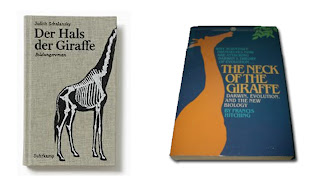


Second hand shops and fete stalls are great places to find books and the most exciting as you can often get lots and lots of books for a few dollars.  I get carried away and end up with books we never look at and which we donate to the next fundraiser.  Last year I packed up a box of books for a school stall, including The Living Planet by David Attenborough.  On the night of the fete I was with my son and his girlfriend, also Mel. She browsed through the book stall, picked out a few to buy and held one out to show me.  "I wonder if this is real", she said holding the book open at the title page. There was a signature -  David Attenborough, it said.  I looked at the cover and it was the book I'd donated, that I'd bought second hand and had been on our shelf at home for at least five years!  Of course we paid the 50c for it. Mel has it on her book shelf now and she recorded the event with a photo layout.


Famous people are often asked what books sit on their bedside table.  As I don't read in bed I can't answer that except to say I think I have a book on patchwork and quilting there, but my husband, Rory, has some favourites that come and go -  a variety of Bill Bryson and Lee Strobel books, plus Sherlock Holmes, Red Dwarf and a huge book on creation. Rory reads books that are given to him or recommended by friends, so doesn't often choose a book unless he is following a particular author or series. He has collected the James Bond novels and books by Wilbur Smith.


My book pile is in the dining room and on the top is How can I use Herbs in my Daily Life? by Isabell Shipard, who lives locally. I am no expert on herbs which is why this book it always on the top. I'm actually more interested in the medicinal qualities of herbs than how to grow them but that should come, I hope.  I my pile to read is Frank McCourt's Teacher Man, Dubliners by James Joyce (I love short stories and my son lived in Dublin last year so...), a P.G. Wodehouse novel, The Girl in Blue, various books on writing and the English language like Bill Bryson's Mother Tongue,  plus patchwork magazines, cross word puzzles and I've just started In Cold Blood by Truman Capote - because I've never read it. 
We were both introduced to reading by our mothers who bought books and read to us at an early age. The Color Kittens was my favourite and I think sparked my enjoyment of interesting book covers.  I joined the local library when I was 10 years old and devoured their entire stock of children's books in two years including the whole series by Lucy Fitch Perkins on twins around the world.  Two old ladies ran the library in a room behind a shop and their book numbers were limited.
 As the closest Council library was out of my reach I attacked the book shelves at home. Dad read classics and war stories and Mum read Readers Digest condensed novels and whatever was popular. I found her books in a suitcase under the bed and read The Carpetbaggers, Mila 18 and Exodus.


I have not, so far, ventured into digital books. I think my hard copy pile-in-waiting will keep me busy for a while yet and then I have stories of my own to write and edit - digital may be the way to go when I am ready - and it will be interesting to see how we choose books from a digital range.


Friday, 1 February 2013

ON WRITING ...


Oh look!  I've pinched the title from a clever writer and added ! to make it mine. On Writing by Steven King is one of the most helpful books I've read. Part biography,  the story of King being run down on the road while jogging and coming back from that - interesting,  and part advice on writing. Amazing. To have that information, from this successful and experienced writer is like finding gold -  or better, the information shared by Steven King changed the way I approach reading and writing.


However,  I am not a Steven King reader, I'm not even sure if I've read any his books, except this one. Certainly not any of his scary stories.


For something like ten years I enjoyed being part of online writing groups. Most of these were critique groups.  All members posted a chapter of whatever they were writing - mostly novels for middle grade readers, around 10 to 14 years. We read and either reviewed these or wrote line by line critiques, which I loved doing, depending on the group.  In one short story group members took turns setting assignments, one every three weeks. We'd all do the assignment and critique the results. Mostly these were to write a story. One of the assignments I set for everyone was to write a story in dialogue only - no speech tags, no descriptions,  just the dialogue - my favourite task. Someone else set us to write about why we write. That was difficult. It was interesting to find this again and read what I'd written back then.

-------

28.03.2004   Looking at the last few assignments and knowing how far they stretched me, how they have improved my writing and uncovered weaknesses, I wonder just what I want to write and why.

What I know - I like writing for children. I want to give them something, tell them things they would not know if they had not read my story.
But my writing is not cute - no talking teddy bears,  it's not funny - so no Adrian Mole.  It's usually about coping with serious issues like step parents, feelings of rejection, illness, loss... all very serious stuff and in the past rejected by publishers for that reason.  'Subject is too serious'.  So? I'm a serious person!

To improve - to make my stories richer I'd like them to show that in spite of the serious issues we often face life is still wonderful - it's worth it!
What started me on this track? -  I think it's just who I am. I was 'making up' stories at the age of 2 or 3 years. My first story involved a pair of bunnies, with six babies, who adopted another baby who was different.  Yes, I know that's a cutsie-pie story - I had a collection of plastic toy bunnies and as inspired, by the colours. They were all shades of green but one odd one was blue,  so he was different. The adoption didn't change him but they were a family all the same.  30 years later I did just that, took a foster child into my family. It was supposed to be 18 months and ended up more like 18 years plus.


So, looking back at the stories that impressed and inspired me to write - I read all the Secret Seven and Famous Five books at a very young age. I enjoyed them but knew they were not real. I got through the children's classics like Black Beauty, Heidi, Kidnapped, Robinson Crusoe, Tom Sawyer and they were okay but not special. Blinky Bill and the Gumnut babies frightened me and I still avoid Banksia trees.


Two books that made a bit impression on me, because they were much better stories - The Happy Prince by Oscar Wilde, (a collection of short stories published in 1888) and The Water Babies by the Rev Charles Kingsley, published in 1963 - such wonderful illustrations. These were the books I loved at 10 years of age. 

So, then onto grown up books, raiding my parent’s collection and the library. More fantasy.  I threw The Carpetbaggers away because at age 12  I thought it was total rubbish - my mother enjoyed reading but usually stuck with the popular titles that everyone else read.  I tried the classics and found idealistic fantasy. I was not easy to please.  Dickens, no, I hated it. Dad's books were mostly war novels and they did keep me busy but only one stands out in memory, The Cruel Sea, by Nicholas Montserrat.  At times scenes from that book pop into my head as if to say ... could you handle this, now?

I picked up The Little Prince, by Antoine de Saint Exupery, pub 1943. I'm still learning from the little prince - though try not to be too involved in the story because I fear there is something distasteful there.  The original illustrations are lovely.

But, the greatest treasure I found in my early teens - a little book of incredible beauty, with black line illustrations that I loved. It was The Snow Goose by Paul Gallico. This was a little bit of fiction inside a true story. And what a story!  I was inspired.  I wanted to write stories like that, stories that caused the reader to choke on their breath.

The next precious stone for me was Catch 22 by Joseph Heller. I bought it from a newstand in the street on the way to a bus stop. I was thrilled to read it.  I read favourite bits over again, talked about it and quoted it.  I knew it wasn't in my personality to write like that, but wow, what a book! It gave me an understanding of the world and how it works.

By this time I was over 21 and devouring every book I could get. Someone gave me The Hobbit, by J. R. R. Tolkien, to read and I discovered, in that gem, the idea of journey and overcoming. Of course this was in The Water Babies and other stories too, but I hadn't been able to grasp it consciously before.

I don't have these three books on my desk. I don't read them over and over. The spirit of them is inside me. I feel I have absorbed the stories and I'm waiting to see what I have nourished.  I don't plan my writing, I just begin - often not knowing the direction I'm heading in but enjoying the scenery along the way.

----------

Today, reading over my thoughts from 2004 I am disappointed to find not much has changed. I have not met my goal of being published, apart from a couple of short stories and bits in newspapers and obscure magazines back in the 1990s - nothing that really counts.  And it is probably because I don't work at it like some do - because I do not want to be a salesman. So that's my reason and that's okay.

I have read more books but nothing really outstanding. It is possible I've kept away from outstanding books because life gets in the way of that sort of commitment.  I enjoy all The Number One Ladies Detective Agency series by Alexander McCall Smith - simple, sweet philosophy, beautiful tales of gentle people written with understanding - I love them.  

I've also discovered Language Change by Jean Aitchison, and some other similar books,  which release me from becoming what they call a 'word nazi'.  


If I had to pick a modern novelist favourite I'd say Kate Atkinson - her story construction and character building is amazing.  It takes a while to get into step with her but when you do it's like solving a clueless crossword puzzle, an enjoyable achievement. And here it looks like I stopped by the shelf for authors starting with A.

I have been busy with other activates since 2004, enjoyable but time consuming, mostly involving the production of a school yearbook for eight years. I have written very little in that time, except in my head.  There are lots of stories in there.  I know my writing is not literature or philosophy, I just make up stories about made up people -  based on true stories and people, and often any deeper meaning within is invisible to me.  
So now to a blog. This will be writing about things that are not made up and that is actually more difficult. I will continue to write for me though.  Of course writers should write for an audience but I feel the reading of it is not my area; the subject, the story and writing of words is the bit I do.


  ----------------------------------------------


There is a comments facility below for your responses
but it's not like facebook
there is a process to keep the spammers and hackers out.  

Click comment, 
type in the box and then 
select from the drop down menu for your identity (anonymous is fine if you aren't on google) and then click publish - but that's not the end .....
you will be asked to 
retype some numbers and letters into another little box, it's not the easiest thing to do, but if you get it wrong you get a second turn.... like a game.  

Once you've done it you'll find it easier the next time, 
and I will reply to your message so it's worth it....  
 (smiley face)
--------------------------------------------------------------------