Thursday, 4 April 2013

OIL PULLING for your TEETH


Isn't it interesting how something will suddenly come into fashion and then, just as suddenly, fade away and you wonder what that was all about? Then something else, that is tried and true, gets bumped out of your life by a new gadget.


Oil pulling is having a revival this year. Either you've never heard of it or you do it.  I've been practicing oil pulling for about two years - not every day now but at least once a week as it fits into my routine. I mentioned it to my dentist once but he'd never heard of it. 'I can't see that it would hurt you,' he said, a little doubtfully.  So, oil pulling has to do with teeth - with cleaning the teeth, and the mouth and it works. 
Oil pulling is a traditional Indian folk remedy - thousands of years old, older than toothbrushes and toothpaste - and it involves swishing oil around the mouth, pulling and pushing it over and between the teeth gently, to remove the bad bacteria, to reduce plaque, to prevent inflamed gums (gingivitis) and reduce bad breath (halitosis). All this is good news for our mouths.

The best oils to use are light in flavour, sesame and sunflower are good. One day I was out of sesame oil (my favourite) and took a gulp of the delicious organic olive oil I cook with everyday and erk... too strong, too thick, gave me a sore throat and I coughed it all out.
Sesame oil
Coconut oil is gaining popularity for many uses - to soften skin and hair, to relieve itches and insect bites, to prevent dementia, to cook very tasty eggs and to cook lots of other yummy food. In fact it tastes so good you wonder how it can possibly be good for you. 
Cold pressed coconut oil
So, I tried coconut oil to clean my teeth. I found that it is not quite as effective as olive oil. Coconut oil is lighter in texture and does not foam the same way as olive oil and there is a temptation to swallow it. In fact I swallowed most of what I had in my mouth before I realised. As the idea is to spit out the used oil this is not good.  When I had finished my mouth did not feel as clean so I brushed with a tooth brush and water. My teeth felt good but the coconut oil had not cleaned the rest of my mouth as well as olive oil. This is possibly because the coconut oil becomes watery and does form an oily foam.  I'm sure this might suit some people so try it, but also try another oil so you can compare. 
If the coconut oil is in solid form you just hold it in your mouth, gently chewing, until it liquefies.

The procedure:
First thing in the morning, before rinsing your mouth or drinking or eating anything - take one or two teaspoons of light oil, hold it in your mouth and slowly begin swishing it around your teeth, pulling it between your teeth, over the tongue, inside the lips and cheeks. It's just a gentle motion to keep the oil moving in and out of every nook and cranny, like a mouth wash. The oil will pick up and hold any impurities.

Swish for 15 - 20 minutes - have a shower or choose your clothes for the day, make the bed or go for a short walk. The action of the mouth will be exercising your jaw and cheek muscles too. The idea is to swish until the oil has mixed with saliva to become a white frothy mixture with a yellow stain.

Spit it all out. Do not swallow. I was advised by a wise old Indian to not spit it onto the ground where it will soak get into the soil, or an animal could find it, because it is contaminated - so spit into a wad of toilet paper and flush away.

Rinse your mouth with water, swish and spit again. You can brush with a toothbrush, but no tooth paste, water alone is enough. 

You'll find you not only have squeaky clean teeth, but also a clean tongue and mouth.  And that is oil pulling.

Now you may start your day.


I wonder if my dentist went home and tried it. 


Count the garden by the flowers, never by the leaves that fall. 
Count your life by smiles and not the tears that roll.

-------------------------------------------


There is a comments facility below for your comments or encouragement - but it's not like facebook, there is a process to keep the spammers and hackers out.  

Click comment, 
type in the box and then 
select from the drop down menu for your identity (anonymous is fine if you aren't on google) and then click publish - but that's not the end .....
you will be asked to 
retype some numbers and letters into another little box, it's not the easiest thing to do, but if you get it wrong you get a second turn.... like a game.  
Once you've done it you'll find it easier the next time, 
and I will reply to your message so it's worth it....   (big toothy smiley face)

                                                     --------------------------------------------


Sunday, 31 March 2013

using the herb COMFREY

I've been in love with the herb comfrey for about 40 years but have not had it growing for half of that time.  We moved around at bit over the years and I haven't had a suitable place to plant it - but now, at last there is a garden and plenty of space to grow this incredible herb.  Comfrey likes to settle in for a long stay, in fact there is an understanding among herb growers that  - you plant comfrey knowing it will still be growing there long after you have gone.


Hairy comfrey leaf, freshly washed


Comfrey sends tap roots 3 metres down into the subsoil (about 10 feet) to find the yummy nutrients that make it the wonderful herb it is,  so a mature plant would be almost impossible to move, or remove. Comfrey is grown from root cuttings and any broken piece of root is a potential plant - you can cut away part of the root without destroying the rest. The author Jackie French tells of accidently ploughing over some comfrey plants, cutting them into small pieces, and she ended up with a paddock full of comfrey. A lucky accident I'd say.


Some leaves are eaten before I can pick them

The comfrey leaf is surprisingly hairy, thick, and sometimes bitter to taste. Flowers can be purple, pink or white and I'm delighted to discover this week that mine are purple.  The harvesting advice I've read is to harvest while in flower but others suggest waiting until the plant is over 60cms high (2 ft) but I pull leaves off whenever I want them.  I often have to race the insects though - they know it's an amazing plant.

So, what is it good for?

Comfrey plant a few months oldSo, what is it good for?  
Comfrey has been used as a healing herb forever - recorded use goes back to 400BC.  Originally from Europe comfrey was used by the ancient Greeks and then European settlers discovered the Native Americans also made good use of the herb. There is a wealth of information available in books and on the net. I've been reading about comfrey for many years, but these days I read and re-read Isabel Shipards book  - How can I use HERBS in my daily life?  One reason is she lives locally, so what grows at her place should grow at mine - the other reason is she provides so much information you feel full. But I do also look into YouTube to watch people making salve, ointments, fertilizer and doing other interesting things with comfrey.


TO USE ON THE OUTSIDE: The leaf and the root can be used as a poultice, a tincture, ointment or just the raw leaf (chopped with a little oil or hand cream to hold in place) as an external application for the healing of;  boils, bruises, burns, coughs and colds, cramps, eczema, inflammation, insect bites, fractures, gout, joint pain, rheumatism, skin ailments, sprains, strains, swelling and more.

Comfrey is also a softener for skin and hair. Make fresh comfrey 'tea' from a few chopped leaves, (bring to the boil in water, stew until water is green, cool, strain) and pour it over your head as a final rinse for soft and shiny hair. Make this fresh each time. You can also add a stronger comfrey 'tea', from fresh leaf or powdered root, to your bath water.  You'll find different ideas about making comfrey 'tea' on the internet.

With such wonderful healing properties comfrey is good for the skin and a comfrey oil can be used as body lotion and as massage oil for tired, sore feet. Rub it on your legs after your shower to deal with all those little cuts and scratches you get and to help with varicose veins and aching joints. Many different recipes for making the oil and ointments, are to be found on the internet.

A WARNING: Do not apply comfrey to deep open wounds or if infection is present as it's healing powers can work so well that surface healing may begin before the underlying wound has healed properly and skin healing over an infected wound is not good. It's better for a deep wound to heal slowly from the inside out.

Comfrey salve or ointment - comfrey infused olive oil
added to melted beeswax.


TO USE ON THE INSIDE:  Comfrey has also been used as a tea to drink, nibbled straight from the plant or as a food with the leaf eaten raw in salads or cooked in stews and soup to;  relieve allergies, anemia, asthma, bladder problems, bronchitis, coughs and colds, digestive problems, fatigue, fever, gallbladder problems, hay fever, psoriasis, respiratory and lung ailments, sinusitis, and more.

BUT I MUST ADD THIS DISCLAIMER: Do not eat or drink tea from any plant you have not fully studied and identified properly. Please consult with your local alternative herbal care specialist before using herbs you are not familiar with. In some areas internal consumption of comfrey is not encouraged, for a variety of reasons.


IN THE GARDEN:  I must make it clear that I am not a gardener. I sometimes say I am an organic farmer, but in reality my husband is the organic farmer and while we chat about the work and make farm decisions together, for me it is theory.  I don't dig dirt or pull weeds. The actual work I do is paying accounts, keeping the books, labeling boxes and making phone calls.  My interest in herbs is for food, health and treating ailments.

In the kitchen garden comfrey is a wonderful fertilizer, especially for tomatoes. I have a bucket of, what is also called 'tea' waiting to be used as fertaliser - a half cup full added to five litres of water, sprayed around the veggies makes them very happy and healthy. I might experiment with some of our ginger plants one day.


Comfrey fertaliser ‘tea’ - I pick the leaves and let them dry out for a day or two
before putting into a tightly covered bucket, just covered with water. This is
two months old and almost ready. Add half a cup full to five litres of water and
water your vegetables.

The leaves also make a rich mulch. When I find dead leaves around a plant I leave them to mulch the parent plant and find they are quickly absorbed into the surrounding soil. Comfrey leaves and stems can be used to accelerate the action of your compost heap. Many websites offer advice on how to make the fertilizer tea and how to use it in compost.

I have heard that when fed to cows comfrey aids milk production and gives longer living, healthier cows, but I've not had any experience with that. I've also heard that horses will eat it but I imagine if it was used regularly you'd need a huge amount of leaves and you'd have to have a comfrey farm. I know chooks like it, but don't seem to seek it out like caterpillars do. A few days ago R spotted a wallaby in the comfrey garden, but I can't say it was comfrey that brought it so close to the house.

Our beloved dog, Rufous, is 12 years old and while he has survived cancer in the past, he now has several more tumours growing on his body and something wrong with his digestive system. The vet doesn't know any more about his stomach problem than we do. We have decided not to put him through the trauma of more surgery to remove misc growths at his age, as he has had more anesthetics than most humans.  I am giving him comfrey in his food and also rubbing it on, and if it does not fight the cancer I hope it will at least give him some quality of life for the time he has left.


Rufous under the frangipani

Last July I bought 5 comfrey roots to grow. I kept them in self watering pots until they had decent leaves, before planting in the garden under my frangipani trees.  I'm not sure if this is the best place for them as they do not get a huge amount of direct sunlight, but they will have the sun for the winter months. The insect damage is the worst problem, as they eat more of the herb than I pick. I do know what type of comfrey these plants are and where they came from.
Then in October I was given an exciting birthday present in the form of a plastic bag of woody bits and dirt, which I recognised as a comfrey root! What an amazing gift!  I had been speaking to an interesting lady at a school fete, and we got onto comfrey, which this lady had growing in her garden. I told her how I'd used a comfrey poultice when I cracked the bone in my elbow. (I made the poultice with leaves from my mother-in-law's comfrey plant, which is twenty years old and a lot stronger than my little babies). A week later that ladies daughter sprained her ankle, so she dug up her own comfrey root to make a poultice and also sent me a clump of twisted root as well. Some of this root I used to in oil and the rest, seven pieces, I planted in my home made pots. Two pieces failed to root, possibly it was the wrong section of wood. As our weather has been extremely wet I've been protecting them and they are not in the garden yet - I'm still looking for the right spot, but that is a job I'll be doing this week.  I plan to put them on the other side of the garden to my first five plants because I do not know their history and I'm not sure if it's the same type of comfrey.  I'll be taking my own advice above and waiting to have it properly identified.


Baby plants waiting for a permanent home

After an eight month wait I'm very excited to find that one of my original five comfrey plants has flowered. This little one, below, was left as a sort of control plant, mainly because it was hard for me to reach. I've already used leaves from the other four plants to make oil infusions, tinctures and ointment, and I'm looking forward to experimenting more with comfrey recipes as all my plants mature.

Purple flower on a full grown plant


The early bird might get the worm, but the second mouse always gets the cheese.


Tuesday, 26 March 2013

choosing a BOOK


I am always very tense to the point of being frightened at the dentist and usually there is nothing I can do to distract myself from that. But one day, trembling in the waiting room chair I forced myself to  look at a newspaper, left on the chair beside me and folded open to a page of book reviews.  The lead article was about the 'humble little book' that had taken New York book stores by surprise. 

And that's how I discovered the  No. 1 Ladies' Detective Agency series, by Alexander McCall Smith. I was able to get the first two books in the series then, and we are now up to No.13.  I buy them all and have a special book shelf for them.  I love the stories of Precious Ramotswe in Botswana,  and I love the story telling style that is sweet and simple, often seeming to state the obvious by our 'sophisticated' standards, but in the search for understanding why people do the things they do, it is just right. Alexander McCall Smith is a philosopher and that is the approach he takes to writing. And yes, there is a TV series now, and while it's a little different to the books, it follows the same stories and is lovely to watch.  These books show a simple world, like going back to the 1950's, and create a place to visit, escape to and hide. 

Alexander McCall Smith writes several series of episodic novels, though I've only ventured into two of them. The Isabel Dalhousie books, Sunday Philosophy Club, is one series, and 44 Scotland Street is the other. 
I like the Scotland Street stories which follow the lives of a group of people who all lived in the same building, at 44 Scotland Street, Edinburgh, in the first book, and though several have since moved out they still appear.  Bertie, the six year old saxophone player with an eccentric mother, and Cyril, the dog of an artist whose best friend lives at number 44, are my favourite characters but I won't spoil it further for those who would like to read the books.  My only complaint is that these books are too short, can be read in a weekend and then I have to wait a year or so for the next one.

Some book discoveries remain very clear in my mind. One winter morning back in 1967, I was on my way through Taylor Square in Darlinghurst, Sydney - to catch a bus to the city. On the corner, where the Bird Cage Nightclub used to be was a news stand. A man set it up in the very early hours of the morning, with folding tables and stands, and took it down before the night life began. On this particular morning he had new books on display and I reached for an interesting title and bought it.  He asked me to let him know if it was any good. I'd never heard of it before but it turned out I'd chosen a book that is often cited as one of the great literary works of the twentieth century.  It was Catch 22 by Joseph Heller.  Yes, it's been made into a movie, but I think it's easier to follow the movie if you've read the book first.

Two other favourite books came from reviews in the Women's Weekly. The Life of Pi was one. I had heard of it before, then after reading the review I bought it - I prefer to buy books rather than borrow them, probably so I can keep the ones that are really special.  I know it's unfair to the author, as they only earn from sales of new books, but many of mine are second hand. I kept Life of Pi.  

The other one was called Started Early, Took My Dog.  Again, I liked the title. The book cover says it's Kate Atkinson's best work to date!  Well, I'm sold.  It was hard going to start with but  once I was in tune with her writing style I found I really enjoyed the story, the characters, the little asides, the sudden switches from one scene/person to the next. I soon discovered this was the last book in a series of four, so I went online and ordered the first three, from different sellers and they didn't arrive in order so I had to wait until I had number one.  But, what a luxury!  I had four books in a series I really enjoyed and I got to read them like one very long novel. Though, the fourth title later became a disappointment because the dog who gets to start early with Jackson Brodie, described as an unlikely but utterly addictive detective and I agree,  is not actually his dog.  I soon went into Kate's other novels, also good, but the Jackson Brodie books are the best. 

Another source of recommendations is TV, in particular The First Tuesday Book Club, hosted by Jennifer Byrne - renamed 'Book Club' for 2013 - I suppose so it doesn't limit them to Tuesday.  As well as new books I've been encouraged to revisit ones I've read before and older books I might never have thought to read.  I have a list from the Book Club that I want to read one day.  The Light Between Oceans by M.L.Stedman is one of those, as is Gilgamesh by Joan London.  I'll wait until I find preloved copies at a good price. In the meantime I have revisited Catcher in the Rye and The Selfish Giant and have discovered new books, and some I've enjoyed a lot, like The Book Thief  by Markus Zusak, which I was put off reading until this cover came out - and just last month,  Daughters of Mars by Thomas Keneally. He writes about two sisters, from a dairy farm in NSW, who trained as nurses and went overseas during WWI, to nurse the wounded at Gallipoli and in France. Two of my grandmother's sisters, my Great Auntie Ada and Great Auntie Claire, from a dairy farm in NSW, went to France as nurses during WWI - one drove an ambulance.  Not the same story, of course, but details of their lives and events are a little more real to me now.

Sometimes it's fun to read books with other people.  My mother in law borrows 40 books at a time from the library. We've both enjoyed all the Jennifer Chiaverini novels in the Elm Creek Quilts series and they have given us something to day dream about. My favourite is The Runaway Quilt which dips into history, touching on the use of quilts and quilt patterns as signals for runaway slaves.  Then my niece had an Amish period and we shared and swopped Amish novels, mostly in series of three and mostly love stories.  They were relaxing to read and fun to talk about.  I was inspired to read The Slap by Christos Tsiolkas, after watching the min-series.  It was disappointing that the book is so different in several areas and I think the screen writers did a wonderful job on the story, making it much more interesting.   
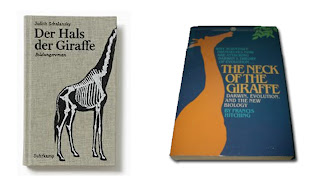
Finding books can be an adventure in itself.  Recently my lovely friend Mel, who lived with us as a school girl back in 1989, mentioned she was reading a book called Der Hals der Giraffe. I translated that as The Neck of the Giraffe and found the title, written by Francis Hitching, about missing links in the theories of Charles Darwin, that is transitional links between supposedly evolved species.  As we'd been discussing exactly this subject at home that week I ordered a copy. It was actually out of print, but plenty of second hands available.  Excitedly I emailed Mel in Germany and said, 'We are reading the same book'.  Mel replied, saying she didn't realise Judith Schalansky's novel had been translated into English. Hmmmm. I looked again and this time translating a whole web page, instead of just the title, found that Judith Schalansky wrote a book called The Giraffe's Neck about a biology teacher fighting to adhere to the laws of nature, straining her neck while eating forbidden fruit and eventually losing faith in her personal God, Darwin.  Hmmmm.  Maybe not exactly the same book.  Babel Fish strikes again!  


Second hand shops and fete stalls are great places to find books and the most exciting as you can often get lots and lots of books for a few dollars.  I get carried away and end up with books we never look at and which we donate to the next fundraiser.  Last year I packed up a box of books for a school stall, including The Living Planet by David Attenborough.  On the night of the fete I was with my son and his girlfriend, also Mel. She browsed through the book stall, picked out a few to buy and held one out to show me.  "I wonder if this is real", she said holding the book open at the title page. There was a signature -  David Attenborough, it said.  I looked at the cover and it was the book I'd donated, that I'd bought second hand and had been on our shelf at home for at least five years!  Of course we paid the 50c for it. Mel has it on her book shelf now and she recorded the event with a photo layout.


Famous people are often asked what books sit on their bedside table.  As I don't read in bed I can't answer that except to say I think I have a book on patchwork and quilting there, but my husband, Rory, has some favourites that come and go -  a variety of Bill Bryson and Lee Strobel books, plus Sherlock Holmes, Red Dwarf and a huge book on creation. Rory reads books that are given to him or recommended by friends, so doesn't often choose a book unless he is following a particular author or series. He has collected the James Bond novels and books by Wilbur Smith.


My book pile is in the dining room and on the top is How can I use Herbs in my Daily Life? by Isabell Shipard, who lives locally. I am no expert on herbs which is why this book it always on the top. I'm actually more interested in the medicinal qualities of herbs than how to grow them but that should come, I hope.  I my pile to read is Frank McCourt's Teacher Man, Dubliners by James Joyce (I love short stories and my son lived in Dublin last year so...), a P.G. Wodehouse novel, The Girl in Blue, various books on writing and the English language like Bill Bryson's Mother Tongue,  plus patchwork magazines, cross word puzzles and I've just started In Cold Blood by Truman Capote - because I've never read it. 
We were both introduced to reading by our mothers who bought books and read to us at an early age. The Color Kittens was my favourite and I think sparked my enjoyment of interesting book covers.  I joined the local library when I was 10 years old and devoured their entire stock of children's books in two years including the whole series by Lucy Fitch Perkins on twins around the world.  Two old ladies ran the library in a room behind a shop and their book numbers were limited.
 As the closest Council library was out of my reach I attacked the book shelves at home. Dad read classics and war stories and Mum read Readers Digest condensed novels and whatever was popular. I found her books in a suitcase under the bed and read The Carpetbaggers, Mila 18 and Exodus.


I have not, so far, ventured into digital books. I think my hard copy pile-in-waiting will keep me busy for a while yet and then I have stories of my own to write and edit - digital may be the way to go when I am ready - and it will be interesting to see how we choose books from a digital range.


Friday, 22 March 2013

using OILS AT HOME


I'm happy to say I've enjoyed a very busy life. I've always had plenty of interests and hobbies, work I enjoyed and self improvement study. And there was house work, organising the family, health issues, friends, extended family and associated problems plus the children with all their interests including pets, homework, sport and other activities.  So, along the way I've had to decide that some things did not fit into whatever space I had left. Understanding how a car works was one thing I did not have room for and physical exercise was another.  One person cannot do everything.

Kambucha tea
I've always had an interest in health and natural remedies.  For years I talked to people and read what I could on naturopathy and herbal medicines, then using what I had learnt, diagnose and treat my family and myself (naughty girl). I did start some naturopathic study once but life got in the way. I am not a person to take things at face value though. I like to know what I am getting into so if something was recommended I would investigate ... things such as bark therapy (not for me), acupuncture (not for me), fasting (maybe occasionally), kambucha tea (eerrkk) reiki massage (seems a bit airy-fairy), aromatherapy (expensive and vague area), homeopathy (I don't understand it) and chiropractic (first experience was a bad one) were some areas I touched and then put aside.  Until recently. My wonderful physio therapist found a different job and I was desperate to find one who could treat the ongoing problems with my damaged neck and shoulder and ended up at the chiropractor.  It seems chiropractic has come a long way in the past 25 years and my shoulder and neck are being treated very well - as long as I take breaks from the computer.

However, I digress - and that's not like me at all!  Lets wind back to aromatherapy.  I don't know what I thought it was but I ignored it because I just didn't have the time. Then my sister emailed me about success she was having with some 'new' oils she was using for chronic bronchitis, so I read about it and found that using essential oils can be called aromatherapy - .  It never occurred to me that I already practiced a type of this therapy, many of us do when we massage Vicks Vapour rub or eucalyptus into chests and make menthol packs for colds and flu or burn scented candles. That's basically what it is.    

Avoiding the airy-fairy feel-good attachments to many alternative remedies, this area of alternative medicine uses essential oils distilled from herbs and flowers to improve personal comfort and health and to heal - just like my mother and grandmother did. My mother used eucalyptus or Vicks, rubbed onto the chest for infections like bronchitis, or spots of the oil on the pillow case for sinusitis. She massaged it into our feet and put us to bed in cotton socks for colds and flu. I always loved her honey and lemon juice sipped from a spoon, in the middle of the night, for a sore throat or the misery of a cold (but that, apparently, is naturopathy). As I suffered chronic sinusitis I learnt, at the age of eight, how to prepare an inhalation and everyone understood that a menthol lozenge would to 'ease the throat and clear the head'.

The essence of the oil is absorbed through the skin or inhaled - but let's keep it away from eyes and sensitive areas.  The brain is stimulated and muscles relax so you can rest or sleep. Blocked sinus passages can be cleared and mucous membranes strengthened. But beware, commercial oils can be very concentrated and some are poisonous so care is needed when handling them.  And, if you are allergic to any food or herbs, you could be allergic to the oils too. 

Lavender
Oils can be antiseptic, antiviral, antifungal and antibacterial, such as Tea Tree.  Brochures available at health food shops list a wide variety of oils available and what to use them for.  I look down the list and always want to buy the lot, but I've learnt the hard way, they are expensive - some over $30 a bottle, and they have use by dates. You could use very little of some oils and end up throwing the bottle away. Apparently it's much cheaper to make your own oils and there are instructions about that here - 

http://www.wikihow.com/Make-Essential-Oils

As the oils are very concentrated they are usually mixed with a 'carrier' oil before applying to the skin in massage.  Carrier oils are made from nuts and seeds which can cause allergies in sensitive people so the use of these essential oils must be tailored to the person being treated. You can substitute a light tasting/smelling olive oil for the expensive carrier oils. And if it's all too messy and too fussy, just use a blob of plain, low fragrance, hand cream in your palm, add one or two drops of the oil and mix together before applying to feet, chest, back etc.

I have never used oils with babies, in my family, apart from a little eucalyptus somewhere in the room, so I'm not sure what oils can be used with little ones - maybe consult a professional first. When one of my children needed it I used a steamer in the room, without oil. When I say children I mean from about age two and up. And take care they don't rub oils into their eyes.


So, oils can be used three ways.

Topical application - the oil is applied directly to the skin by massage or soaking in a foot bath or a whole body bath.

Aerial diffusion - the oil evaporates into the air disinfecting the room and treating the patient.  This can be done through a commercial diffuser, or in an oil burner. A hot scented heat pack, usually lavender, can bring comfort too.

Direct inhalation - the oil is inhaled to treat respiratory infection or decongestion. Boiled water is poured into a bowl and a few drops of the oil added. The patient holds their face over the bowl breathing in the steam, and the oil.  When I was young my grandmother insisted I have a towel over my head to avoid wasting the steam, but it is stifling inside that hot 'tent' for child and could possibly lead to burns, so I never do that now. You could make a larger tented area with a sheet if needed. Oils in the bath can be inhaled too but the bath needs a really good clean out afterwards and I got sick of scrubbing away greasy eucalyptus tide marks. In fact all oils are inhaled to a degree, from massage or spots on clothing or candles.

Some useful oils to have on hand would be,

Eucalyptus  - This is the first bottle I reach for when I I have a cold or flu. It clears blocked airways and. I feel, can help to prevent the infection spreading from head to chest. Eucalyptus does not need a carrier oil before applying to the skin for adults, but maybe you should dilute it with young children. And we all know eucalyptus comes from Australia.

Lavender  -   I've found to be an aid to relaxation.  Massaged into neck and temples it can give relief from some headaches. It is also used as an antiseptic and pain reliever for minor cuts, burns and insect bites. It can be used in massage for muscle pain or in chest rubs. Some people add Lavender oil to a hair rinse to treat head lice. It is a traditional 'old lady' perfume, used in soap and talc.  Lavender originated in Europe and now grows widely across the world.

Sandalwood - I love the smell of sandalwood and use it as a comforting chest rub or foot rub.  I find it helps me sleep when I'm not feeling well. Sandalwood originates in India and is used in cosmetics and as a perfume.
Tea tree - I use it for its disinfectant and antiseptic properties - very handy for insect bites and apparently it can be used as a mouth wash.  During WWII Australian soldiers carried Tea Tree oil in their first aid kits. It's a little strong to be a perfume but you do get used to it.

Cloves - I use the oil in damp weather to discourage mould. The bottle I have is extremely concentrated and a stray drop can be smelled on the skin all day, and I don't like the smell.  Apparently is it a topical analgesic, or painkiller and I know it was traditionally used for toothache. My grandmother didn't use oil, she would just put a whole clove in her mouth and bite down!  It can also help with nausea but I'm not sure how.  Apparently cloves are native to Indonesia and can be used as a tea.  I'll have to look into that as I'm becoming in interested in teas lately.

Citronella - This oil is a great insect repellent. Used in soap, candles and incense to repel insects it is sometimes called the mosquito plant.  It grows in pots and is handy to have in outdoor living areas.  Apparently it is also good to calm barking dogs. I think they put it into those spray collars, but I've never used one.


And that's the news on good oils.