Sunday, 12 May 2013

about PATCHWORK ...


I love patchwork, I love looking at patchwork and pictures of patchwork. I have stacks of magazines and books and I watch youtube clips on making patchwork. I have made patchwork from fabric and wool and paper. You can stitch, knit, crochet, glue, carve, plant, cement or nail a patchwork.  You can buy fake patchwork with the patches printed onto fabric but real patchwork is made of small pieces or patches, joined together following a set design, or strips of fabric joined and re-cut and joined again. New designs and patterns are constantly being made and with endless variations it would be most unusual for a quilt to be repeated exactly.

This is a small section of a Bargallo quilt, made for me by my friend Alison.
It's an example of how beautiful patchwork can be.


Decorating with mosaic tiles is a bit like patchwork, as is laying a patterned pathway or planting a flower garden in a particular design but we usually associate the word patchwork with sewing fabric. And that brings up the image of quilts - as many quilts are made of patchwork, which is why they are called patchwork quilts. There are other quilts,  'whole cloth' quilts that are not patchwork at all.

Crochet squares.
Back in the days when my fingers and wrists were nimble, and I could successfully multi-task, I crocheted many small squares and circles from different coloured wool or cotton, and joined these pieces to make patchwork shawls and baby blankets and waistcoats. Thousands of women of all ages around the world do the same, some of them creating amazing works of art in wool, just with their fingers and one little hook or with two knitting needles.

I made my first patchwork on a hand operated Singer sewing machine in the corner of the kitchen.  It was a blanket for the very large rag doll I had also stitched on that machine. The sewing machine had been owned by a great aunt and passed on to my grandmother who gave it to me. Two years later, when she saw I was into sewing, she gave me her more modern machine which was operated by pressing a bar with the knee.  It was another Singer, one of the first electric machines and it only went forward, no back stick and certainly no zigzag.

I used that machine to make dolls and doll clothes, then all my clothes for 20 years. I've also carried it with me around Australia and it was only recently I discovered the wooden outer had disintegrated. It didn't like being left under the house for the last eight years.  In 1972 I made a full layette, including the bassinet liner and blankets for my first child. My first patchwork bed cover, not quilted, for my baby daughter was made of flannelette squares in pastel lemon, pink and mauve.  Each lemon square was decorated with an embroidered cuddly animal and the backing was white spotted mauve flannelette. Very pretty, and as it turned out, not very practical. The washing machine wore out the flannelette in a few years. 

My 38 year old UFO
Around that time I started looking for books about patchwork - not too many around in those days, but I did find some illustrated history books. So, by the time my daughter was three I had finished a bedspread for her, also not quilted, of hand stitched hexagons - my own design of a tree surrounded by flowers. It had taken me a long time to make even though the hexagons were huge - I did have a young child to look after and a part time job and I'll repeat... hand stitched. Each piece was cut out with scissors and stitched over a cardboard shape before being hand stitched together and the cardboard removed.  We used it but it's never been finished. When I found it recently it looked like the work of a child, possibly because the fabrics were off cuts of other things, not pretty new fashion fabrics specially chosen.  It could be worth fixing, but I'd be tempted to change so much it might not be a good idea.  Quilters and patchworkers call these unfinished projects UFOs.

This blog post is about my mistakes and, as usual, my search for understanding. The quilts I have kept are the those with memories or the experiments, so this is certainly not a display of amazing craft work.  I have a passion for understanding how things came to be the way they are - origins, history, stories all fit into that. But, with my investigation into patchwork and quliting, I didn't look for the source at first, but worked backwards from my own fumbling attempts to translate ideas into fabric.

When I did look at patchwork patterns, I was delighted to discover it could all be done on the sewing machine.  About this time my stepmother bought a new sewing machine and in a moment of unusual generosity for her, she gave me her old machine - rather than trade it in.

Patchwork begins with small pieces, squares, strips or triangles. These are sewn together in a certain pattern to create a block. The blocks are stitched together in rows to make the 'top'. This can be surrounded by one or more borders and finally bound to the backing fabric by a folded strip called the binding. In between the top and the backing a layer of wadding is usually added for bulk and warmth.  I didn't know all this. 

Even though sewing machines were passed around in the family I don't remember anyone, other than me, ever sewing.  Mum and my grandmother taught us to knit and I taught myself to crochet. No one knew about patchwork. There were no classes that I knew of, and I'd never seen a patchwork/quilting magazine. All I had were library books. Being unfamiliar with terms like piecing and blocks and sashing and with a dislike for following patterns I learnt by looking at the pictures and working out for myself how the blocks went together. I made some silly mistakes and did everything the hard way. Now I know there are short cuts and tips to make it much easier, but back then I actually cut a tiny triangle and stitched it to another tiny triangle to make a square.

When my little girl went to preschool I made a sampler bedspread. The idea is to work on different patterns as a 'sample' piece.  Samplers are also used to show off stitching skills. The blocks are separated by strips of fabric, called sashing, so the patterns can be seen better. Most sampler quilts are very simple, like mine, which had 6 designs on 12 large blocks, but some can be real show off pieces for piecing and quilt stitches.

I sold my sampler at a school fete and was given orders for more.  At this stage I'd still not done any quilting, my pieces were just bedspreads with no filling - though everyone called them quilts.  A friends husband worked for a textile wholesaler and he organised for me to get some fabric samples - most 2 or 3 yard lengths.  I soon found that the fabric 'made' the finished product. It's a huge investment though, so I bought a roll of plain calico and a roll of light weight denim (not stretch in those days) and designed my quilts around those fabrics.

The 35 year old checkerboard calico quilt
I continued making and selling my counterpanes (old fashioned word for bedspread).  I was amazed because I didn't think they were very good but people liked them and were happy to pay me. Before long I had 'quilts' on consignment in two shops and was selling and taking orders through a market stall. At the same time I was involved in making leather handbags and belts at home - hand made leather items were all the rage and we could hardly keep up with the demand at times.

One of my early quilts, made around 1978, was just a checker board of squares backed with calico. I had clued up on the wadding by that time so it was properly filled, but instead of binding I put a calico frill around the edge. There was no quilting but I 'tied' it by stitching through the three layers in the corners of the patches and tying that off in a knot. I still have that quilt. It's wearing thin and one day I plan to add new filling and quilt it properly.

Finally I made a red quilt, for my daughter. It was properly pieced, filled and bound but the quilting wasn't the best and some seams have pulled open. This quilt was passed down to my granddaughter, but I have if back now for repairs, which I hope to get to soon, and maybe a great granddaughter will use it one day. 

The red quilt - well used, torn and stained and in need of repair


This was followed by countless patchwork cushions, shopping bags, dressing gowns, rag dolls and other toys as well as the odd quilt. Living in the cold climate of the Blue Mountains, NSW, I had plenty of inside time to fill and this was in the days before computers, internet and facebook. 

When my first son arrived I made boy clothes, especially overalls, which I could draw on, paint or decorate with braid. My little boy came with me to markets and people began asking about his overalls.  I was a bit bored with the patchwork by then so began to make children's clothes instead. I'm a terrible craft worker, always distracted by something new and not very interested in repeating what I've done before.  It's really the design process that interests me.

Years later, still looking at pictures and reading about patchwork I fell in love with the plain fabric Amish quilts and Seminole patchwork patterns. By then I had two growing boys. I made them Seminole style quilt covers, rather than quilts, and this worked well for us. I bought the fabrics from a Sheridan sheet outlet, so it was very good quality cotton. When I pulled them out from the cedar chest this week to take these photos I found them in perfect condition despite ten years of heavy use and longer than that in storage.


The boys quilts with details of the Seminole style patterns.


I also love crazy or scrap patchwork, which includes as many fabrics as possible in more random arrangements, along with embroidery and embellishments. I am very proud of my prize winning crazy patchwork duck. It was my first crazy project and, just for fun, I entered it into the patchwork section of the local Show .... and it won!  It won the overall prize and I was stunned - usually my work is experimental and more naive than professional so this was amazing. The fabrics were mostly curtain samples, I used different types of lace, some of it very old and I used a piece of leather for the beak and it was the beak that got attention and made the whole piece.  
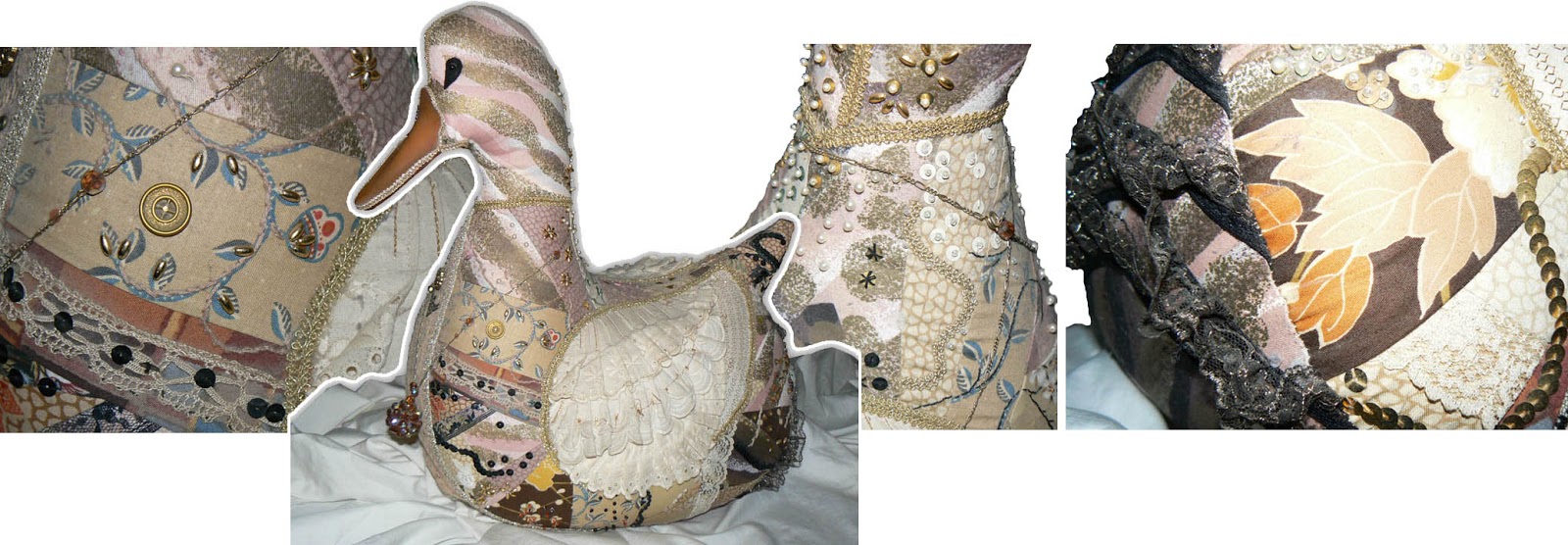

The crazy patchwork duck with details.

Eventually I learnt to quilt, by hand and by machine. Stitching together three layers, a top, a layer of batting and the backing,  is called quilting and the quilting stitches often follow very involved and lovely patterns - one area I've never gone into.  These days most quilts are made of patchwork but before patchwork was developed they were whole cloth quilts. 

Egyptian sailing boat
During those years of my experiments in patchwork I was also reading about the history of patchwork and quilting, the culture that has grown around it and the language within the craft.  Way back in ancient Egypt patchwork was used to make sails for fishing boats on the River Nile - I find that very interesting. As I've also done a little (and I mean tiny little) bit of weaving I understand that the size of the loom limits the size of the cloth. If you want a big piece of cloth you take the lengths from the loom and sew them together to make a wider piece - and that would be patchwork, of a sort.

Remnants of patchwork have been found in ancient China and illustrations show that it was probably practiced in other cultures as well, but as fabric doesn't survive like pottery, we can't know for sure. Some people might think that patchwork was invented in America, but the craft was taken to America by early settlers from Europe. Who knows when or where it began, the birth of patchwork was a matter of women saving precious scraps of fabric from worn out clothing. Old skirts and shirts were cut down to fit children and any leftover patches were stitched together for head coverings, blankets, draft stopping curtains or small decorative items. Fabrics made by working people may have been rough and hand dyed but when anything is hard to get, or expensive, it becomes precious.  I love that it came from need, became a handcraft and is now preserved as art.

Those who could afford softer fabrics often had clothing decorated with embroidery, lace and beading.  From about the 12th century traders brought painted and printed fabrics from India, but the dye wasn't always reliable and it was expensive so was mainly used as decorative wall hangings. By the end of the 17th century printed linen and calico was produced in France and Germany, but working people didn't have access to cheap printed cloth until after the industrial revolution, early in the 19th century, and this was in the form of printed calico flour sacks. Bread was baked at home and the sacks washed, opened up and made into clothing. In America the flour producers deliberately used floral printed calico for their sacks, to attract the housewife. What did not go into petticoats and skirts became patchwork bed covers.

Here in Australia my great grandmother, Annie Morehead, made a new petticoat for each of her six daughters, every year. They were made from bleached flour sacks or sugar bags. No pretty flowers though, just the product name printed on the calico. Any leftover scraps were saved to use in quilts. pillows or as bandages.

Gradually patchwork designs developed to make use of different coloured and patterned  fabrics. Designs travelled the world, were copied and adapted, given names and meanings and we arrive at the patchwork phenomenon we know today.  It's a huge industry.  There are now millions of fabric designs and colours to make into millions of patterns.  The original idea of using salvaged fabrics is long gone and today's patchworkers buy new fabric to cut up.

Patchwork has a vocabulary, a history with special museums, local and international shows and competitions, university degrees, folk tales, an industry in publishing and fabric sales - even super star pattern and fabric designers.

A quilt made with pre-cut fabric squares,
which also means pre-chosen by the manufacturer.
And, Patchwork has risen from a craft to an art form. Works are embellished with beads, embroidery, other fabrics and feathers or hand dyed and hand painted. Patterns can be traditional, scrappy or even free form. Landscapes and portraits are made in patches and new processes of printing at home enables us to print our photos onto fabric, our favourite poetry or personal messages. Today you don't even have to cut your fabric as precuts are sold in rolls of strips or packs of squares, to enable a bulk buy that includes several different patterns, and with such unfabric-ey names as jelly rolls, charm packs or bundles of fat quarters.

Patchwork can also incorporate appliqué, which is stitching a fabric shape over the top of a base fabric, a little like sewing a patch over a worn area, but decoratively. Appliqué designs can be very elaborate and have been found as part of folk art across the world, from Africa to Egypt to South America.


This appliqué piece was made in Egypt - by a man, as this is an industry for tourists now and not suitable for women in that culture. Men run the stalls and stitch while waiting for customers. I recognised the story above as a fable often called, The man, the boy and the donkey.  Originally by Aesop there are different versions of the story from different places. The original version ended with the donkey falling off a bridge and drowning - not nice - so I prefer this version from Switzerland. It doesn't match exactly with the design but almost.


A man was riding home on his donkey, while his boy walked beside them. 

A traveller passing by said, "Father, it is not right for you to ride while you make your boy walk. You have stronger limbs."

So the father climbed off the donkey and let his son ride. 

Another traveller came along and said, "Boy, it is not right for you to ride while you make your old father go on foot. You have younger legs."

So they both mounted the donkey and road on a little way. 

A third passer by and said, "How stupid! Two fellows on one weak animal. Someone should take a stick and knock you off its back!"

So they both climbed off, and all three went along on foot, the father and son left and right, and the donkey in the middle. 

A fourth traveller came along and said, "You are three strange companions. Isn't it enough if two of you were to go on foot? Wouldn't it be easier if one of you would ride?"

So the father tied the donkey's front legs together, and the son tied its back legs together. Then they put a strong pole that was lying beside the road through its legs and carried the donkey home on their shoulders.

That's how far it can go if one tries to please everyone.


                                                       ---------------- FIN ----------------


Working with hexagons
                                                            

A watercolour patchwork landscape


Patchwork waistcoat

Patchwork garden


Thursday, 2 May 2013

looking at the movie, MARGARET


Sometimes on surveys or those 'who are you' fwd emails you get asked to name your favourite movie and I find that difficult.  I don't have a favourites list,  I just have a 'won't watch list'. 

The Movies I like are usually dramas involving the way people relate to one another or mysteries that reveal the true nature of the people involved. I love stories with layers and also appreciate the rather quirky raw life stories like Napoleon Dynamite or Moonrise Kingdom but these can be overdone easily.

There are so many wonderful movies, some are visual works of art, some are brilliant stories, some are just great fun to watch. And names! I couldn't even come up with the best name - such poetic feasts are promised by 'Children of a lesser God' or 'Midnight in the Garden of Good and Evil'.  And think of the money invested in these books-come-to-life - millions and millions of dollars and euros are spent every day - employing thousands to stroke the egos of actors, directors and screen writers and all resulting in such rich entertainment for us - we may as well eat all we can.

I like watching DVDs at home. I don't have to go out, I can choose my time and even give myself an intermission. Also DVDs often have extras - interviews and behind the scenes footage. If we enjoy a movie we like to get as much as we can from it.  And you can miss so much in the theatre. Our oldest son studied film and multi media and in turn educated us to the process of filming scenes. In the movie 'The Children of Men' we found a scene in a car that is filmed on a 360 degree pan, all in one take. The shot takes in what is happening outside the car and inside... how did they do that? Where was the camera?  We had a few fun hours with that DVD, rewinding (do you rewind on a DVD?) and slowing it down.  


Shirley and Jack in Bernie
And movies based on true stories often interview the real people. One we saw this year was Bernie, with Jack Black. The movie itself was full of 'real' people from the real Bernie's home town and they were wonderful. Also, the movie changed my attitude towards Jack Black. I love how he sang in the car and dances in his band costume. So cute!

But, if I was asked to name the last really excellent movie I've seen I would be able to answer that.  A few weeks ago I watched a movie called 'Margaret',  and it affected me so much I'm still talking about it.

Maybe I noticed the title because my mother was a Margaret.  I read the brief outline that hinted at an intriguing story despite the fact that the main character was a 17 year old girl. I put it on our list in the movie club and then it arrived in our letterbox as a lovely surprise. 

Through the movie I gained understanding of myself at the age of 17, long ago. And with that came a realisation that would have been very handy back then, if I'd been able to understand. Even just for that personal experience this movie was brilliant, but it's also a good story.

Kenneth Lonergan, an American playwright, screenwriter and director is responsible for the script and direction. He filmed in 2005 and then had post production problems leading to a court case which held it up until 2009 and the movie was finally released in 2011. Apparently he made a movie that was over 3 hours long, hoping to edit it back to the required 150 minutes. On the DVD there is an extended version of 186 mins, which was what I watched and I can't see how you could cut a second of that. The actors, in order of some importance to me as a viewer include; Anna Paquin,  Mark Ruffalo, Jeannie Berlin, Kieran Culkin, Jean Reno and J. Smith-Cameron.

I have since read several reviews and gather that not everyone loved it as I did. I suppose it's not for everyone but I loved it - I loved the sound track, the scenes of the city, the people crossing streets and the snatches of conversation .... all that was part of the story, not just background but a real part of the story, the music and the city were characters too. The title Margaret comes from a poem read by a teacher (Matthew Broderick in a very small part) about two thirds of the way through - 'Spring and Fall' by Gerard Manley Hopkins, which starts ... 'Margaret, are you grieving', the rest of the poem is at the bottom of this page, for those who must know everything (like me).

Anna and Matt in Margaret
The heart of the story begins with a conversation Lisa has with her teacher, Mr Aaron Caije (Matt Damon). She says she doesn't like maths (geometry) and will never need it in her life and he says, haven't you ever thought you didn't like something and then changed and began to like it? She says no, and he asks her again. She says no again and then spends the rest of the movie facing situations that change the way she sees her world. Didn't anyone else get this?

I don't think she is frustrated as some reviews say, I think she is working very hard to find her way through the adult world and she's doing it all alone. No one really supports her, mostly because she's difficult but also they have their own problems, but still she's only 17 and trying to right wrongs but there is no one for her - until the end, at the opera, the music and the perfect duet and Lisa is in tears (and I was in tears too). She understands then that we can't do it alone, we should not be doing it alone ... and there is her mother, also alone and they find each other.

It is a tremendous movie, so touching, so like all our lives, just brilliant, and I am sorry that many people have passively watched this movie expecting to be entertained and missed the beautiful truth it holds. I saw no problem with editing, in fact I enjoyed the editing, the flow, the look and the sound - all 186 minutes. Best movie I've seen for a long time - a not to be missed review by Janine

This is a synopsis I copied from a movie site:     Margaret centres on a 17-year-old New York City high-school student who feels certain that she inadvertently played a role in a traffic accident that has claimed a woman's life. In her attempts to set things right she meets with opposition at every step. Torn apart with frustration, she begins emotionally brutalizing her family, her friends, her teachers, and most of all, herself. She has been confronted quite unexpectedly with a basic truth: that her youthful ideals are on a collision course against the realities and compromises of the adult world.

Anna Paquin plays Lisa in the movie Margaret


My final comment   - If only Lisa knew, if only we all knew at 17,  that the moment we start to think we know it all and can control our lives and other people's responses, that is the moment we should start learning that we don't and never will.


And for those interested,  my 'won't watch list' includes;

... movies made from books that I've read and enjoyed recently (I need to wait a few years), 
I have not been able to watch 'The Lord of the Rings' trilogy because visuals of my first reading those books back in 1970 are still strong and I may never be able to see the movie version of 'Life of Pi').
... anything about zombies, vampires, devil worship or demons or those super fantasy video game style movies is a no no. (Back in the video days I even edited our copy of Indiana Jones and the Temple of Doom, removing the bits I didn't like).
... most teen movies, especially involving American college students or sport competitions.
... wrongful imprisonment and torture - some movies I can't watch at all and other's I just have to keep my fingers over my face and peek.

.... but, sometimes we need to know the bad things and sometimes we need to watch to learn. 'Shooting dogs' was one of those, based on true life genocide/slaughter. It had to be watched and I now have a better understanding of some world situations. The characters are fictional but the story is real - based on actual events in 1994.  
After the Hutu President of Rwanda was shot the Hutu militias take it out on the Tutsi people and there is slaughter. The movie focuses on a group of 2,500 Tutsi refugees under siege in a catholic school. When they are abandoned by the UN they are murdered with machetes. 
The UN peacekeepers shoot local dogs that feed on the dead bodies of genocide victims, which were left in the street, but when the Tutsi's ask them to shoot their children to spare them being hacked to death, they refuse. It's a good title but strangely the movie was also shown under the title 'Beyond the Gates' and that does not have the same impact.
The goose bump at the end - going into the credits, we see shots of some of the crew on the movie - who are real life Rwanda genocide survivors. This certainly helps to cope with what went before.

                                                                            ---------------


And here is a quote on movies from our Clive James;    'All television ever did was shrink the demand for ordinary movies. The demand for extraordinary movies increased. If any one thing is wrong with the movie industry today, it is the unrelenting effort to astonish.'


Aussie Clive James


... and the poem from Margaret


Spring and Fall   by Gerard Manley Hopkins (1918)
to a young child

Márgarét, áre you gríeving
Over Goldengrove unleaving?
Leáves like the things of man, you
With your fresh thoughts care for, can you?
Ah! ás the heart grows older
It will come to such sights colder
By and by, nor spare a sigh
Though worlds of wanwood leafmeal lie;
And yet you wíll weep and know why.
Now no matter, child, the name:
Sórrow’s spríngs áre the same.
Nor mouth had, no nor mind, expressed
What heart heard of, ghost guessed:
It ís the blight man was born for,
It is Margaret you mourn for.


Saturday, 27 April 2013

ANZAC DAY... every year

ANZAC DAY can mean... 
- a day off school or a national celebration 
- a difficult morning taking elderly people to the march or a day without normal TV 
- a cranky family after the dawn service or a drunk Dad after the RSL
- a day of nostalgia or a day of discomfort if your family are German or Japanese
- time to visit the family or visit the cemetery 
- or a bit of a mystery

On Anzac Day I think of my Dad. His birthday is also in April, but I usually forget the actual day. Anzac Day represents the massive change in the lives of my parents, that influenced my upbringing. While we live in a country sheltered by it's geography we were not untouched by the events that came under the Anzac banner.

So much of my early life was in the shadow of World War ll.  Growing up in the 1950s in Sydney was life in the 'Post War era'. Every family had someone who had 'been in the war'. This often  mysterious event, that happened far away, was very much in our daily lives. So many men came home with permanent reminders. Uncle Bruce limped on a wooden leg, a result of his plane being shot down and Uncle Don's arm was permanently bent.  Mr Wilson down the road had flashbacks to Changi prison and locked his wife and children out of the house. The neighbours always took them in.  The man who swept the railway platform turned his face away to hide his burn scars and missing eye, and we knew of men who lived in 'rehab' hospitals. There were other wounds that didn't show, the wounds that led to too many beers and too many arguments.

Both my parents and their siblings were in the services, as were family from the generation before - my grandparents and their siblings and cousins struggled through The Great War in different ways.  We now remember it as WWl - now that we have had other wars equally frightful.

My grandmother, Eva, who was a trained nurse, married in 1914.  As a married woman in those days she didn't work but during the Great War she was busy raising money for hospitals and organising groups to roll bandages and knit socks for soldiers. She and her husband promoted the planting of vegetable gardens instead of lawns, in their area of Sydney. They also collected food from family in the country, to help the families of men serving overseas - there were very few social services in those days and people, especially children, actually died of starvation. 

Two of my grandmother's sisters went to France, Claire as a nurse and Ada to drive ambulances. They brought home many souvenirs of the war which were stored in a glass cabinet in the living room of their mother's house and entertained all the younger family members for years. Then they opened a small hospital in Harris Street, Sydney, specialising in rehabilitation of war injuries. The building had been donated by a family friend.  My great Aunt Claire married one of the patients and he took her away to South Africa. 

Then came WWll. Mum's sister, Joan continued in the footsteps of her aunts as an Army nurse in Port Moresby. Her future husband staggered down the Kokoda track, one arm almost blown away. 

1943 Mum on the rifle range
Mum was a Sergeant in the Army and spent her war in Qld, supervising on the rifle range or in the office. Before the war she had aspired to be a fashion model but as men joined up to fight working women were expected to take on their civilian job. Mum was 18 and forced to work in a bank. She hated it but waited until she was 21 to join the army. In all life situations we all have different experiences and not everyone had the same war. She had friends who joined the Land Army and worked on farms in place of the men who were away.

For some young men it was a chance to escape from home, or boring jobs, to see the world and learn new skills.  All the services had cooks and drivers, admin staff, mechanics and nurses and the list goes on. Not everyone is exposed to horrors on the front line. Dad did not talk about his war but Mum did and made her years in the Army sound like an exciting school camp. War time in Brisbane was parties and picnics to help people relax and Mum met my father at a dance for serving officers.

1943 aged 22
Dad was at university when he joined the Navy in 1942. As a sub Lieutenant he served on ships as assistant navigator, saw action at sea and spent time on an enemy occupied island near Borneo, hiding in the jungle at night and in holes in the sand by day, waiting to be picked up . It's a shock to think he was only about 22 then, much younger than my children are now, in fact only four years older than my granddaughter!  Dad's only brother was in the army, and from photos I think he may have been in North Africa. I have a photo of Dad's father in army uniform too. Dad always had nightmares which caused him to shout in his sleep.  He said he had leg cramps. 

On Anzac Day Dad disappeared in the early hours to catch a train from our outer Sydney suburb of Caringbah into the city. He marched every year, until he died at 65, no matter where he was living.  After the March he went to his club, with navy friends. Two of them had remained in the service.  I think Dad always regretted leaving the navy. He got out to get married, as most of the young people did at the  time.  He continued in the reserve, RANR, went to sea for a couple of weeks once or twice a year, and gave weekly classes in navigation at Rushcutters Bay. I loved seeing him arrive home late on Thursday nights in his uniform. I especially loved him in the summer whites that showed off his tanned face. For a short time in my teens I went out with a navy dental assistant, stationed at Garden Island.  He walked me to the door one Thursday night and we ran into Dad in the driveway - Dad in full uniform - sailor, whose name I have forgotten, also in uniform that night and snapping to attention.  I was taken by surprise, but it was fun and I was proud of my Dad.

After retirement age, which I think was 60, Dad remained with the volunteer reserve, RANVR, until he left Sydney for is dream hobby farm near Taree. Dad's civilian career had been 30 years in banking. He was a serious person who understood commitment and respect.  
Always a country boy at heart he loved animals and children and the sea. His hobbies were growing vegetables, reading, swimming, sailing and classical music. He donated blood, as often as they let him, for his whole working life - because he'd seen men die without it.  In 1964 the HMAS Voyager sank off Jervis Bay, after colliding with HMAS Melbourne and 82 men died. While in grief for them all Dad lost more friends. For Dad, Anzac Day was a tribute to all those who were lost, and a show of respect for those who had survived.  He was anti war and anti violence. 

My mother's reaction to the post war years was to embrace the immigrants who poured into Australia from Europe. She loved meeting new and interesting people, especially from the 'Continent'. She like all things continental -  and she soon learnt to cook spaghetti bolognaise (using tomato soup) and to say welcome in Dutch. Her new friends came from Austria and Holland and Russia and Germany.  Mum loved this variety of people and backgrounds and also the fact that Australia could offer them a home. We children learned the difficult to pronounce names and ate food cooked with garlic and the children from Europe learnt to speak English in a few weeks.

When stories of Vietnam began appearing in newspapers I asked Dad where it was. I had heard of Indo-China but place names like Vietnam, Cambodia and even Thailand were new to us.  Dad said it was not worth discussing and stopped bringing the newspaper home.  He was hoping it would be over quickly, but before long my sister and I were waving goodbye to friends, some who didn't come back and some who came back changed. I attended anti war demonstrations but also met American sailors at parties. Young Australians were marching in the streets of Sydney and it seemed like a lot of fun. This was the first televised war and we saw it on TV every night.  When horror stories of the behaviour of soldiers on both sides led to the abuse of returning servicemen, Dad did talk about it. He told me to separate the men from the politics - to remember that the boys we knew who were in the fighting were people just like us and that hadn't changed.  The Anzac Day marches, which had been growing shorter as WWl veterans dropped out, became longer with the addition of the Vietnam Vets.
1961

Years later my parents divorced. Mum married a man she'd known for years, a German who had served in the German airforce in WWll.  That was a situation we lived with and all handled in our own way.  Of course it was very difficult for Dad and there were many emotional years for everyone - it's almost impossible to explain.  Dad married again too, eventually, but that's another story.

My father's navy sea chest, with his name stencilled on the sides, was my toy box as a child, and we played with a white canvas bag that was probably his laundry bag.  Now I sew laundry bags for Australian Defence Force personnel deployed overseas. Working in a school for over 20 years I've known a number of students who went on to the Army or Air Force, including children of staff members and friends.  Our Prep teacher's son, Michael, who I first met when he was two weeks old, served with the army in Afghanistan in 2010/11. His mother put a link on facebook to the blog for Aussie Hero Quilts and Laundry bags, and as I loved sewing I had a look. Not only did they make patchwork quilts, and I love patchwork, they also made bright coloured laundry bags to help the service men and women keep track of their laundry. I knew this was something I could do. Every laundry bag or quilt block I sew now holds my thoughts of Dad and his war service.  I am pleased to be part of this group of dedicated ladies who are all about helping our defence force personnel feel closer to home but my continual prayer is that fewer and fewer people will have the need.


In 1945, Dad wrote in his diary;  Dear God, guide me, may my choice be right...Easter is now past, went to church and communion.  I prayed that you might lead me Lord, in the job ahead, be it what it will, that I shall be able to do my job, to the best of my ability, and if I'm called upon to die, may it be faced with courage.  I'm prepared for that, if it will help to bring peace and happiness to the country that I love and to the world!  To those that I love I'm not afraid...I'll do my job.  Padre Eyers is a fine man, a man that I can follow, if I follow his teaching well I can't go far wrong.  He is a fine inspiring Padre, well loved by his men.


Anzac Day is for my Dad. I have his service medals mounted and framed with a photo of him in uniform, at the incredibly young age of 22. While my husband takes his father to the dawn service and the Anzac March I turn on the TV.  In my mind Dad is still marching alongside all those men and women who understand the high price of commitment.


1945 Mum and Dad in Sydney, on the way to tell her family that they were engaged.


 If would like to know more

AUSSIE HERO QUILTS AND LAUNDRY BAGS 


-----------------------------------------------------------------


Tuesday, 23 April 2013

growing a SALAD

Gardening tips from Janine - ha ha ha!  It is funny because I am not a gardener and I keep saying that, but I do like to grow things to eat. I know very little about potting-up, planting-out, watering-in and even less about flowers or bulbs or annuals or staking - despite years and years of watching Gardening Australia.

Dad worked in the garden on weekends, when he wasn't at the beach or on a boat, and I often watched but he never suggested I help. He did a lot of digging, mowing and raking and had a compost area, referred to in those days as the 'manure heap', thought it was only grass cuttings and food scraps. Dad kept us supplied with chocos, green beans, (favourites on the dinner table - NOT), pumpkins, and roses - that's all I remember.

My first interest in plants was in my first year of Art College and I was surprised to find I was pretty good at plant drawing. We all had to bring in something leafy and interesting to draw - not as easy as you'd think. Rose leaves all looked same to me and the vegetable garden was down the back and not on my way to the bus so I picked something from the side of the road or in bushland.  This turned out to be a good thing because by the end of semester I had a huge variety of different plants and leaves in my folio, many of them natives which were not in fashion for gardens then. Most of the other students seemed to draw flower garden plants like hydrangeas or nasturtium or gum leaf clumps. 

So without being in the garden I developed an awareness of different leaf shapes growing in different patterns on the stem - pairs or in steps, and colour variations like lighter on the top and darker underneath.  They don't teach this at school, we're all supposed to learn it by ourselves. Maybe everyone else did, it was just me who had to think it through.

Eventually I worked out how to grow things in pots.  I still didn't become one of those people who produce jungles of plants and masses of things to eat - I wish.  At other times I managed to turn soil with a shovel, remembering what I'd seen Dad do in the garden.  I have produced, over the years, varieties of tomatoes and lettuce, corn, silver beet (we call spinach) green beans, strangely shaped brocholi and lots of herbs.  But, apart from the herbs I have never had more than one or two meals to harvest so there is no way my gardening would feed the family. It is exciting though.

Dad grew roses and I managed Roma tomatoes

Now that I live on a ginger farm and have lots and lots of room to grow things - though finding space in direct sunlight is a battle - you'd think I would be out there growing things all day.  I have tried but my inside hobbies always shout loudest to grab my attention. Being so distracted I have planted. but failed to water, I have watered. but not weeded, I used seedling trays and nothing grew and bought seeds not suited to our climate. 

I did have success with frangapini trees.  They are a big favourite and if I saw one I liked, even in the street, I'd pull or break a bit off, much to the embarassment of my children hiding on the floor of the car.  I knew to leave it lying on the ground until the sticky sap stopped leaking out and then put it on a pot and mostly they grew. Some died when the pot got too small. That's a cruel thing to do to a tree. But some lived and I have 7 lovely, if not a tad stunted, frannies growing along the front of our house. Strangely all, except one, have the same multi coloured flowers, sort of pink and yellow and white. I call them fruit salad flowers. The other tree is scarlet. It's gorgeous. A rich, delicious red. I must break a bit off that tree and grow another. I love the colour. I do not have a white flower frangipani. I thought I did but it grew as a fruit salad.

There are 7 other frannies still in a pot somewhere. It's a big pot but with them all sharing it they have decided to become dwarfed frannies though they present me with full size leaves every summer and lose them every winter - for about 9 years now. Isn't nature brilliant? I must plant them somewhere and give them their freedom. Soon..... I promise.

When we started our little farm it was a herb farm. For several years we grew organic basil, parsley, shallots (onions), garlic, rosemary and sunflowers.  When I say we, it's what big R calls the royal 'we', so it means he grew them and I observed. I have cleaned, weighed and packed boxes over the years. I also label things, do the paper work and pay the bills but I don't dig in the dirt or plant anything.

The parsley was the most difficult to store and transport. There were times when our bath tub was full of bunched parsley waiting for shipping the next day. They went off in polystyrene boxes on wet newspaper.  How does polystyrene go with organic? 


Flat or Italian parsley and curley parsley

One day, while researching for a story I was writing, I discovered cycads - the dinosaur plants. They have very sharp spikes and shallow roots. They get upset and go into hybernation if you interfere with them, they grow alien flowers and the baby cycads are called pups. There are some interesting stories about cycads and I might write about them some time, but you can't eat them so they don't belong in this post. We have several now and I leave them alone and they just get on with it.

Growing things to eat, I have found, can be done in a pot.  The pots I really, really like are self watering pots.  That means I don't have to dig up the paddock with a shovel or remember to water, unless it's been months without rain.  These pots have a plastic tray that sits on a ledge a bit above the bottom. As water trickles through the soil it pools in the bottom for the plant to soak up later.  There is an overflow hole in the side and I usually empty them after heavy rain when the plants have had enough.


I have great success with these self watering pots

I don't use potting mix - it's a bit dangerous if you breathe in the dust and I have many allergies and I don't want to add anything else to the list. I've tried to grow seeds in seed trays. They never grow. Either they die of thirst or I over water them and wash the seeds away. Sometimes we grow vegetables in the paddock in the bare areas after the ginger has been harvested, but I can't use the watering system and it's so far from the house .... the self watering pots seem to suit me best.

I like to use the lovely black dirt that we have in the paddock. Sometimes I mix in a bit of sand and sometimes I forget.  I just scatter the seeds over wet dirt, push them down gently with my finger and walk away.  I look at them each day but don't dare to touch.  So far I have managed to grow salad, even if not every vegetable or herb comes up in the same year.


Here is my salad -

Tomatoes - I have grown some amazing tomatoes in years gone by. I prefer the low acid Roma Tomatoes.  The secret seems to be to grow them in front of a wall that soaks up the morning sun and reflects back onto the plant and also warms them after the sun has moved on. They'll grow in pots too, big pots, but they still like a warm wall behind them.

Chives - they grow very well in pots and are great chopped over any salad or stir fry, in a sandwich or soup to add a light onion flavour.  They are lovely sprinkled over hot potatoes with butter.

Nasturtians - grow anywhere including pots - these are the boring round leaves some people brought to art class.  They have a good peppery flavour so I use them whole in salads or sliced for stir frys, sandwiches, stews and soup.  The flowers can be eaten too or used as edible garnish.

Parsley - also does well in pots -  and is so good for you. I prefer the flat or Italian parsley for a pretty garnish that you can eat, and it goes into any salad dish or stir fry or soup, stew, sandwich - you can even add parsley to bread or scone dough, with cheese and spices.  It goes anywhere.  You can eat it right out of the garden.  Big R likes the curley parsley because it looks good. I usually grow both.

Rocket - grows in pots or in the ground - one of my favourites to eat but i have not had success this year - other people get tons of rocket.... sigh .....

Lettuce - in the ground or a large planter is not hard to grow but it's best to buy good healthy seedlings. A variety is nice. If you stagger the planting you'll have some ready to harvest every week.

Rocket and chives go with everything

English spinach - plant seeds in the ground or a large planter. I'm planning to try it in my raised garden next spring - it's a lovely lettuce alternative or goes with lettuce and again, into almost any salad or hot dish, even on pizza - raw or cooked it's good.

So, there is a salad - growing in pots or a small garden - lettuce, tomato, chopped herbs, whole spinach and rocket.  Add a cucumber - not hard to grow depending on where you live. I did grow one, once.  There are many other good herbs that grow in pots, sage, thyme and dill are popular and the traditional mint is one I intend to have next summer.


Nasturtians and mint in every Aussie garden

My grandmother and all her friends had mint, if nothing else, in their gardens.  
Rosemary was also very common, and both went with the traditional Sunday roast lamb. 

Mint smells nice in the garden, is easy to grow, though cuttings are faster than seeds. It likes a damp corner with shade and once it's established you have it for years. In some gardens it takes over so a large pot is a good option but it  needs damp soil so water regularly.  (Listen to me giving that advice!)  Often is was found growing by a leaky garden tap or outside the laundry where the maid emptied the wash tub.

Of course we are very fortunate to have fresh ginger available at our place, for most of the year, and it adds a lovely lemon-pepper flavour to hot and cold dishes but that is another post for another day.


How a seed tray should work and my result of planting 50 kale seeds - this one shoot lived one day.... sad


Now I am humming the song that Simon and Garfunkel called Parsley, Sage, Rosemary and Thyme. 

Originally the "Scarborough Fair/Canticle" it ian English folk song from the 16th century 


Are you going to Scarborough Fair?
Parsley, sage, rosemary & thyme
Remember me to one who lives there
She once was a true love of mine

Tell her to make me a cambric shirt
Parsley, sage, rosemary & thyme
Without no seams nor needlework
Then she'll be a true love of mine
etc


This is such a long post - I do ramble on but then some people tell me they like that.

There is a comments facility below for your gardening tips and experiences or your comment on how much I do ramble - but it's not like facebook, there is a process to keep the spammers and hackers out.  

Click comment
type in the box and then 
select from the drop down menu for your identity (anonymous is fine if you aren't on google) and then click publish - but that's not the end .....
you will be asked to retype some numbers and letters into another little box, it's not the easiest thing to do, but if you get it wrong you get a second turn.... like a game.  
Once you've done it you'll find it easier the next time, 
and I will reply to your message so it's worth it.... (smiley face)